

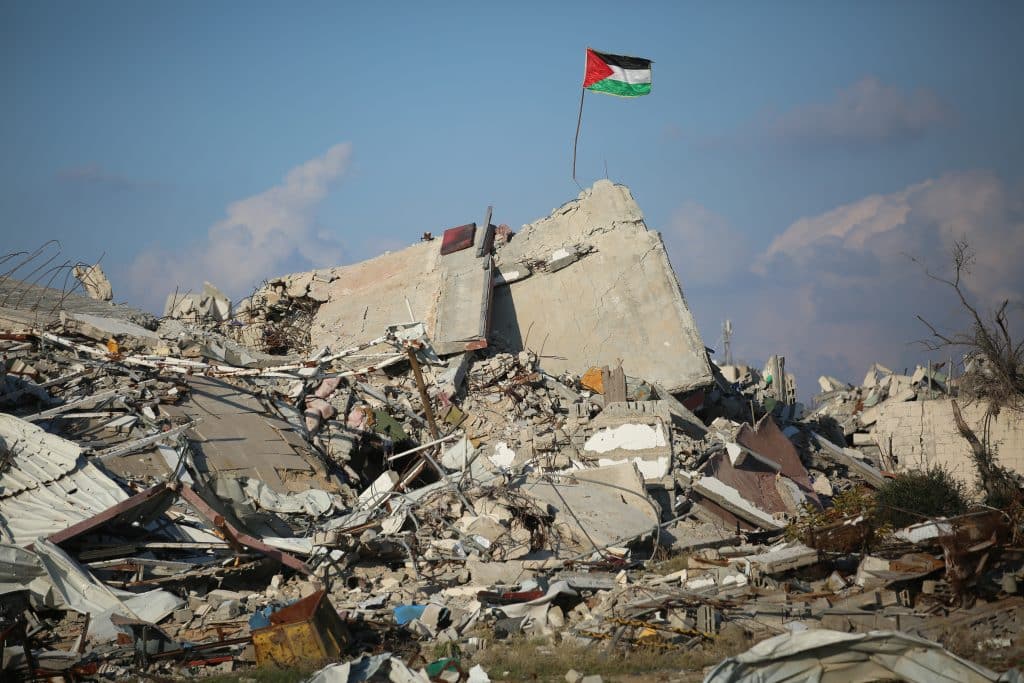
Every few decades, a new group of powerful men gathers around a table to decide what to do with Gaza or with Palestinians in general. The language changes. The underlying logic does not.
The latest proposals to “govern” postwar Gaza, from Jared Kushner’s beachfront development fantasies to the so-called “Board of Peace” and various international trusteeship schemes, are presented as bold, forward-looking visions. In reality, they are just recycling the same colonial framework that has governed Palestinian life for over a century: external actors decide what Palestinians need, what they may have, and what they must become in order to deserve it.
Gaza’s crisis was never a problem of governance or waiting for the right foreign administrator. It was, and remains, the product of a specific political structure: prolonged military occupation, a seventeen-year siege that strangled every dimension of life, and a settler-colonial project that treats Palestinian existence as an obstacle to be managed or removed. These are the roots. Everything else — the poverty, the misery, the desperation — is a symptom.
Yet every plan now circulating wants to treat the symptoms while leaving the roots untouched. They promise reconstruction without ending occupation. They offer economic incentives without political rights. They propose “deradicalization” programs without acknowledging that it is the violence of dispossession, not some cultural deficiency, that drives resistance. This is not new. The logic of “economic peace,” the idea that Palestinians can be pacified with jobs and consumer goods while their land is taken and their rights denied, has been tried repeatedly. It failed under the Oslo framework. It failed under the Quartet’s conditional aid regime.
It failed because no amount of economic programming can substitute for freedom.
What is new, and what should alarm anyone paying attention, is the scale of ambition behind the current proposals. Kushner did not misspeak when he described Gaza’s waterfront as “very valuable” real estate. The vision is not reconstruction. It is erasure. Build data centers and luxury resorts on the ruins of Shuja’iyya and Rafah. Erect skyscrapers where neighborhoods, mosques, schools, and cemeteries once stood.
The “Dubaification” of Gaza is not a development plan. It is the final stage of a process that began with bombs and D9 bulldozers: dismantle not only Gaza’s physical infrastructure but its social fabric, its cultural institutions, its memory, its capacity to produce defiance.
This is what makes these plans more than cynical. They are parasitic on genocide. The destruction of over seventy percent of Gaza’s built environment, the killing of tens of thousands, the displacement of nearly the entire population — these are not obstacles the planners must work around, but the necessary preconditions required by planners. You cannot build a seaside resort in a living neighborhood.
I grew up in Deir al-Balah. The Gaza I knew was not a blank slate awaiting foreign investment. It was a place dense with life, with teachers and poets and engineers and farmers and students who debated politics and planned futures despite the blockade. The idea that this place and its people need to be reimagined by men who could not name a single street in Gaza City is not visionary. It is colonial in the most precise sense of the word.
These plans may be attempted. Contracts may be signed. Renderings may be published. But they will not work — for the same reason every previous attempt to govern Palestinians without their consent has not worked. Palestinians are not a problem to be solved or a population to be pacified. They are a people with political demands that no amount of construction can build over: an end to occupation, the right of return, sovereignty, and freedom.
Until those demands are addressed, every plan imposed on Gaza from the outside will meet the same fate. And when it fails, Palestinians will say what they have always said: we told you. The problem was never Gaza. The problem was what you did to it, and what you refused to stop doing.


“I grew up in Deir al-Balah. The Gaza I knew was not a blank slate awaiting foreign investment. It was a place dense with life, with teachers and poets and engineers and farmers and students who debated politics and planned futures despite the blockade. The idea that this place and its people need to be reimagined by men who could not name a single street in Gaza City is not visionary. It is colonial in the most precise sense of the word.”
Thank you for continuing to bring clarity to a most horrific example of continued oppression, human rights crimes being committed by the Israeli government and military supported by powerful and sickening U.S. power players. Netanyahu, Smotrich, Gallant, Ben Gvir, Israel Katz, Kushner, Witkoff, Trump and team some of the most dangerous, deadly psycho paths operating these days. All appear to have superiority complexes. Deadly…deadly!
So worth watching and listening.
Prof Mearsheimer tosses out some logical hope.
https://www.youtube.com/live/vx1KnspP1gM
“Palestinians… are a people with political demands…..an end to occupation, the right of return, sovereignty, and freedom.”
_____________________________________________________________
These political demands are plausible by campaigning for the PLO founding demand. A secular state. Saeb Erekat and Mahmoud Abbas’ Plan B.
A contemporary debate in MW on that plan’s merits could influence the Board of Peace. Could be timely and faciliative.