

This month, New York voters will head to the polls for the state’s Democratic primaries.
Military aid to Israel, the genocide in Gaza, and AIPAC have already factored into elections across the country this year, and New York is no different, as these issues have already factored into many of the races.
Zohran Mamdani’s mayoral victory over the pro-Israel Andrew Cuomo last year showed that previous assumptions about the issue had flipped. Up until that point, many still viewed Israel as a third-rail issue that would inevitably hurt a campaign. Now, many candidates understand that highlighting Palestinian human rights is viewed as a positive attribute by most voters.
And just last month, members of the Park Slope Food Coop voted to approve a boycott of Israeli goods in the shadow of one of most contested Congressional races in the city between Brad Lander and incumbent Dan Goldman. Activists have been pushing for a boycott for over a decade and the fact they’ve finally achieved success shows which way the wind is blowing in New York. Yet, despite this reality, pro-Israel politicians like Ritchie Torres are expected to win their elections.
Why has Israel become a liability for some and not for others? How will the battle over Palestine factor into the upcoming races? What will Mamdani’s endorsements mean? Will AOC run for President and, if she does, how will her position on Palestine impact her campaign?
Mondoweiss U.S. correspondent Michael Arria spoke to political consultant Peter Feld about these questions and more.
Mondoweiss: Let’s start with the 13th district, where Mayor Mamdani just endorsed organizer and DSA Darializa Avila Chevalier, who is trying to unseat Rep. Adriano Espaillat.
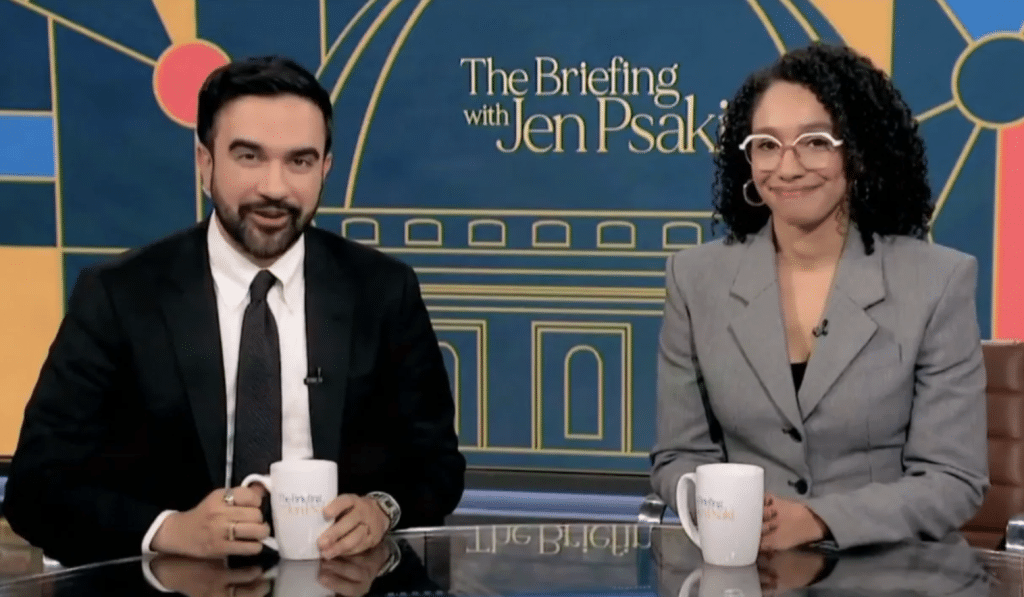
Yes, it’s big news that Mayor Mamdani has endorsed Darializa Avila Chevalier for Congress. It was certainly striking to see this anti-Zionist mayor endorsing an anti-Zionist candidate on Jen Psaki’s show, for anybody who remembers her horrific press briefings in 2014 during Israel’s assault on Gaza.
It wasn’t guaranteed that Mamdani would endorse Chevalier, although she’s running with support from DSA [Democratic Socialists of America], the mayor’s political home base. There were several factors in play. But at least one of them has to be the national trend that’s taking place right now of surging progressives. Chris Rabb just won the congressional primary in Pennsylvania’s 3rd district. In New Jersey, Analilia Mejia won a special election and is in Congress, while in the 12th District there’s a lot of hope for Dr. Adam Hawamy. And in the Michigan Senate race, Dr. Abdul El-Sayed is pulling ahead. Chevalier may benefit from this momentum for insurgent candidates who have staked out a really brave and vocal position on Palestine, but not limited to that issue. Affordability is a huge concern here in New York. It’s a big part of Chevalier’s campaign as it was for Mamdani’s.
There’s now a good chance that this Mamdani endorsement will give Chevalier the boost that she needs. But she had already put a lot of points on the board by herself. Mamdani sees an opportunity now. It’s a balancing act, because he’s opted out of other challenges to mainstream incumbents. He and his advisors have a deliberate strategy about placating the establishment. He made sure that there wouldn’t be primary challengers to Hakeem Jeffries and Governor Hochul. I think he got into NY13 because it seems like it’s really coming together, with a top-notch challenger, and an incumbent Adriano Espaillat who’s allegedly the boss of New York City’s last standing Democratic machine, but that machine’s been looking creaky in recent years. As long ago as 2022, Espaillat backed challengers to two progressive state senators, Robert Jackson and Gustavo Rivera, and he lost both of those races. Mamdani was able to analyze all that, and see that this may be one where he can dive in and have an impact.
In the 10th district, it seems like former New York City comptroller Brad Lander has an impressive lead on Rep. Dan Goldman. Lander endorsed Mamdani and Mamdani has endorsed him in this race. Can you talk about how Israel is factoring in to this one?
Well, Israel is certainly a huge factor in the race between Goldman and Lander. Mamdani’s biggest impact was at the beginning in structuring the race. There was another candidate, Alexa Avilés, who was planning to run, and had already won the endorsement of DSA. Mamdani’s involvement put the brakes on the Avilés campaign, and cleared the way for Lander.
Now, Lander is already very popular in that district. He was a city council member who represented a chunk of it. He was then elected citywide as city comptroller and ran a strong campaign for mayor, most notable for his cross-endorsement with Mamdani.
The Mamdani endorsement of Lander was impactful, but it was a little bit overdetermined. There was some payback involved for the cross-endorsement. Obviously, Mamdani is much more closely aligned with Lander than he is with Goldman. Goldman’s been one of the most viciously pro-Israel members of Congress on the Democratic side that there’s been. He voted to censure Rashida Tlaib, though he now says he wouldn’t, and slammed the Columbia encampment after visiting it with notorious pro-Israel New Jersey Congressman Josh Gottheimer. He joined Republicans in condemning the genocide case against Israel, and criticized Mamdani for canceling Eric Adams’s executive order that imposed the IHRA so-called definition of antisemitism.
But the huge size of Lander’s 57%-23% polling lead over Goldman makes it seem as though the endorsement alone isn’t what’s putting Lander over the top. It’s more his own popularity, and that there’s a complete misalignment between Goldman and the fairly progressive voters like me who live in that district. Recall that Goldman was elected in 2022, winning a primary with only about 26% of the vote, just three points over Yuh-Line Niou, who supports BDS and is now running for state Senate. He only got 65% of the vote in his primary two years ago, against two completely unknown opponents with no funding. There was never really an outpouring of support for Goldman in that district and now he’s getting creamed.
So Lander-Goldman turns out to be low-hanging fruit, while the Chevalier race in District 13 is a reach. Lander is so safe in his margin over Goldman that it opens up the opportunity for Mamdani and others to expand the playing field and to get involved in more races and have a bigger impact on June 23, primary day.
Claire Valdez is another DSA member running for Congress. This is the 7th district, where Nydia Velasquez is retiring. Can you talk about that race?
Well, that one was more complicated. This is really a left vs. liberal race between first-term DSA-backed Assembly member Claire Valdez and Antonio Reynoso, the Brooklyn Borough president. The district is in Western Queens and North Brooklyn, part of what has been dubbed the “Commie Corridor” by Michael Lange, a local political writer very connected to DSA. The race started because the incumbent Congress member, Nydia Velasquez, is retiring. She’s very popular, though she hasn’t been truly at the forefront of the DSA wave of progressive organizing in recent years. Still, she’s been closely aligned with many progressives.
Velasquez wanted her successor to be a Latina, and there were several from DSA she liked, but those were not acceptable to Mayor Mamdani and his advisors. So Velasquez went against Mamdani’s choice Valdez and endorsed Reynoso, who has been elected borough-wide and is popular, and was a city council member who represented a portion of that district previously. Normally District 7 would be an obvious opportunity to elect somebody from DSA, but because of this proxy war between Rep. Velasquez and Mayor Mamdani, it’s unclear what will happen. A fight’s been set up between DSA and the more mainstream progressive Working Families Party who backs Reynoso, and some people are frustrated because the left could be focusing more on beating the establishment in other races. In a new poll, Valdez is leading Reynoso by just two points, 23% to 21%, with another 13% for a third progressive candidate, Julie Won, and a huge 43% undecided.
Anything can happen. With fewer than two years in the Assembly, and representing Queens when most of the district is in Brooklyn, Valdez might be considered a weaker opponent. But she’s got DSA’s organizing muscle and the mayor, and is more steadfast when it comes to Palestine. She supports an arms embargo. And it’s just been reported by Jewish Insider that Reynoso, who is generally critical of Israel but has not taken the strong position Valdez has, will be getting third-party support from a undisclosed and apparently pro-Israel source — as will Espaillat in NY13. But that can backfire, and if DSA can turn out the vote for Valdez in their home territory, it could put her over the top.
The polling shows pro-Israel Rep. Ritchie Torres leading in the 15th district, but you recently worked on a poll that went a little deeper and revealed some interesting things. Can you talk about that race and what you discovered?
Torres’s big, 60%-15% lead in that poll I did for A Fight Worth Having, the new PAC from ex-AOC comms director Corbin Trent, is being wrongly interpreted as showing people in Torres’s district don’t care about Israel. It shows the opposite: that they don’t know how belligerent an Israel supporter he is. Most voters, especially in that district, are not necessarily consuming all the social media that Torres is notorious for. And he in fact has toned it down. He saw what happened in Mamdani’s election last year and decided there isn’t as much upside anymore in screaming about Israel all the time.
Our poll shows that Torres is way ahead because the case against him has not been sufficiently made in a way that voters would hear it. It also shows that he could be beaten. Torres’s 45-point lead flips to a 41%-38% win for Blake after voters see campaign messages — what pollsters call an “informed vote.” But Blake really has not been able to get any of the funding that he would need in order to bring those messages to the voters.
Blake is an interesting candidate. He’s run before, and he was the runner-up in 2020 when Torres first won his primary for Congress and it was an open seat. Last year, he ran for mayor. He didn’t get too many votes, but he was included in one debate where was able to really wipe the floor with Governor Cuomo over sexual harassment. Blake seemed like a candidate who could perform well if he had the resources to run a race with a fair amount of paid communication. But he doesn’t have that.
The poll tested the kinds of messages he might use if he did have those funds. And what we found is that Blake could win if he were able to make the sustained case against Torres, not only on AIPAC and support for the genocide in Gaza, but also affordability, of failing to pass Medicare for All, failing to pass any of the things that were on the Democratic agenda when Biden was elected in 2020, such as the Child Tax Credit, paid family leave, and raising the minimum wage.
So the ingredients to defeat Torres are there. Voters do not like his position on Israel and the other issues on which the entire Democratic congressional leadership has failed. But in an environment where Torres has all the money, with an initially positive job approval rating, he can glide to an easy victory. What would make it difficult for him would be a candidate like Blake or anyone else who calls him to account for all the different ways he’s out of alignment with his district.
We’ve talked previously about how much the genocide is a turnkey issue, especially among Black and Latino voters and younger ones. This poll proves it: we flip Black and Latino voters away from Torres when they learn about his record. The ideal district to hold AIPAC Democrats accountable is one with a high share of Black and Latino voters, as this district has, and where a lot of the white voters are progressive.
We also learned in this polling that similar arguments convince voters — including Black voters — that Hakeem Jeffries needs to be replaced as the Democrats’ leader in Congress. A lot of the arguments that we saw that were effective in New York 15, the Torres district, are likely to also be effective in other districts. They’re likely to be effective on behalf of Chevalier in District 13, and they could have been effective against Hakeem Jeffries if he’d had a challenger like Chi Ossé in District 8, which Mamdani was able to prevent. More recently Jeffries knocked an underfunded, little-known challenger off the ballot, so there isn’t even a primary in name. Based on this polling, Jeffries might have had something to worry about, which is why he found it so essential to block any kind of a primary in his district.
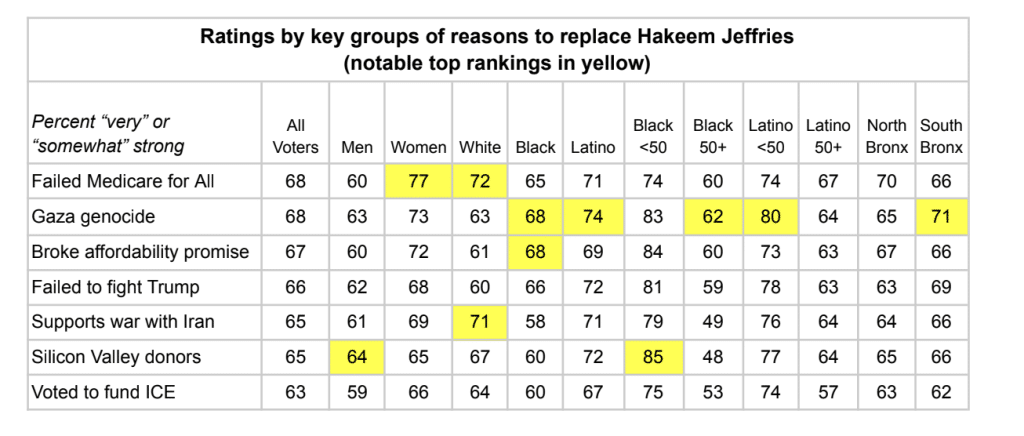
The type of arguments we tested in NY15 are never tested by mainstream pollsters, not because they’re ineffective, but because they work. But those arguments that we were able to test are a proof of concept. And we should see those arguments being made in other districts, not just in New York, but elsewhere in the country.
Last month, the Park Slope Food Coop voted to approve a boycott of Israeli goods. This was one of the early domestic BDS battles. We’ve been covering it at Mondoweiss since 2011. What do you think that vote says about the shifting views on Israel, and is it factoring into the election?
The Park Slope Coop vote is an interesting overlay to the Lander versus Goldman race. Now, both Lander and Goldman said they would have voted against it. And that is a function of the fact that Lander, as much as he is framing an alternative position on Israel to Goldman, is still a liberal Zionist. [According to a chapter in the book Wrestling with Zion: Progressive Jewish-American Responses to the Israeli-Palestinian Conflict ] at his son’s bris, Lander proclaimed, “We are thrilled to pronounce you a Jew without the ‘Right of Return.’” So he rejects some of the underpinnings of Zionism, but still says he supports a “Jewish and democratic state.” That’s now seen by many as a failed formulation. It may be his formula, but it’s not the formula of the people who belong to the Park Slope Food Co-op, who are actually a big part of Lander’s original base.
So what it really tells me is that Lander’s base is ahead of him on this issue. That after the genocide in Gaza, the anger is really bubbling over so much that what was able to be suppressed in 2011 can’t be suppressed anymore. The anger of Park Slope liberals and others toward the atrocities that are spilling across our social media feeds every day means that there’s no more consideration for the delicate feelings of Zionists who feel “unsafe” because a store won’t sell their hummus.
It also means that a candidate like Alexa Avilés, the DSA-backed council member who Mamdani helped push out from the NY10 race, might’ve also been able to beat Dan Goldman. And Avilés might’ve been a much more steadfast leader in support of Palestine than Lander may turn out to be.
And it means that Lander, if he’s elected to Congress, as seems almost certain now, he’s going to have to watch where his base is. He’s going to have to realize that the people who are going to elect him do not support a “democratic Jewish Israel” anymore and are not going to excuse those war crimes.
Finally, I wanted to ask you about Rep. Alexandria Ocasio-Cortez. There’s a growing belief that she will run for President and that has generated a debate about her stances on Palestine and Israel. It did seem like she shifted her position on, what some people refer to as “defensive weapons” for Israel. What do you make of all this?
There is a strong likelihood that AOC will run for president. Her other option is to challenge Chuck Schumer for reelection to the Senate, but she is polling strongly enough for president that it seems like she may really go for it.
On weapons to Israel, the Overton window shift is happening very, very fast, and AOC has tried to move with it. The lobby and Israel itself are beating a strategic retreat. They understand that sending aid to Israel is rapidly losing support, and they’re not going to be able to preserve free weapons. So they now are making a strategic concession on aid in order to preserve weapons sales. In fact, they are trying to push through a stealth integration of the US and Israeli military that will make weapons aid irrelevant.
A number of candidates for Congress have begun to stake out stronger positions, such as an arms embargo and sanctions that would block all sales. So that now becomes the new progressive position, as Josh Reubner just wrote here — not just cutting off the aid, not just cutting off offensive weapons aid, not even just cutting off so-called “defensive” weapons assistance like Iron Dome, which we know are not really defensive weapons at all because they enable Israel to conduct its genocide without consequences. There was a time when AOC tried to make that distinction and it fell flat. And she was pressured. She recently agreed to oppose all military aid to Israel, including so-called defensive weapons like Iron Dome, as a condition of receiving DSA’s endorsement for her reelection this year. And then we have Sen. Chris Van Hollen, also a potential presidential candidate, who just came out with an op-ed where he called for conditioning aid if there isn’t going to be a two-state solution.
Well, “conditioning” aid is a five- or ten-year-old position. Cutting off offensive aid to Israel seems like a two-year-ago position. Cutting off defensive weapons seems like a three-month-old position. And where we are right now is that if you don’t support a complete arms embargo, including a ban on all weapons sales to Israel, you’re not doing enough. Because Israel does have the money to buy these weapons, and everybody knows it. And in fact, if they buy these weapons, it’s still a subsidy to our U.S. arms industry. So you see both Chevalier in NY13 and Valdez in NY7 coming out for an arms embargo on Israel.
Now, where is AOC on that? We have yet to see. But I think she’s going to come under pressure for this, because the fact that Rahm Emanuel and Netanyahu are saying they’re willing to end aid to Israel shows that they are really scrambling to preserve these weapons sales. Blocking that is going to be the new litmus test. And it’s good that we’ve moved this far this quickly.
And it’s good that we have a potential new wave of very strong incoming pro-Palestine Congress members — Rabb, Hamawy, Chevalier, Valdez, El-Sayed, Saikat Chakrabarti — who are not hedging in the way AOC and some of the earlier wave of progressives sometimes have.

Our diversities should not matter…we all live on the one and same planet. So why can’t we just accept each other as we are and live in peace together?
By the way, many Jews were upset about Mamdani not attending New York’s Israel parade, but it turns out that many Jews were also upset about the parade –
New York’s Israel Day Parade was a shanda – but not because of Mamdani...honoring three far-right Israeli ministers was an indefensible political choice.
NYC’s Israel Day parade was a shanda. It wasn’t Mamdani’s fault – The Forward
The article mentions the ‘Overton window’. Well, the Overton window would really change if our leaders had the courage to state the obvious: the Islamic Republic of Iran has nothing to do with Islam and the Jewish, democratic state of Israel has nothing to do with Judaism or democracy.
Nope, you must be thinking of Fritz the Cat. He had a bizarre, drug-fueled fantasy about a political negotiation over a two state solution, where U.S. President Jimmy Carter and Israeli Prime Minister Golda Meir announced a deal to trade the West Bank for the New York City boroughs. But that never happened. The problem is division, racism, and nationalism.😏
Remember real Anti-Zionists are screwed either way. Even if we convince Democrats, Republicans, Reform, Conservative, and B’nai B’rith to abandon Israeli Zionism, they’ll just revert to being Zionists here in the USA. Native Americans, Cubans, and indigenous Mexicans are in the same boat here as the Palestinians — genocide, apartheid, and refusal to admit their (so-called) nations were “states” with rights, privileges, immunities, representative in Congress, and equality in their homeland. See; “Under the leadership of Isaac M. Wise, the Union of American Hebrew Congregations and most of the graduates of the College, as well as the members of the American Jewish Committee and the B’nai B’rith-a fraternal organization designed by the older settlers to help the new– were not Zionists or Jewish nationalists. “We are Jews by religion and America is our home, our Zion.” This was not only a slogan; it was a conviction. — Jewish Museum
Daniella Weiss is from a Lehi family whose Patriarch was a US citizen. So, she is entitled to dual citizenship by operation of US law. We need to stop her from infiltrating and subverting the ZOA. Otherwise the predictable pattern of establishing an outpost, then a settlement, filled with “hilltop” zealots will reoccur. They will continue to unofficially occupy (de facto annex) New York City (NYC) and threaten to declare its independence if we resist.😏 Draft legislation exists to give IDF veterans US GI Bill benefits or abolishing US military aide to Israel through a hostile merger and takeover of the DoD. See:
*Congress quietly moves to integrate US and Israeli militaries. In the first step towards shifting aid further into the shadows, the House’s 2027 NDAA would all but fuse the two countries’ armed forces together
GOP reps want same benefits for Americans serving in Israel army. IDF soldiers would get same protections as those serving in US National Guard or Reserves
Four U.S. States That Were Once Independent Countries
List of historical unrecognized states
List of former sovereign states
Aaron Mate (Dr. Gabor Mate’s son) is on “Judging Freedom” right now. They are discussing the “Israel Day” parade and how Mamdani is being criticized for not attending. Kind of surprised Mate chooses to throw a softball and refer Smotrich as a “bigot.” Why not call him what Smotrich is a “sadist war criminal.” A more powerful description of Smotrich. Nail it down Aaron.
https://www.youtube.com/watch?v=4kp_N4WK1Zg
I vote (from Canada, by mail) in ED 12.
ED 12 is where the Kennedy scion Schlossberg is running. Nope. I voted for Nina Schwalbe, an anti-Zionist Jew. She won’t win, but if she gets a decent number of votes it may do some good.