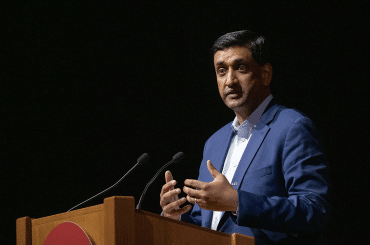
Last night in Woods Hole, MA, I heard former ambassador George Lane, a career foreign service guy who was our top envoy to Yemen, speak about the U.S. role in the Middle East. Lane looks to be in his 70s, a big guy with a strong nose and an aw-shucks delivery that belies his depth of knowledge (a historian's son, he's taught at Clark and Holy Cross). Andrea Rugh, the scholar who introduced him, noted that Lane's wife Betsy is the daughter of missionaries who set up a boys' school in Tripoli, Lebanon. Good humble values.
Lane's speech contained one blinding insight. "The great battle of the 20th century" was between communism and nationalism. Nationalism won. Now the great battle is between nationalism and religion. This is the test that Iraq faces. If the Shi'a consider themselves Arab, they will resist Iranian domination. If they consider themselves more Shi'a than Arab, they won't resist. "That's the open question." Smart.
I of course was there to hear anything the ambassador had so say re Israel/Palestine, and I wasn't disappointed. While his subject was the entire Middle East, which he defined as Libya-to-Iran-less-Turkey-and-Sudan, he visited I/P often. Here are a few of his nutshells:
After '67, France backed away from Israel because its aid to Israel, including the French planes that knocked out the Egyptian and Syrian air force (and Lane didn't say, helping Israel get nukes), had blackened its rep in the Arab world. "The U.S. became almost the sole supporter of Israel politically and militarily." UN 242 then set the basic parameters for the peace process. There have been spasms of peacemaking since then, leading up to Camp David 2000, "which was not well-prepared, and which failed," and Annapolis, when for the first time the two-state solution was adopted by all parties.
Lane then made a point I arrived at on my own just the other day: There is "not a lot to show for 40 years work" by the U.S. And his conclusion was the same: "Friends don't let friends drive drunk. Well, the United States has let Israel drive drunk." Has allowed it to believe it can "have its cake and eat it too," that it can "have all that land and have a Jewish democracy" too. So today it is "extremely difficult to see how things will work out." And where has the U.S. been? Israel should have recognized the PLO sooner, shouldn't have built all those settlements. We gave 'em the keys to the car.
"You've got to admit that the situation is bleak." Neither side has strong leadership, and will Israel be willing to give up enough land to satisfy Palestinian leadership? "I find that hard to imagine." It used to be that the Israelis would say, we can't talk to the Palestinians because we have no "valid interlocutor." Well now the Palestinians can say the same thing. And what will one state look like? Will the U.S. support "transfer" of Arabs–translation, Ethnic Cleansing– which some Israelis favor?
I can be too penny-ante, and in the Q-and-A, I landed on this point. I said, You can't be serious, that the U.S. would favor transfer. He said, No, I don't think the U.S. would. Nor would Israel. "I think most Israelis would see that as an abomination."
Two other people had better questions. A woman who I want to say is Arab pointed out that the Sabra and Shatila massacre in Lebanon in '82, which Lane had described in his speech as the work of Christian militias, had been enabled by the Israeli occupiers of Lebanon and General Ariel Sharon, who "sealed" the camps. Then a British guy said that Europeans felt hoodwinked by the U.S., which had justified the Iraq war in Europe by citing "WMD–full stop." Now Europe is absolutely determined to resolve the Israel Palestine issue and is dismayed by Washington's passivity.
Lane responded that there were a lot of reasons for the Iraq invasion that were unstated. One of them was that Paul Wolfowitz "felt very guilty" that he hadn't gotten Saddam back when he was #3 at the Pentagon in the first Gulf War. This was actually the second time Lane made this psychological point. He had earlier said that Wolfie, Cheney and Powell "felt that they failed in the first Bush administration… [because] they hadn't gotten that SOB."
After the lecture I got on line, with a bone to pick. My wife was ahead of me in the line and she said: "Why doesn't anyone talk about how much the oil companies and Cheney are making off the Iraq war…" Etc. I must say I felt a little crestfallen when I heard her saying this. Here she is sharing my bed and table, being indoctrinated by me night after night about Israel's security as a neoconservative motivation for the Iraq war, and what does she come out with when she's face to face with an ambassador? The facile Upper-West-Side war-for-oil line. Hon, we need to talk.
Then I got my chance. "You're doing a lot of mindreading on Paul Wolfowitz. It's interesting to me that you don't even mention the neoconservatives and Israel's-security motivation for the war that many others think was there. I gather you don't agree with that theory." Lane said actually he did agree with that theory, it was a real factor, the idea of "taking the pressure off Israel." He said he should have mentioned it, he didn't. As it is, he has a bugaboo about his We-didn't-get-Saddam theory.
I left impressed by the ambassador's mind, but also struck by the fact that he had censored himself. And why? He is a genial diplomatic guy; and in polite society, i.e., elite circles, it is still as acceptable to say that war-for-Israel was any part of the motivation as it is to fart loudly when you're reaching for your fingerbowl. I have arguments with my own family about this specific question. A couple of them were in attendance that night. It would have been nice to have the ambassador on my side. Walt and Mearsheimer (and probably Joe Klein too) have had precisely this experience. A lot of smart people privately agree, but don't look for them on the hustings!
P.S. A month ago I blogged about Rami Khouri's appearance before the same group, the Ad Hoc Committee for Peace & Justice in the Middle East, and called Woods Hole a "privileged resort." Well it's also a scientific community and home year round to a lot of people unassociated with tourism.