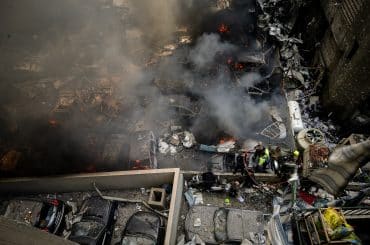
We visited the Bedouin village of Attir. Two weeks earlier, 27 homes in the village had been destroyed by the Israeli Army. Keep in mind that this is INSIDE Israel and everyone under discussion is a citizen of the state. The story is that there are 45 “unrecognized” Bedouin villages in the Negev, a truly Kafkian designation. Some predate the state, some are somewhat more recent. To be “unrecognized” means that the village does not appear on any map, and receives no electricity, water, garbage pickup, roads, schools, or health services from the state. The government has a policy of wanting to “concentrate” the Bedouin in more urban, sedentary areas, which are known as development towns. Hand in hand with this goes a policy to “Judaize” the Negev, with 500,000 Jews, with affluent North American Jews particularly targeted.
Worst of all, if you live in an “unrecognized” village, by definition you cannot receive a permit to build or extend a home, so all the villages live with the threat, and reality, of potential home demolitions by the state at any time. This village was particularly under threat probably because the Jewish village of “Yattir” is being developed nearby.
In any case, a young man named Ra’ed was our host. After lunch he told us the story of the home demolitions. He started the story by saying that traditionally this village was quite integrated into Israeli life, was considered quite successful, and had sent many people to become doctors etc. at the university in Beersheva. He even talked about how Ariel Sharon had come to visit the village as Transportation Minister in 1994, after some floods that killed two children, and declared that “we are with you.”
But two weeks ago, without warning, 5000 Border Police descended on the village during the night and destroyed these homes. He told the story of a four month old baby who had just had heart surgery, and that a policeman came and secretly gave him a little toy during the operation. He also told the story of an old woman who fainted after watching her house being destroyed. Her family asked a policewoman for water and she replied, “I don’t give water to Arabs, they all should die.”
Finally, he took out an envelope that he opened the morning after the home demolitions: it was his call-up to do reserve duty in the Israeli Army! Then he said he will never serve in the Army again, and concluded, “there can be no coexistence if we don’t exist.”
We went out to see the demolitions afterward—they are already re-building. Some villages have been destroyed or partially destroyed many times.
At some point I realized that we were only about fifteen minutes by car from Tuwani (in the South Hebron Hills), and that really the only thing that separated these communities were the vagaries of the Green Line after the 1967 war.
Another stop on the tour was to visit an 800 acre organic farm run by a young Jewish guy and his wife. We all crowded into their house, which was remarkably cool for a July afternoon, and sipped tea brewed in the sun while sitting on pillows on the floor. The visit really highlighted some of the contradictions between ecological awareness, which I usually associate with being quite left politically, and Israel/Palestine politics in particular.
This farmer was remarkably clueless. One of the people who attended the tour was a young Bedouin woman named Elham. It turned out that while she now lives in Rahat, one of the Bedouin “development” towns, her husband’s family had originally lived on this guy’s land. Once a year they come back and have a picnic and re-acquaint themselves with their ancestral home. She spoke quite movingly about the regrets that her family have about having been coerced into a sedentary lifestyle, how they wish they had preserved their heritage and are now entrapped by a somewhat-materially-easier, but emptier, life. By keeping the “unrecognized” villages nearly impossible to remain in, as Ra’ed described, many families are convinced to go to the recognized townships like Rahat, which while they have some of the lowest socio-economic status of the entire country and are vastly underserviced compared to Jewish communities, are at least protected from the threat of home demolitions.
The farmer confirmed that once a year he lets a group of Bedouin spend time on his land, but was quite dismissive of her claim that they would come back if they could. Which is surprising, because he of course has chosen this lifestyle himself, so if anyone could understand her point of view, he should have.
We were watching, in real time, a classic example of the competing versions of reality that Jews and Palestinians (in this case both Israeli) have of Israel and Palestine. But while Elham was gentle and forgiving towards him, he was dismissive and somewhat hostile toward her.
He in fact is squatting on the land illegally, and while his house hasn’t been destroyed by the Israeli government as many Bedouin homes have been, he complained bitterly about the way the Israeli government is treating him, in fact his outraged phrase was “they are treating me like a Bedouin!”
Finally, my first trip to the “unrecognized” village of Wadi Na’am. I think it’s the worst thing I’ve seen since coming to Israel, including anything in Palestine. BUSTAN has a long history there, including building a health clinic entirely of recycled materials that is solar-powered. Just ten minutes from Beersheva you turn off the main road onto a dirt road. The landscape is lunar desert. One of the first things we saw was a dead abandoned camel with its entrails hanging out.
The sun was setting and it was beautiful in a terribly desolate kind of way. The village is on a hilltop, and is just a bunch of tents and tin huts. It is surrounded 360 degrees by Romat Hovav, Israel’s toxic waste/petro-chemical industry complex. They are literally up against the walls of this pollution machine, belching yellow smoke, lit up like a Christmas tree, and they have no electricity (except from generators), no running water, no sewage service, etc. All the kids seem to have asthma or bronchitis. I felt nauseous from the second we got out of the car, and since an army base nearby was closed because the soldiers got sick, and since the Health Ministry wouldn’t send doctors to the clinic BUSTAN built because they didn’t want to endanger their health, I doubt it was psychosomatic. The contrast between the crazy high-tech, even devilishly futuristic power plant that literally overshadows the village, with the almost pre-industrial life in the village (although they actually have lots of appliances hooked up to their generator) was overwhelming. I simply cannot imagine life there, it felt almost like a different planet.
These are Israeli citizens, living in the most dangerous, toxic, life threatening circumstances, and they don’t receive even the most basic services like sewage, running water or electricity, from their government.