
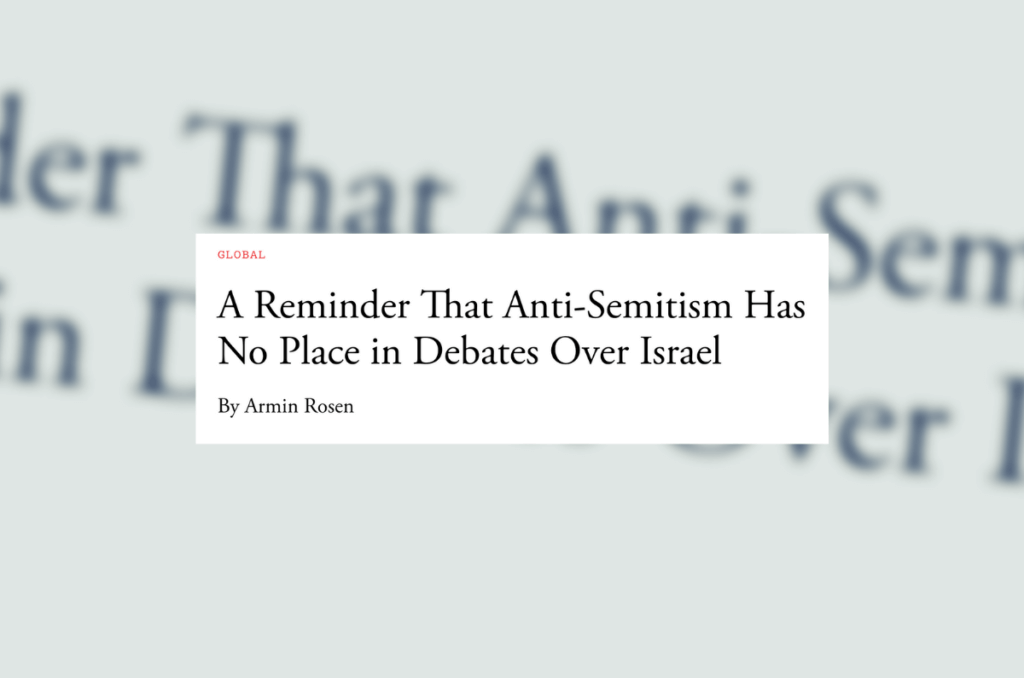
There is one last important point to be made about Armin Rosen’s attack on this site and me in The Atlantic, and it concerns my (Jewish, white) privilege in talking about the Israel/Palestine issue.
The article has garnered two responses by leading writers at the publication–Robert Wright and James Fallows–that have pushed back hard at Rosen. Andrew Sullivan has also given Wright’s piece his nod of approval. And I deeply appreciate the pushback over what was an unfounded smear.
But it is important to ask the question: would high-profile journalists push back the same if the target of the “anti-Semitism” smear was someone who was not Jewish or white? If the target was a Palestinian or an Arab? Well, the record is not good on this. Ali Abunimah first made this point on Twitter, and Benjamin Doherty followed up with a good post at the Electronic Intifada.
Doherty points to the crazy charges that were leveled at people involved with the PennBDS student conference earlier this year. The situations are not analogous, but when a professor at the University of Pennsylvania published an article calling Omar Barghouti’s book on the boycott movement “Mein Kampf,” there was no prominent condemnation. The silence came, as Doherty notes, after Sullivan pledged to “back” anyone weighing in on Israel/Palestine who was smeared. PennBDS supporters emailed Sullivan, but there was no response.
The larger point being made is that Palestinian voices are excluded from the mainstream debate on an issue that principally concerns them, while Jewish and Israeli voices are much more prominent. I think this is apparent to anyone who looks carefully at mainstream media coverage of Israel/Palestine and who they talk to and leave out. So as much as I appreciate the defense from Sullivan, Wright and Fallows–even though they don’t fully agree with us–you don’t see this sort of response in cases in which Palestinian voices have been marginalized. And that’s something we should all work to change. Challenging the racism in our media conversation on this issue is an integral step towards opening up the larger mainstream debate on Israel.

“…Palestinian voices have been marginalized…”
Palestinian voices are always marginalized. This is pivotal to the Zionist enterprise.
It’s not their voices per se. It’s the fact that if they have voices, then they exist, and if they are acknowledged to exist, then that’s the thin edge of the wedge, and the whole rationale for Zionism starts to fall apart.
If Palestine is to have been ‘a land for a people for a people without a land’ then obviously there cannot have been, and cannot be, a people whose land it was.
Above all, Zionists seek to suppress anything that indicates that the Palestinians are actual, living, breathing people. I’ve noticed this repeatedly. They have to remain an abstraction. Anything that clothes them with flesh, that suggests the bullet is thumping into actual living human meat, cannot be allowed to come to the surface.
So of course Palestinian voices are marginalized. No one wants to know how the sausages are made. It all needs to come out as a hygienic, morally appetizing proposition.
You guys are amazing! If the Zios had even a little tiny bit of the introspective ability, consistency, and genuine-ness you all have, the world would be a far, far better place. This conflict would be solved tomorrow.
And, ftr, I think that observation goes beyond zionism and its adherents and into the broader political world. But alas…
I have to say this dismissiveness (probably not the right word) is even evident here when Palestinian or Muslim bylines come through. Not very many comments, and I am guilty of this as anyone, so no finger pointing involved. It just seems to be a phenom.
Speaking for myself, in the spirit of this post, the coupled powerlessness and anger is a turn off. Not a turn off in the sense of not being right or worthy of support, but in the sense of not knowing that anything I can say or do will help. And even if it will marginally help support the cause, the powerlessness comes back into play (i.e. where does it go from here). I know that’s very not right, but I think that powerlessness begets ignorability. Probably the same with Sullivan, et. al. They can ignore/dismiss/not defend Palestinian voices and the world as we have come to know it simply goes on. The “they’re all potential terrorists” (not to far off, imho) cultural overlay is persuasive (through repetition, not reality) and has been internalized.
The recent post here about boycotting dates on Ramadan is maybe illustrative. I don’t know the background behind the why and wherefore, but it was presented by someone other than the Muslim originators of the idea. Why? Not so much why did Ms. Szremski bring it here, that’s obvious. It was the right thing to do (and she did right by it). But rather why didn’t the folks behind the idea bring it here. Did they themselves feel that it would get a better hearing if she wrote it up? Why?
This is confounding and I don’t know what to do about it other than to recognize these subtle and not so subtle prejudices in myself, and adjust. So thanks again for this post. Maybe the “Sullivans” of the world (he is far from alone in this, as you point out) will also seek to recognize these prejudices in themselves, and they too will adjust accordingly.
I can note that even Mondoweiss got lost in this topic. From “smears of anti-Semitism” (victims be defended, MW-Kane and others) to “anti-Semitism” (non-Jews’s opinion is “nice”). atlantics robert wright says alex kane deserves an apology
Would an Arab or non Jew have been defended as strongly on this by journalist? I doubt it.
BUT…catch the news right now….Michele Bauchman’s attack on Hillary’s Arab assistant , Huma, (sp?) is being condemned by quite a few republicans, led by John McCain.
On CNN tonight one guest nailed it….he said ”far right Jews, far right Christians, all the far right fringe groups are the ones behind the demonizing of Muslims”.
The fact that you would even raise this question just proves what a self-hating Jew you are. (Just kidding.)