
I frequently link the piece Apartheid on Steroids, by an American who was formerly a keen supporter of Israel. I first witnessed apartheid in 2006— the same year Jimmy Carter put the word in a book title. Ofer Neiman writes, “Sol Salbe just posted a translation of an article by a jurist, who recently did his reserve duty service at some checkpoints. His observations of the clearly racist practices would not doubt have some people reaching for their Afrikaans dictionary, and with very good reasons.” Original in Hebrew.
Arabs, This way
Gur Megiddo
19 June 2013
Once again I was called up for reserve duty. In preparation for our move to checkpoint 104 (the one guarding the entrance to Tulkarm situated on the Hafradah (separation) Barrier south of the Nitznei Oz interchange), we lined up for a briefing.
The commander explained that the IDF wishes to buoy up the development of the Palestinian economy. The underlying assumption is that a person who has an income is less inclined to participate in terrorist activities. Therefore the IDF allows the passage of Israeli Arabs into Tulkarm [in the occupied West Bank], to spend some money on the Palestinian side and develop trade relations. Our mission is to stand at the checkpoint and ensure that anyone who enters Tulkarm is indeed an Arab. It’s simple: you identify a person is an Arab by the name in their identity card or by their appearance, and wish them a good trip. If Jews arrive, you explain to them that entry is prohibited and prevent them from entering.
When we arrived at the place I noticed that one of the concrete blocks at the centre of the barrier carried a big sign: “The area in front of you is Palestinian area A. There is no entry for Israelis – Entry to this area is in violation of the law.” No sign said “Israeli Arabs excepted”, but simply “Israelis.” I eased my conscience by noting that, there is a real difference between Jews and Arabs here: A Jew who entered the area takes a risk, while the Arabs are in no danger. I still remained disturbed by the fact that I was required to stand under the hot sun, wearing a ceramic flak jacket and politely inquire: to what race does Sir belong? Is Madam an Arab? A few days later I was asked to help provide backup for a military police unit carrying out vehicle inspection at the Te’enim checkpoint, located on the fence near the village of Khirbet Jabara. The commander, a second lieutenant, briefed a young soldier: in this lane it’s simple: a car comes, you say “shalom”, if you hear that they don’t have an accent, you opens the gate. Not pleasant, I thought, but nothing new. That’s what every security guard at a shopping mall entrance does.
After a few minutes I noticed that the queue on the right lane was significantly longer than the one in the left (where the soldier was stationed). One of the drivers in the right lane noticed that too, and began shifting into the left lane. A female military police officer began to shout at him: Hello! What are you doing? And hissed: “Arabs this way.” The driver hastened to mend his ways and returned to the Arabs lane.
I turned to the commander: Hey, is this the instruction? A track for the Jews and a track for the Arabs? “Yes,” he answered simply. “Even Israeli Arabs?”, I stubbornly queried. He replied: There is no reason that Jews, whose cars we do not check, should be waiting in line. I stuck to my guns: But it can’t be right that the army has issued such an instruction, if you were to tell me that the order was for one lines for Israeli citizens and one line for Palestinian’s I’d believe you. The written order, he answered me, is that whoever has a “Resident’s Tag” passes through the fast lane. But the vehicle that had just passed did not have tag, I said. And the commander replied: True, but you could see that he was a Jew, right?
The debate heated up. I refused to continue participating in the security detail at the checkpoint and the officer, in turn, complained about me to my reserve company commander. Udi, the company commander showed some understanding of my behaviour, but tried to convince me that the separation was warranted. His main justification concerned the security of Jews passing through the checkpoint. He contended that if Jews were to wait for a long time they would become stationary target for attacks. Therefore it’s imperative to reduce their stay there through the use of fast-through lane.
With all due respect to this explanation, there is less harmful solution: increase the number of checkers and provide additional check-through lanes. Thus, reducing checkpoint waiting time to zero for all people, Jews and Arabs.
I get the impression that the IDF did not properly consider the racial segregation of these two checkpoints, and that the instructions were issued haphazardly. There are two indications that back up this argument: firstly, the large and conspicuous sign at a checkpoint 104 says “Entrance forbidden to Israelis.” If the IDF was convinced of its legal grounds when issuing an instruction that differentiates between Jewish and Arab citizens, it would phrase the sign differently (or, at least, would have removed the sign).
Secondly, taking into account both the Te’enim checkpoint commander comments and those of Udi my company commander, who doubled up as sector commander, it’s clear that the IDF presents one set of instruction in writing (separation on the basis of possessing a ”Resident’s Tag”), but in practice it carries out a different provision (racial discrimination).
If the IDF sees separate lining up tracks on a racial basis as something moral and worthy, why not do it openly? Unfortunately I think that giving a verbal command is designed to allow the blame to be shifted onto tho the lowly guard, is a practice for which the IDF is known. When they come looking for the guilty party, responsibility will be sheeted home to checkpoint commander and his soldiers, who didn’t carried out their written instruction. I would not be at all surprised if this would be the IDF’s response to the publication of this item.
The most disturbing thing to me is that most of my reserve unit comrades, beautiful and caring Israelis (really, I don’t mean it cynically), remained oblivious to this racial segregation. Most of them still do not really understand what was I going on about. Had there been a sign saying: Jews to the left, Arabs to the right above, then perhaps it would have raised some unpleasant connotations. Then, even if their opinion would not have changed, at least their stomach would have turned a bit.
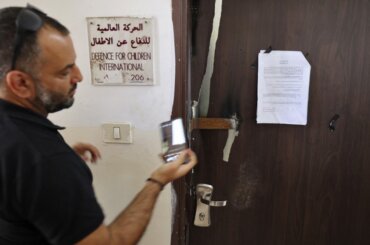

“The most disturbing thing to me is that most of my reserve unit comrades, beautiful and caring Israelis (really, I don’t mean it cynically), remained oblivious to this racial segregation”
Israel was founded on racial segregation. The history of Israel is racially segregated. Israeli archaeology is racially segregated. The drinking of coffee in Israel is racially segregated . Israel’s airports run racial segregation. Israeli schoolbooks are racist.
But only outsiders and palestinians can see this.
I wonder why.
While all of us Palestinians have been living this for years and it’s well known to and experienced by any visitor of Palestine, coming from Gur Megiddo, an Israeli reservist, is a welcome addition to the narrative.
As I was reading the piece, my mind wandered and saw Nazi’s separating Jews from others. What a powerful visual that Gur Megiddo conjured up in my mind. I hope every Israeli and Zionist reads this and sees the Nazi SS officer doing the same to Jews in Europe. Maybe the conscience will wake up.
“The most disturbing thing to me is that most of my reserve unit comrades, beautiful and caring Israelis (really, I don’t mean it cynically), remained oblivious to this racial segregation.”
They’re not. The writer’s problem is that he assumes that if they were aware of it, they would demand change. He seems good hearted, but naive to the extreme. These “beautiful and caring” people are vile bigots, plain and simple. They don’t care that they are oppressing the Palestinians. They are the willing oppressors.
People like this need to grow up already and recognize that these “beautiful” people are the enemy that he needs to fight. Or he needs to give up the pretense of his own goodness. He cannot be both on the side lines and free of the taint of cowardice and of being an accomplice in this crime.
Re: ..I hope every Israeli and Zionist reads this and sees the Nazi SS officer doing the same to Jews in Europe. Maybe the conscience will wake up.
C O N S C I E N C E ????
Which conscience ???
Whose conscience ???
This illustrates for me what might be called “community-based ethics,” (or “when is deceit ethical?”) which I’ve been thinking a lot about, trying to reconcile how people practice deception, while considering themselves good, moral people. It’s apparently part of the basic make-up of the CIA, that, to ensure “plausible deniability” for political and other leadership, certain orders are unwritten, and people are pledged and expected to lie, even under oath, denying their existence. [See text and notes in Douglass, JFK and the Unspeakable: Why He Died and Why it Matters, Chapter One, notes 130 through 144]. In competitive sports, like soccer, or boxing, and in military action, feints, trickery, outright deceit, are essential, and line-drawing is a perpetual subject of analysis. Deceiving your opponent is good, diving to deceive the official is bad (but, if it wins the game, applauded by many), but, in basketball, faking an opponent off his feet, then purposefully jumping into to him to “draw a foul” is a prized skill. In the old British navy, flying false colors was considered standard tactical practice up to a point, to avoid unwanted confrontation, or to gain advantageous position, so long as you presented your true colors before opening fire (failure to do so would have been dishonorable).
What I’ve distilled is that such deception is okay and even viewed positively (heroically, even), if used to deceive opponents to gain tactical advantage, and is inherently different from deceiving members of one’s own team or community, membership in which and loyalty to which prohibits deception. This serves community strength (and thus is an evolved genetically-based phenomenon), because a sense of trust among the community is essential to high level community functioning. While the freedom to practice deception with opponents also strengthens the community.
It’s figuring out what community you belong to, and what rules it’s playing by, that is the perpetual challenge, in complex and diverse communities, like modern states, because the answers change, depending what roles and activities are involved. Our make-up which evolved when we lived as part of small family-based groups doesn’t function as well when communities are layered upon us.
Here you have a jurist, schooled in formal legalities, playing a different role – soldier at a checkpoint in the occupied territories – bringing his legal mind to bear upon a “work-around” put together by the IDF, possibly at the local level but possibly high-up, to practice racism while not creating written records of doing so. The extent to which being both a Jewish state and a democracy may be a contradiction is one of the recurring themes of this blog. I would suggest that considering who is speaking to which communities is a key to understanding the intent and meaning and ethical framework of what is said. Maybe that’s obvious to some, but it’s how I’m only now starting to make sense of it.