

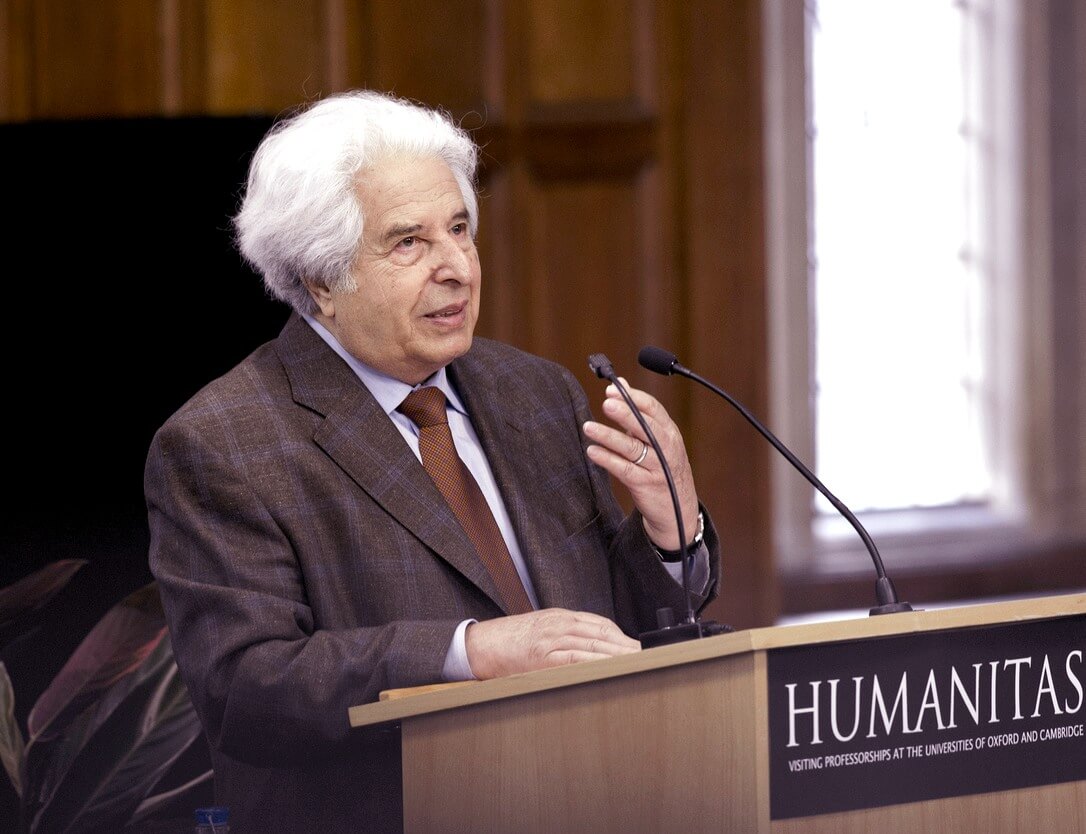
Holocaust historian Saul Friedlander, an Israeli who teaches at UCLA, was in Israel to receive a prestigious prize, and made these comments in an interview in Haaretz:
“I am connected to this country. My eldest son and grandchildren live here but I can’t call myself a Zionist. Not because I feel estranged from Israel but because Zionism has been taken, kidnapped even, by the far right. You could say I was a normal Zionist until 1968, when I wrote a short book in French about Israel’s future. I don’t think it was especially daring, but I already then I wrote that we couldn’t continue holding on to territories with Arab population; no one called them Palestinians then. I thought and still do that it would ruin the values of Israeli society from within.”
So we are beginning to see mainstream Jews distance themselves from an ideology that is as user-friendly as Communism was when Stalin destroyed that brand in the ’40s and ’50s. David Rothkopf calls Zionism “exactly the wrong” response to history. So it is necessary to talk about the idea content of Zionism, its claim that Jews must be sovereign in order to be safe. Even Norman Finkelstein, who dismissed that kind of argument two years ago by saying that Zionism might as well be a hairspray for all that Americans know what it means, goes right after Zionist ideology in his new book Old Wine, Broken Bottle.
“Like the tobacco industry after the Surgeon General’s warning in the 1960s, the formidable challenge confronting Zionist true believers is to repackage the old product such that it still sells despite its disquieting contents.”
In that Haaretz interview, Friedlander also says that people should be allowed to criticize Israeli policy by using the Nazi analogy. “[T]he political-messianism and its connection to religion and extreme nationalism we see in Israel today is similar to the main component of extreme European movements,” he says. Full context:
As an early member of Peace Now, Friedlander regrets that his colleagues in the Israeli left prefer not to base their arguments more on the lessons of the Holocaust. “It’s a mistake of the left to keep clear from such a major part of our history. They are afraid of dragging the Holocaust into the political game but we can turn around the way the right uses it.”
Friedlander is fundamentally opposed to making political use of the Holocaust, but believes the left has no choice, since the right has been doing so for over 30 years. “Since the 1970s when Menachem Begin described Yasser Arafat as a ‘second Hitler,’ we have seen how the political right in Israel has been using the Holocaust and its memory to justify more and more radical positions. It caused the left to refrain from even mentioning the Shoah. Personally, it caused me a dilemma when I saw how the subject which I devoted my life to has been used to prop up the most repulsive political attitudes.”
Friedlander knows the backlash awaiting anyone who compares what is happening today between Israel and the Palestinians with the dark days in Europe. But few know as much as he does about that period. “Things that are being said now remind us of some of the bad regimes of the 1930s, but not the 1940s,” he says, making a clear distinction. “But it’s dangerous to compare because the ordinary reader doesn’t distinguish between the thirties and the forties. The moment someone says Germany you immediately think of extermination; it’s a very slippery slope. But the political-messianism and its connection to religion and extreme nationalism we see in Israel today is similar to the main component of extreme European movements.”
Just like Max Blumenthal said in his book Goliath, and the pro-Israel crowd went nuts about what you can and can’t say.
Thanks to Nima Shirazi.


I can’t but help but note the same sense of double standards that all liberal zionists and sadly some anti zionists use. If it was wrong to occupy and take Palestinian territory in 67 why wasn’t wrong in 48 when zionists first waged their war of conquest in Palestine. Why two different standards for the same acts just because they happened at different times? I applaud the recognition of the wrongness but with out confronting the hypocrisy of treating 67 and 48 differently it doesn’t really show very much evolution in thought in my opinion. Theft is theft is it not? Last time I checked the relevant parts of international hadn’t changed
Decades ago, the late Israel Shahak, a chemistry professor at the Hebrew Univ. of Jerusalem, was one of the few Israeli Jews who criticized Israeli oppression of the Palestinians. Shahak was a human rights activist who was active back when the language barrier (Hebrew to English) prevented the US public from reading damning documents from the Israeli Hebrew press. Shahak translated important articles from the Hebrew press and sent them on to Alexander Cockburn, Edward Said, and Noam Chomsky, who were some of the very few people willing to take on the Israel Lobby.
Shahak connected his activism with the Holocaust. Shahak said that so much attention was devoted to the final stages of the Holocaust that not enough attention was devoted to the beginning stages of the Holocaust. “And in Israel today,” Shahak continued, “we are way, way past the beginning”.
For Cockburn’s 2001 tribute to Shahak, click here. Cockburn also praised Israeli journalists, who exposed Israel’s oppression in ways that couldn’t be voiced in public in the US, because of the power of the Israel Lobby.
David Rothkopf calls Zionism “exactly the wrong” response to history.
Well it is. The 1949 Geneva Conventions were exactly the wrong thing, if you look at the earlier international law that prohibited acts that it merely sought to regulate. There was the criminal indictment of the Kaiser in the Treaty of Versailles; the Kellogg-Briand Pact prohibition against wars of aggression; the Montevideo Convention on the Rights and Duties of States and its rules on the inviolability of the territorial integrity of states and the prohibition of foreign military occupations; the Stimson Doctrine; the UN Charter prohibition against the threat of use of force; and the Nuremberg Tribunal’s Charter prohibition of crimes against peace and crimes against humanity. Now the parties to the Rome Statute have accepted those customary definitions of aggression and have proposed that military occupations, blockades, & etc. in violation of the UN Charter be criminalized.
The latest development that Palestinian Solidarity activists need to fully appreciate and appropriate as a precedent for their cause is the ruling of the European Court of Human Rights that Turkey must pay $123 million for its 1974 invasion of Cyprus:
* Crimea after Cyprus v. Turkey: Just Satisfaction for Unlawful Annexation? http://www.ejiltalk.org/crimea-after-cyprus-v-turkey-just-satisfaction-for-unlawful-annexation/
* European court orders Turkey to compensate Cyprus for 1974 invasion
http://www.reuters.com/article/2014/05/12/us-cyprus-turkey-courts-idUSBREA4B0K520140512
As the author of the historical classic Nazi Germany and the Jews, Saul Friedlander is qualified to say what one can and cannot compare with Nazi Germany.
It’s well worth checking out David Coles latest interviews on the holocaust. Ground breaking recordings that drip authenticity.