
By the end of the eighteenth century, after a troubled history, Jaffa became a central urban location in the emerging modern Palestine. It still had to face the Napoleonic invasion in the very beginning of the nineteenth century, before it was pacified by able local governors and notable families. The Egyptian take over in the 1830s brought with it more spatial expansion and construction that continued with the return of the Ottomans in the early 1840s. It was in the very beginning of the previous century that this process accelerated and matured in a way that made Jaffa a centre of commerce, culture and social life.
During the mandatory period, Jaffa, was a vibrant culture hub – cinema, theatre, literary clubs and of course newspapers flourished, as did commerce and social life (the height of which was the Nabi Rubin feast). This normality was disrupted by the brutal British response to the Arab revolt in 1936-39, when parts of the town were destroyed, but the town bounced back to its former glory, until it was almost entirely ruined by the 1948 Zionist ethnic cleansing of Palestine.
The development of the city was helped and enabled by the intensive involvement of major families in the city’s fortunes. One such family was the Derhally family, famous for its contribution to the city’s architectural expansion and growth. Even the destruction following the urbancide of the city by the Zionist forces in May 1948 was unable to erase all the beautiful structures this family has left behind it. To this day, the Derhally market is there, even if not in its full grandeur of more than one hundreds shops and buildings.
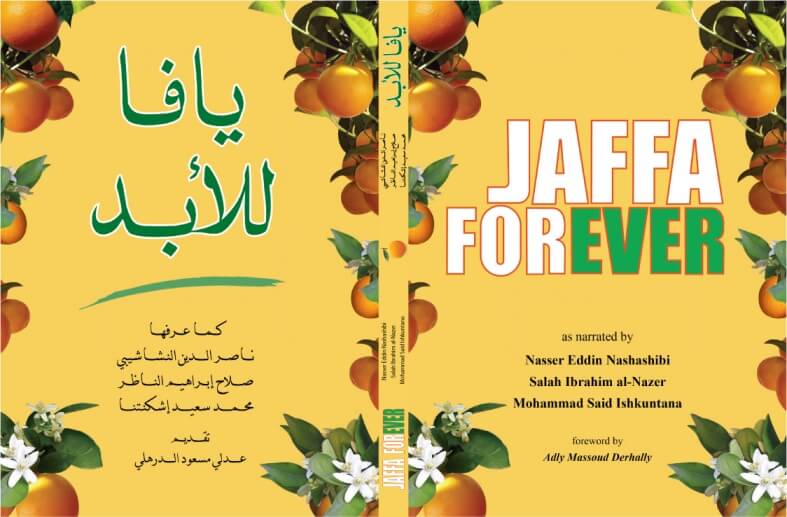
This book Jaffa Forever was compiled by a descendent of the family who devoted his life to immortalise the Jaffa that was destroyed – so that it will not be erased from our memory. Through social, philanthropic and scholarly work, Adly Massoud Derhally has kept all of us in contact with one of Palestine’s gems and through it with the country’s history and memory in general.
The book is a compilation of three testimonies from the past. The first by Nasser Eddin Nashashibi, the famous Palestinian intellectual and scholar. He reconstructs for us the cultural life of Jaffa, through the story of its newspapers, Falastin and al-Difaa, from which one could see how the city was located on the main cultural avenues of the Eastern Mediterranean, frequented by the most known artists, writers, playwrights and singers of the day. It had a vibrant cinematic and theatrical scene – aspects of life that were destroyed in the Nakba and their disappearance is no less traumatic than the loss of the homeland itself.
Salah Ibrahim al-Nazer provides us with a chilling description on Jaffa’s fall in 1948. As does Mohammad Said Ishkuntana who also helps to see how the catastrophe in Gaza can be a way for a different future. The destruction of Jaffa was part of a wider de-Arabization of the mixed towns and cities of Palestine, all done under the watchful eyes of the British, in the last days of the Mandate. The buildings which are still there, the Palestinians who still reside in Jaffa, Haifa, Acre, Ramleh and Lydd and the dedicated works by committed persons such as the author of this book, make sure that there is still hope for some peace and justice in the future. This elegantly bi-lingual book will be an important part in our struggle to remember and rebuild what was lost in the past.


Thank you for this, Ilan Pappé .
Jaffa oranges (Shamouti)…… a long- ago, sweet memory.
Is this a newer edition? The original is early 2013. I checked on Amazon and it seems that the few copies available will come from Jordan or UK and it doesn’t say what the shipping charges are or whether it is the English or Arabic version. The book’s website doesn’t seem to offer the book for sale.
I really want to buy this book as Jaffa and its history fascinate me. The city plays a major part in my almost-finished historical novel Palestine. Several of my characters have the surname al Nashishibi.
Jaffa, incidentally, was part of the intended Arab state of Palestine under the 1947 UN Partition Plan. Jewish forces exploded a truck bomb in the Jaffa town square in January 1948, then attacked and ethnically cleansed the city in April of that year, a full month before the declaration of the state of Israel and the entry of Arab “armies” into the fighting that same month.
Here’s a description of Jaffa: