
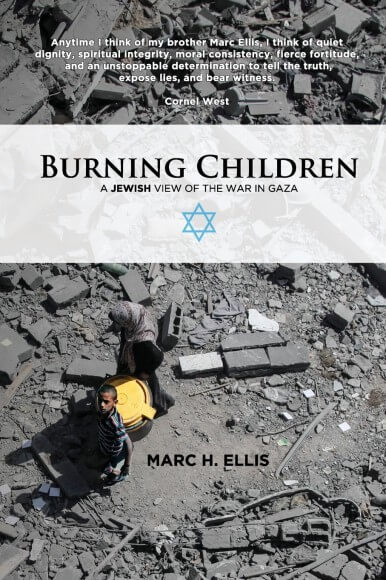
This is part of Marc H. Ellis’s “Exile and the Prophetic” feature for Mondoweiss. To read the entire series visit the archive page
From November 25 – December 5, I toured Bethlehem and Jerusalem for the first time in eight years. I found what I had experienced in my travels to Israel-Palestine beginning in 1973, only worse. In fact, in each of the five decades I have traveled to Israel-Palestine the situation of Palestinians has declined. The violence of Israel has increased.
I was invited by Bethlehem Bible College to lecture and consult with them on their academic programs. I was delightfully challenged by the vision of the college and especially by its young scholars. Though BBC is becoming known for its innovative and distinctive Christ at the Checkpoint conferences, it has yet more to offer as it expands its view. The window of opportunity is now.
During my time in Israel-Palestine, I visited Jerusalem and had a lunch discussion with the staff of the YWCA-Palestine. Later that evening I launched my new book – Burning Children: A Jewish View of the War in Gaza. In each venue my lack of hope was evident and queried. Could the situation be so bleak?
I had a premonition about this “hope” conundrum and thus decided to publish my lecture for the Kairos Palestine conference before I left for Israel-Palestine. I knew even then that my words would be too harsh to speak publically in Bethlehem, especially when the conference was celebrating the 5th anniversary of its document. For as a Jew in solidarity with the Palestinian people don’t I have a responsibility to keep hope alive even if I despair of such hope?
I thought, too, that by publishing my lecture before the conference it might inspire real discussion about the future instead of a rhetorical celebration of a situation that cannot be celebrated with a clear conscience. Though the conference was quite interesting on a variety of counts, “hope” reigned. Some of the reports that have circulated since the conference close have upped this hope quotient in an irresponsible way.
Of course what I see everyone else sees too. Palestinians experience the reality I viewed in ways that I can’t pretend to. What then is the disconnect?
As I prepared for my Kairos Palestine presentation, I wrestled with my responsibility and wrote the following presentation – which upon reflection I also thought lacked hope. I then thought of simply abandoning my honest reckoning and perhaps lie about, or at least fudge, my understandings on behalf of others. In the end, I delivered the presentation below which, coupled with my initial writing for Kairos Palestine, is more or less where I stand.
Is there a way forward? That’s the question on everyone’s mind as I toured Bethlehem and Jerusalem last week.
While touring, I reread Kairos Palestine. The situation on the ground doesn’t look good.
It isn’t about what Jews or Palestinians want or don’t want. It’s a question of what’s happening on the ground and what’s likely to happen in the near future.
On the 5th anniversary of Kairos Palestine there is little to celebrate. If we’re honest the future looks bleak.
So in my lectures and book launch in Bethlehem and Jerusalem and in my writing as the 5th anniversary approached, I avoided hope and have been criticized for it. Some say I disparaged hope. I certainly have resisted it.
Meditating on hope, last night a phrase came to me – “resist hope.” I asked myself what this could mean.
I experience such phrases as omens. Like years ago when I suddenly imagined the Torah scrolls in the Ark of the Covenant in every synagogue in and outside of the Israel giving way to Star of David helicopter gunships. Ritualized and silver, the Star of David helicopter gunships were, at least in my mind’s eye, right there in the Ark.
 Would we be better off without the images that come to us in the night? Better off not to write them down or speak them?
These images are almost all against hope, Biblically speaking. They resist hope. Do they also invoke hope by resisting it?
Sitting with companions the next morning at breakfast, I discussed my “resisting hope” epiphany when it suddenly was completed with an additional image: “Resisting hope – prophetically.” But what could this mean?
I thought of the Biblical prophets like Ezekiel who, when called by God, was instructed to eat the text of his own doom.
Strangely, and certainly against the grain, Ezekiel ate the text even after God had already told him he would be rejected and that the people Israel would not listen.
God and Ezekiel were without hope, big time.
It is recorded in the Bible that the text Ezekiel ate tasted sweet. Just like honey.
I would love to chat with Ezekiel, the LSD prophet, Psychedelic Ezekiel, and receive confirmation that in fact he wasn’t Biblically redacted into honey like Job’s prosperity at the end of his travails.
Most Biblical scholars believe that Job’s comeback was a late, tacked-on hope. I wouldn’t be surprised to learn that Ezekiel’s sweet tasting text was also a later addition.
Is the sweetness found sometimes in exile – hope?
Is the 5th anniversary of Kairos Palestine, as difficult a time as it is, sweet?
At least in my exilic life sweetness isn’t the word for doom, not even close. But gratitude that is struggled for – that’s another story.
Is gratitude another way of resisting hope – prophetically?
Resisting hope – prophetically seems counterintuitive. After all, the Biblical prophets are always on the run. Backs are turned to them, even those who invoke the prophet’s name. The powers that be and often the people of ancient Israel wanted them somewhere else.
So “resisting hope,” even when those around you desire it, demand it, criticize you for not having it, even when your critics know the score like you do, even when they agree with you, even when they encourage hope in others when they don’t experience it in themselves. That isn’t hope. It’s pie in the sky.
But resisting hope – prophetically is a clarion call to resist injustice even when the chips are down.
You see, a Jewish theology of liberation, which I first wrote about in the mid-1980s and which became known in the first intifada years, isn’t about hope. It isn’t even about resisting hope, only.
A Jewish theology of liberation is about embodying a Jewish witness together with others, a witness to the indigenous of the people Israel, which isn’t the land and never has been.
The indigenous of the people Israel is the prophetic and always has been. That’s how ancient Israel came into being in Egypt. That’s how ancient Israel was admonished and exiled in the land. Embodying the prophetic is the only reason to be Jewish. All the rest is commentary.
What does it mean to embody the Jewish prophetic today on the 5th anniversary of Kairos Palestine?
Embodying the prophetic means a solidarity with the Palestinian people which is also, and at the same time, a deep solidarity with Jewish history. Embodying the prophetic is embracing Jewish destiny as the arc of the Jewish universe bends toward injustice.
Ethical Jewishness has left the historical scene. It has been squandered. Jewish history now dwells in a darkness from which there is no return.
We have come to the end of Jewish history as we have known and inherited it. We should resist hope about the return of Jewish ethics – prophetically. That is, without justice for Palestinians such hope is pie in the sky.
This means that Jews inside and outside of Israel must begin with the confession which I first spoke of in Jerusalem in 1987 when I launched a Jewish theology of liberation. I have repeated it in every speech I have given since that time: “What we as Jews have done to you, the Palestinian people, is wrong. What we as Jews are doing to you, the Palestinian people, is wrong.”
What this confession meant in 1987 and what it means today is the same. However, the context of Palestinian and Israeli life has changed. In the last five years, even with the clarion call of Kairos Palestine, the situation continues to decline. It will change in the next five years too – for the worse. Even if a “peace” deal is struck in the coming years, it will only hide and solidify the injustices we see so blatantly today.
Our Jewish witness has to change. As the facts on the ground continue to decline our Jewish witness has to deepen.
Among Jews in America in 1987, that is among Jews who knew we had come after the Holocaust – which we do – I was a lone voice. But since that time, and increasing today, the Jewish prophetic voice is exploding.
The Kairos that Christians experience today is experienced by Jews in America, in the United Kingdom and in Israel itself, among those Israelis who remain and those who leave Israel.
Kairos for Christians is the prophetic for Jews.
But, to be honest, both are independent of hope. Neither are deepened by hope. In both cases hope is tacked on. Rather when fully embraced Kairos and the prophetic are experienced as a form of fidelity. This is where we have arrived on the 5th anniversary of Kairos Palestine.
Kairos/the prophetic are moments/lifetimes in the pursuit of justice. At its deepest level, though, justice is the pursuit of God and meaning which exist as difficult possibilities. Without justice, meaning is elusive. Calling on God is idolatry.
Kairos/the prophetic isn’t hope for things unknown and unseen, or things that aren’t going to happen. These lead to false hopes that eventually become slogans that faiths, political campaigns and sometimes resistance is organized around.
This is what the interfaith ecumenical dialogue/deal has been and is organized around. I called this interfaith ecumenical deal to account decades ago. It remains today, battered to be sure, on the ropes, but hanging on. Sometimes it is resurrected, even in the Holy Land, to keep appearances up. The dialoguers call it “balance.” Those of us who have been around know the drill.
But the true basis for an interfaith solidarity is elsewhere, in a Kairos/prophetic solidarity that resists the temptation of hope and instead resists in the dark waters that surround us. A new interfaith solidarity avoids cheerleading or even the proclamation that our witness leads somewhere.
Which it might one day, perhaps, when history opens. In the Israel-Palestine of today it isn’t leading anywhere. At this very moment, Kairos/prophetic is searching for light in the darkness, with the darkness of oppression prevailing and the light of resistance dim, though continuing, sometimes exploding, with many, too many casualties.
The casualties increase daily, even after Gaza.
Has the world already moved on from the destruction of Gaza? It has.
And with less and less room to breathe and with time running out, if it hasn’t already, political and religious institutions, including the friends of Palestine – the churches, NGOs and the United Nations for example – lack commitment. They continue to repeat rhetorical, mantra-like ethical and political positions that go nowhere.
I call these mantras “ritualized solidarity,” a solidarity we call on but don’t deepen through self-sacrifice. Not seizing the moment, no reckoning even after Gaza – the reckoning that wasn’t – and in the next five years, the reckoning won’t be happening either. The preference being? Cheap grace that Bonhoeffer named when the Nazi chips were down.
For the friends of Palestine a real solidarity is too costly in the arenas that have nothing to do with Palestinians. Like breaking publically with the Jewish establishment in the United States and Israel or calling the United States and the European Union to account. We’ve known the list for decades.
The programs being developed or inherited, the careers being made and unmade, all with good intentions, everything needs to be questioned now. The reckoning that wasn’t has to come.
But a further difficulty lies here: Kairos Palestine was a reckoning that has and hasn’t come. Kairos Palestine was a reckoning calling for embodied action. The facts on the ground, all of them, are worse. The Jewish Prophetic, Kairos Jewish if you will, has come and hasn’t come. The Jewish prophetic is exploding. The facts on the ground, all of them, are worse.
To continue on in fidelity we have to clear the decks, collect our witness and move on. Kairos Palestine and the Jewish prophetic have to move and in so doing they will resist hope together – prophetically.
We can speak rhetorically but as we do we should recognize the limits of rhetoric. Our dreams, two states for two peoples or one state for two peoples are not going to be realized in our lifetime.
Thus Kairos Palestine has to be re-thought/re-written on a number of levels. Is it possible to do this without breaking Kairos Christian boundaries?
There is one state today, Israel from Tel Aviv to the Jordan River. That one state is enforced by Israel/America/Egypt/the European Union/Jordan/Saudi Arabia/the United Nations and beyond.
This one state will remain for the foreseeable future. What will happen inside this one state over time is unknown.
If the rhetorical dream of two states is realized it will be take place within this actual one state. When spoken of today two states’ actuality means a dependent, truncated, geographically limited and militarily, economically and church/NGO occupied Palestinian autonomy.
On the 5th anniversary of Kairos Palestine we are down to one card, the biggest one of all, the prophetic wild card. With no way out, Palestinians still have to live. Palestinians continue to struggle. At the end of Jewish history, the Jewish prophetic remains constant. It isn’t disappearing.
Could these Palestinian and Jewish strengths come together in an unexpected way, clearing the path for a new future of justice and equality?
Amen.
Dear Marc,
You wrote:
Kairos/the prophetic isn’t hope for things unknown and unseen, or things that aren’t going to happen.
I disagree. Isaiah is a prophet, and his prophecy included a prediction of the resurrection. (Isaiah 26). Yet this “prophetic” future event was yet not “known” to have occurred, in the same way we know material, current facts. Rather, it is a hoped-for expectation.
Kairos Palestine includes hope. But hope does not even have to be our expectation for hope to exist. We can expect failure and yet still hope for success. I think that this contradiction better explains Kairos Palestine. It does not necessarily mean all the Christian authors optimistically expect the situation to correct itself, but they “hope” and spiritually “seek” for it to occur.
By the way, I think that your underlying message is OK. What you are saying when you are talking about resisting hope, I think, is actually that you reject what you call “pie in the sky” optimism about a bleak situation. I don’t think that you actually mean “resisting hope” is by nature a definition. Otherwise, an _absolute_ sense of hopelessness could be a virtue. Such absolute hopelessness would not even see light or a positive hope for one’s own cothinkers’ spirituality.
It depends on the church and the NGO. the UNESCO sacrificed major US funds by recognizing Palestine as member. Palestinian churches are making sacrifices too.
RE: “I experience such phrases as omens. Like years ago when I suddenly imagined the Torah scrolls in the Ark of the Covenant in every synagogue in and outside of the Israel giving way to Star of David helicopter gunships.” ~ Marc Ellis
MY COMMENT: Pastor John Hagee would probably say your Star of David helicopter gunship vision was the work of Satan. Dana Carvey playing the ‘Church Lady’ would undoubtedly purse his/her lips and agree!
I like that he calls israel one state enforced with gunships and apartheid.
Perhaps there should be a counter campaign phrase for the recent…the jewish state of israel.
Suggestions?