

A story amongst Washington, DC, foreign policy cognoscenti goes like this. In 1947, Truman, under vast domestic pressure, rammed through the United Nations General Assembly Resolution authorizing the partition of Palestine. From 1947-1948, the new Israeli state carried out cleansing operations, disturbing regional stability and setting a spark to the tinder of Arab nationalism. In 1948, Truman recognized Israel. The State Department’s Arabists protested, pointing out that petroleum interests were imperiled. Again, domestic pressure prevailed. In 1949, after further cleansing, domestic lobbying ensured that Truman would not pressure Israel to return any refugees. There lies the root of the Palestine issue.
In her new book, Dying to Forget, jack-of-all-trades historian Irene Gendzier examines unexamined archives, extracts the crucial bits, compares the facts they convey to the dominant narrative, and rewrites the history of that crucial hinge-point, 1947-1949.
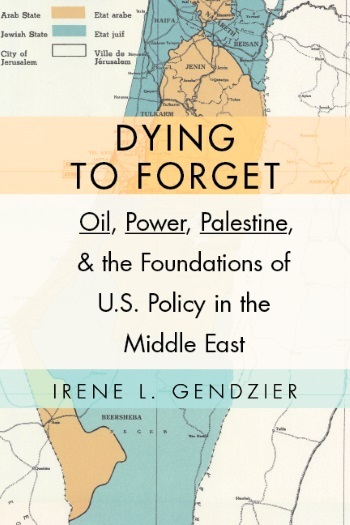
The crucial reinterpretation comes late. Gendzier’s key claim is that it was not merely the Zionist lobby which pushed Truman to back off from insisting on a goodwill gesture on the refugees. Instead, “For reasons unrelated to domestic politics” – and perhaps she should have said electoral politics, since the military-industrial complex is quite domestic – the Joint Chiefs of Staff “concluded that Israel’s military justified U.S. interest, and such interest merited lowering the pressure on Israel to ensure that it turned away from the USSR and toward the West and the United States.”
But she crosses some ground before getting to that point. In 1945, she writes, Palestine was barely on Washington’s agenda. By 1946, commissions cooked up endless explorations of potential policies, from letting in Jewish refugees from Europe’s displaced persons camps to trusteeship to partition. At that early point, in the words of diplomatic historian David Painter, establishment consensus was that promoting partition “could undermine relations with the Arab world, provide an opening for the Soviet Union to extend its power and influence, and lead to loss of access to Middle East oil at a time when the West needed it for European and Japanese reconstruction.”
Emphasis on “could.” As the CIA also realized, the oil-producing states were unlikely to break relations with the US. The Agency cited Saudi statements saying, “The oil companies were private corporations and did not represent the U.S. Government, [and] opposed the Iraqi delegate’s stand that the contracts should be cancelled.”
By March 1948, Truman as well as the supposedly least sympathetic member of his cabinet, George Marshall, were prepared to accept Israel’s declaration of statehood. Gendzier here exposes the role of Max Ball and his interactions with Eliahu Epstein, a representative of the Jewish Agency. Ball was not quite part of the establishment but was legendary for his encyclopedic command of the needs of the US petroleum companies. Epstein carefully cultivated him, showing how the Jewish Agency wanted Israel to be seen as a US asset, not a liability. The desire to offer its services to one or another Western power dates back indeed to the conception of the Zionist project. And, Gendzier cautiously affirms, “Ball appeared to promote” the notion of Israel’s use for Western power.
By June 1948, Israel had carried out further ethnic cleansing operations, and had piled up military victories against the Arab armies and irregulars. Saudi Arabia urged the US to maintain the appearance of neutrality, for fear of inciting a regional response.
By November 1948, Truman had largely backed off from putting pressure on Israel, even to accept a small number of refugees. Why? Here Gendzier’s excavations really bring out some intriguing evidence. She first notes the testimony of the US Consul in Jerusalem, William Burdett, who sent telegrams to Washington speaking of how the refugees simply wanted to go home “regardless of the government in control,” and were “victims not only of the UN and Israel but of the failure of the other Arab States to live up to their boasts.” As he added, their “lack of hope and faith…make the refugees an ideal field for the growth of communism.” Burdett was righter than he knew, with the Marxist-Leninist Popular Front for the Liberation of Palestine eventually rooting itself deeply in the majority-refugee Gaza Strip.
Such warnings went unheard. In March 1949, the chief of staff of the U.S. Air Force noted, “Existing Joint Chiefs of Staff policy on this subject appears now to have been overtaken by events. The power balance in the Near and Middle East has been radically altered… [Israel] has demonstrated by force of arms its right to be considered the military power next after Turkey in the Near and Middle East.” By May 1949, the Joint Chiefs of Staff said, “From the viewpoint of tactical operations, Israel’s territory and its indigenous military forces, which have had some battle experience, would be of importance to either the Western Democracies or the USSR in any contest for control of the Eastern Mediterranean-Middle East area.”
Gendzier concludes, “The decision to defer to Israel on these core issues signified Washington’s subordination of the Palestine Question, and its legitimation of Israel’s use of force in its policy toward the Palestinians to calculations of US interest.”
The author has contributed seriously to our knowledge of a crucial historical episode. She does not suggest that we ought to backdate the Special Relationship to 1948. On the other hand, she delivers a devastating blow to the complaints of Arabists that it was always the “common sense” in Washington that Israel was a useless albatross.
If one can take issue anywhere, it is that Gendzier does not give enough attention to the interests of the oil companies in the region, or in setting US foreign policy in this era. By not setting out their views more systematically, or offering the reader a regional overview, she might presume too much knowledge of the intricacies of the US-Saudi Arabia Special Relationship. One might also lose the sight of the contours of the landscape of power amidst the blurring effect of a blizzard of details about internal diplomatic maneuvering during this intense two-year period.
Finally, the question of the relative power of different sectors of government is opaque. Clearly, the President would have given weight to the opinions of the Joint Chiefs of Staff. But how were the oil companies weighing in during this period? Did they go along to get along? Or were they focused chiefly on keeping close relations with Saudi Arabia, conducting a parallel commercial diplomacy? Be that as it may, this intensely textured and intensively researched monograph has reworked our knowledge of a key period in US and global history. It ought be read and considered widely.

there’s a 2011 article by Gendzier that says as much and expands on this time period
https://occupiedpalestine.wordpress.com/2011/05/24/us-policy-in-israel-palestine-1948-%E2%80%93-the-forgotten-history/
i didn’t realize the Consul General for the US in Jerusalem Tom Wasson, like Bernadotte working on the truce, was also assassinated a few months before.
i wonder why that’s not mentioned as much as Bernadotte’s assassination? Wasson was replaced by Burdette.
We have reissued as eBooks several documents about the history of British Mandate Palestine and of Israel (http://plunkettlakepress.com/israel), for example Abba Eban’s autobiography (http://plunkettlakepress.com/aa), his major speeches (http://plunkettlakepress.com/voi) and Chaim Weizmann’s autobiography Trial and Error (http://plunkettlakepress.com/te).
Tree: “Given the fact that the place that he was shot was in an area controlled by Jewish forces, its most likely that it was a Jewish Israeli who shot him…”
Exactly the opposite. That fact makes it more likely that it was enemy fire, from the Arab side.
In wartime shots hitting one side most likely come from the other side.
OT, Amitai Etzioni writes in Ha’aretz that Israel should “flatten Beirut” (because Hezbollah is there). Prominent American professor proposes that Israel “flatten Beirut” — a 1 million-person city it previously decimated.
I read the book recently. Definitely an important historical work, albeit rather tedious and repetitive at times.
She does not suggest that we ought to backdate the Special Relationship to 1948.
True, but the book does demonstrate compellingly that the U.S. Establishment view of Israel as a strategic asset and potential key ally did not suddenly emerge after the 1967 war, as some writers suggest.
Dying to Forget: Oil, Power, Palestine, and the Foundations of U.S. Policy in the Middle East (p. 302). .
————
Critically, Gendzier highlights “calculations of US interests” not “the Israel Lobby” as the key factor in the reversal in U.S. policy beginning in 1948- 49.
Gendzier also has a lot to say about changing perceptions of U.S. oil interests in relation to Israel.
* * *
* * *