
The children of the wealthy, the enlightened, the rabbis—
They call the Hebrews to Zion.
We’ve heard this old story before, from our enemies:
“A ghetto for the eternal Jew!”
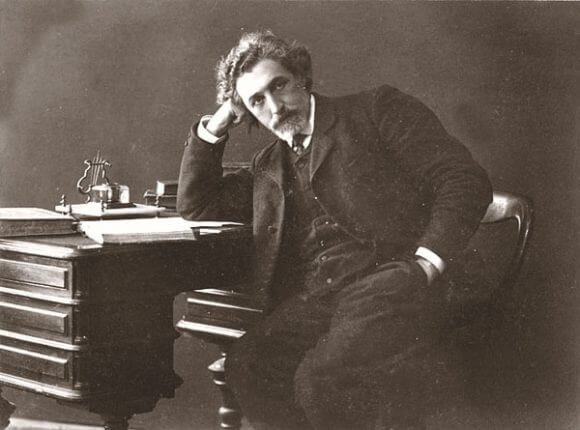
One could be forgiven for mistaking these lines for a foray into recent debates over alleged anti-Semitism in the British Labour Party or in the movement for Boycott, Divestment, and Sanctions (BDS). The lines, however, come from the 1901 poem “In Zaltsikn Yam” (“In Salty Seas”) by the great Yiddish writer S. An-sky. An-sky dedicated the poem to the General Jewish Labor Bund, and after it was set to music, the poem became one of the Bundists’ best-loved anthems (although the verse in question is not usually sung). It is an outstanding work of philo-Semitism. And it is resolutely anti-Zionist.
An-sky’s reasons are clear: he and other supporters of the Bund were developing a vision of Jewish identity that insisted Jews had a place in Europe and wherever else they were in the world. They were formulating a role for Jewish struggle within an internationalist labor movement that called for universal emancipation. They sought rights and revolution for Jews in cooperation with non-Jews, wherever they all were. The Zionists’ call for Jews to emigrate and concentrate on their particular, national liberation directly contradicted the vision of the Bund.
I like to think that if I had been alive in 1901, living in the shtetl of (some of) my ancestors, I would have joined the Bund. But it’s hard to say. I might have added myself to the hundreds of thousands of other Jews in Eastern Europe who joined the Mensheviks or the Bolsheviks or (my favorites in retrospect) the Socialist Revolutionaries. Or I might have gone the way of much of the Feinberg family and emigrated—not to Zion but to the melting pot of New York (the term “melting pot,” let’s remember, was coined by disaffected Zionist Israel Zangwill, who now dreamed of assimilation), where I could have become a reader of the socialist daily Forverts, the city’s premier Yiddish-language newspaper and, in its heyday, one of the most widely read newspapers in the United States. None of these decisions—including the one to jump into Zangwill’s melting pot—would have required giving up Jewishness.
Today, making an analogous decision—rejecting Zionism—makes it very hard to play a part in Jewish communal life. The world contains millions of secular Jews who do not identify with the currently existing Jewish state. But for many it’s hard to find any community or organization in which to express non-Zionist conceptions of Jewishness.
Yes, I am troubled by persistent anti-Semitism in the world. But I am also troubled by the damage done to Jewishness when Jewish identity is collapsed into support for Israeli policy, and when accusations of anti-Semitism are wielded as a tool for silencing debate. What I found so compelling about Jewish history is the wealth of ideas that have emerged surrounding what Jewishness can be. That wealth is lost when name-calling replaces debate, and when a single, tendentious version of Jewishness renders itself impervious to criticism.
But it’s not only a matter of Jewishness in general. The hypersensitive defense of Israel is not good even for Zionism. Zionism has played its part in the rich history of Jewish debates over the meaning of liberation. (And what else is Judaism but a long-running debate over the meaning of liberation?) When An-sky wrote “In Zaltsikn Yam,” Zionism was associated with the wealthy supporters of Theodor Herzl, whose dreams centered on the formation of a Jewish state sponsored by the great Western powers. But these political Zionists were later eclipsed by Labor Zionists who believed that the Jewish community should be rebuilt from the bottom up on the basis of new, more egalitarian social relations. There were revisionist Zionists who fought ruthlessly for the creation of a strong Jewish nation-state; but there were also anarchist Zionists, for whom the settlement of Israel meant the creation of communal structures like kibbutzim that could render state organization obsolete. There were Zionist chauvinists who were interested purely in the defense and power of Jews, but there were others, like Martin Buber, who saw Zion as a meeting place of peoples and saw Jewish liberation as inseparable from the liberation of Arabs and all the peoples of the Middle East.
No doubt, all of these tendencies have been filled with contradiction from the outset, and it’s an open question whether any of them ever had much chance of unqualified success, if by success we mean the long-term establishment of a fair, prosperous, and peaceful society for all people living in Palestine. Still, when I think it over again, I realize that if I had left my ancestors’ shtetl a hundred years ago, I might well have given into my utopian and adventurous inclinations and gone to join the idealists in Zion. Yet today, as Zionism becomes identified with support for Israeli policy, it becomes difficult for an internationalist Jew—a Jew who sympathizes with all the wretched and uprooted people of the earth—to identify with Zionism.
Nevertheless, Israel does maintain at least one aspect of Jewish heritage that is disappearing elsewhere: in spite of a general narrowing of its political landscape in recent years, it remains a place where Zionism is much more avidly debated than in other places, where the issue is posed as a simple yes-no question, a matter of all-or-nothing “support for Israel.” Within Israel, competing Zionisms still coexist alongside lively criticism of Israeli policy and of the Zionist project itself. Outside of Israeli, this imaginative pluralism tends toward a one-dimensional argument between defenders of a monolithic “Israel,” who ignore or strategically overlook Israel’s internal differentiation, and critics of a similarly monolithic “Israel,” who are uninterested in the complexities of the Zionist idea—in no small part because their opponents have tried so hard and so successfully to identify current Israeli policy with Zionism as such, and to identify any criticism Zionism with the hatred of Jews.
Jews have long been identified as a people of the book. The book in question is a collection of stories and critical reflections upon those stories, and Jewishness develops through the continuation and enrichment, and occasional inversion and negation, of this critical tradition (or, we might say, through the continual “critique of critical criticism,” to borrow a phrase from world history’s second-most-famous Jew). Of course, as with any cultural tradition, Jewish tradition comes in many forms, some of which have closed themselves off to criticism and seem determined to freeze their worldview in sets of principles established decades or centuries ago. But the Jewish identity that I—and maybe a few others like me—care to identify with is a confrontation with non-identity, and it lives on only with criticism.


“Within Israel, competing Zionisms still coexist alongside lively criticism of Israeli policy and of the Zionist project itself ”
Still not looking full on in the mirror.
I`m afraid at this sounds very much like a case of “look at us JSILis , we are a normal healthy Western type democracy – we have open debate about what we do and whether we should be doing it”. Meanwhile in the Occupied Territories and Gaza this “lively criticism” converts to SFA. The IDF jackals continue to rip apart the Palestinian carcass.
So which version of Zionism was the one in which an immigration of Jews and settling in Palestine was not enforced against the will of the country’s majority whose decision on the matter would have been respected?
@- Talkback: So which version of Zionism was the one in which an immigration of Jews and settling in Palestine was not enforced against the will of the country’s majority…?
The mythical one? The self-serving, tortured “soul searching” and hand wringing over the supposed differences (some real, some not so much…) between the Zionists camps and how if only the compassionate, universalist version of Zionism had won out always makes me cringe. The above article is, imo, less cringe worthy than most. But it still feels, to me, like there’s that equivocation in there that lets Zionism off the hook for the massive tragedy of Israel. It reminds me of some folks in the Solidarity Movement (JVP & Campaign To End The Occupation) who use “Non-Zionist” instead of “Anti-Zionist” to describe themselves and there position. It’s part of why I left JVP.
My assumption is that the argument in favor of using the term non-Zionism, or even “Liberal-Zionism,” over the term anti-Zionism is that historically there have been different strains of Zionism and that they had different goals, practices, ethics, etc.; ie: Cultural Zionism, Religious Zionism, Christian Zionism, Practical Zionism, Political Zionism, Messianic Zionism, etc… So I further assume that a “non-Zionist” believes that some forms of Zionism were acceptable, but not others.
But there’s Zionism in theory, and then there’s Zionism in practice with its results “on the ground,” if you will. Whatever “strains/forms” of Zionism a “non-Zionist” may believe was the righteous one (I’m waiting for the “Compassionate Zionism” political party candidate to emerge…), the Zionism that has emerged as the undeniably dominant version for a very long time now is the version which occupies Palestine, is political and nationalist in nature, discriminates, murders, etc. The “political vs. cultural” competition within Zionism is over. The political/nationalist form won.
And whether there was ever a truly clear, total separation between these two basic conceptualizations of Zionism is debatable. As early as 1914, Horace Kallen wrote about practical and political Zionists, “there can be no ‘cultural center’ without a political center.” For someone as prominent in the Zionist movement as Kallen to write such a thing, as early in the movement as he did, is instructive. My understanding is that there are many other people, events, and quotes that argue toward the idea that the “political” and “cultural” versions of Zionism were never quite so very separate and unique from one another in practice. The romanticization of the early Zionists and kibbutzim as a group of agrarian, open society sweethearts is in line with other types of mythifications of the creation of Israel. I’m not claiming to be an expert, but this is what I’ve come to understand.
“But the Jewish identity that I—and maybe a few others like me—care to identify with is a confrontation with non-identity, and it lives on only with criticism.”
Anyone care to tell me what this expression of navel-gazing actually means?
so, An-sky was a gifted, ideological , idealistic workers leaning fool who thought jews would blend in (and what? disappear?) as if that is the ultimate goal