
Several years ago I was asked to participate in a panel about the movie “Farewell Baghdad” in Berlin. The Jewish Museum in Berlin who organized the event also invited the Israeli Embassy. In front of the cinema representatives of the Embassy were distributing pamphlets titled “Remembering the ‘Forgotten’ Jewish Refugees”. I was stunned. Since when did the Israeli establishment care about Arab-Jews?
I spent 12 years in the Israeli school system and never heard the Arab Jewish narrative. It wasn’t until university that I learned that Ben-Gurion’s government made a deal with Nuri al-Said’s Iraqi government where Iraqi Jews would immigrate to the new Israeli state so that the Zionist regime could bolster its Jewish population, and in turn they would be forced to leave their property to the Iraqi state. I learned about the 1950–51 Baghdad bombings that were possibily connected to the Mossad. Israeli sociologist Yehouda Shenhav says there was a direct connection between the bombings in Baghdad and the Jewish registration rate to leave the country from March 1950 to June 1951. It’s clear we cannot rule out the possibility that the Zionist emissaries used the incidents to frighten hesitant Jews and prod them to leave the country.
Just before the panel started the organizers asked me not to talk about the history of Iraqi Jews from a perspective critical of Zionism. They asked me to speak in a “personal” way about my experience as an Iraqi Jew. I went up on stage and tried my best not to talk about the deal or the story of the bombs. But when the Embassy representatives talked about the lost property of the Arab Jews, I couldn’t hold back. I said they were using the property of the Iraqi Jews in the rather cynical way, simply to silence the Palestinian demand for their own lost property. And then, as if on cue, the Israeli ambassador who sat in the first row like a communist commissar got to his feet and left the discussion with dozens of his staff and security guards. I am for the return of the property of the Arab-Jews but not in relation to the property of the Palestinians. One injustice shouldn’t be on the back of another one. It isn’t only a demand for the money but of an acceptance in the Jewish life of the Arab states.
Now, earlier this month, the The Times of Israel reported that Danny Danon, the Israeli Ambassador to the U.N., told the UN General Assembly that he plans to propose a resolution about what he called “the ‘forgotten’ Jewish refugees” to counter what Israel sees as a one-sided focus on Palestinian refugees. Danon himself has Arab roots, as his father was born in Egypt. “We don’t hear the international community speak of them when they discuss the refugees of the conflict, perhaps because it doesn’t serve the Palestinian narrative,” Danon said. A week later it was reported in Israel Hayom that lost Jewish property in Arab countries is estimated at $150 billion, and the paper offered an exclusive glimpse into a classified government project seeking to assess the scope of property left behind by Jews who were expelled or fled Arab nations and Iran. “We may be able to right a historical wrong,” the minister said. So now this cynical use of Arab Jewish property has become an official governmental policy.
Danny Danon, and the white Ashkenazi establishment in Israel, is manipulating the Arab-Jewish narrative for several purposes.
First, they aim to silence the demands of the Palestinian refugees. They want my community to block the way of compensation, or any kind of historic justice, for the Palestinians (I have already lived on their land for far too many years). Danon and his partners know well: No Arab country will pay $150 billion to the Jews of North African and Middle Eastern states.
Secondly, Israel is using the issue to win the support of its oppressed masses of Arab-Jews. The community, which has historically been ignored by the Israeli elite, suddenly feels cared about, and Danon and his party hope this will translate into votes in the next election.
But lastly, and even worse, this cynical strategy puts me and my community in a new position of conflict with the Palestinians. Danon and his people know that re-writing our Arab-Jewish history as one of being denied refugees will create a new wall, and war, between us and the Arab world. The Arab-Jews will say to themselves, “ohh we were betrayed by the Arabs countries so we must keep on fighting the Arab world.”
But before I go on about the vicious cycle this rhetoric leads us into, I first want to explain what is wrong at the heart of this erroneous analogy between Arab-Jews and Palestinian refugees.
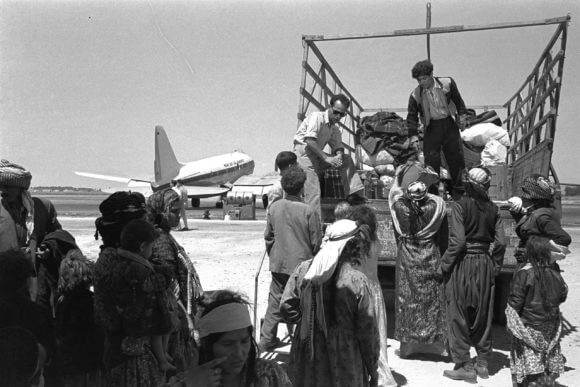
The definition of Jewish “refugees” from Arab countries that Danon introduced at the UN seeks to create an analogy between Palestinian refugees and Arab-Jewish immigrants who arrived in Israel in the 1950s and 1960s, and to present both populations as victims of the 1948 war. The strategy Danon is using began as a government policy in 2010 when the Israeli parliament passed a law that requires every Israeli government that negotiates with Palestinian representatives to demand the return of lost Jewish property in Arab countries before dealing with compensation to the 750,000 Palestinian refugees and their descendants for their own property that has been taken by the Israeli state. So, this distorted analogy wherein Arab Jews are refugees just like the Palestinian refugees, is really just a cudgel being used to sabotage negotiations with the Palestinians. Suddenly there are around 850,000 Arab Jews that Israel now represents to counteract, in their minds, the demands of 750,000 Palestinians who lost their property during the Nakba.
Maybe one can compare the Palestinian refugees’ camps in the Arab states after 1948 to the Arab-Jewish “Ma’abarot” tent camps in Israel. But the historical analogy is still all wrong.
First, Arab-Jews were never a collective in the same way Palestinians who were rooted to the same land are. Israel created them as such only in order to subordinate them, erase their Arab roots, and re-construct them as subjects of the Zionist regime.
Secondly, the Arab-Jews were never refugees, as is often claimed. In the case of Turkey or Morocco they even could go back and forth to the Arab states (this was also the case of Iran until the Islamic revolution). This is the definition of refugees in the UNHCR:
A refugee is someone who has been forced to flee his or her country because of persecution, war or violence. A refugee has a well-founded fear of persecution for reasons of race, religion, nationality, political opinion or membership in a particular social group. Most likely, they cannot return home or are afraid to do so. War and ethnic, tribal and religious violence are leading causes of refugees fleeing their countries.
Another difference between the Arab-Jews that emigrated to Israel and Palestinian refugees is that they were coming to a country that embraced them as full citizens. This is not the case with the Palestinians, who have never received full citizen rights in any Arab states. More than that, Arab-Jews always enjoyed a privileged life inside of Israel, even compared to the Palestinians of 1948 who were not forced off their land during the Nakba and eventually became citizens of Israel.
Politicians like Danon even know that the term “refugee” is not quite correct for Arab-Jews. Therefore, they try to stress the idea that they fled because of a deeply antisemitic history in the Arab countries. Israel uses the European experience of antisemitism and projects it on the Arab Jewish experience, which is not accurate. Historians Lior Sternfeld and Menashe Anzi contradicted that idea in Haaretz:
“The Jews in the Muslim world, so the narrative goes, lived humiliated lives as second-class dhimmis, just waiting for Zionist redemption. This narrative is misleading in many ways. It ignores more than a thousand years of Jewish existence in the Muslim world, a reality that was neither good nor bad exclusively, but one that included both aspects, and was characterized by complicated relationships with the majority population, with other minorities, and with the local and imperial political structures.”
As you can see, the twisted analogy behind the apparent Arab-Jewish refugees and Palestinian refugees just becomes more cynical layer after layer.
The truth is most Iraqi Jews in the 1950s and 60s weren’t Zionist. They lived well in a modern city. Actually, Baghdad was much more progressive than Tel Aviv back then. Iraqi Jews had already read about the Nakba, and the hard life of Jewish immigrants that were forced to live in tent encampments in Israel. The majority of them didn’t want to leave and immigrate. But Ben-Gurion needed the people because after the Holocaust there weren’t enough Jews for his Zionist dream. So through some very dubious Mossad activism, he struck a deal with the Iraqi government. Iraq got the money and property, and the Israel got poor Jews who immigrated as a subordinate group to Israel. So the question remains — where were the Arab-Jews more oppressed? And how does the term “refugee” apply to a people who were – maybe unwillingly – forced into an Israeli citizenship by their own ethnic group?


(1) To quote Yehouda Shenhav, of Iraqi Jewish heritage and professor of sociology and anthropology at Tel Aviv University: “Any reasonable person, Zionist or non-Zionist, must acknowledge that the analogy drawn between Palestinians and Mizrahi [Arab] Jews is unfounded. Palestinian refugees did not want to leave Palestine….Those who left did not do so of their own volition. In contrast, Jews from Arab lands came to this country under the initiative of the State of Israel and Jewish organizations.” (Ha’aretz, 8 October 2004.)
(2) Avi Shlaim, born into an affluent and influential family in Baghdad: “We are not refugees, nobody expelled us from Iraq, nobody told us that we were unwanted. But we are the victims of the Israeli-Arab conflict.” (Ha’aretz, August 11, 2005) Shlaim is referring to the well documented acts of terror, including bombings of synagogues and Jewish owned businesses, carried out by “The Movement,” a Jewish/Zionist terrorist group controlled by Israel, whose purpose was to instil fear in Iraqi Jews and motivate them to immigrate to Israel. Several books and articles have been written by Jews of Iraqi origin about this little known chapter of history and an award winning documentary has also been produced and viewed around the world. Throughout the Arab world, especially in the Magreb, recruiters from Israel pressured Arab Jews to immigrate to Israel. This is a long and complicated story that has long since been documented, but not publicized in the West.
Regarding the emigration of Iraqi Jews, I quote American diplomat, Wilbur Crane Eveland from his book, Ropes of Sand:
“In attempts to portray the Iraqis as anti-American and to terrorize the Jews, the Zionists planted bombs in the U.S. Information Service library and in synagogues. Soon leaflets began to appear urging Jews to flee to Israel…. Although the Iraqi police later provided our embassy with evidence to show that the synagogue and library bombings, as well as the anti-Jewish and anti-American leaflet campaigns, had been the work of an underground Zionist organization, most of the world believed reports that Arab terrorism had motivated the flight of the Iraqi Jews whom the Zionists had ‘rescued’ really just in order to increase Israel’s Jewish population.”
The U.S. State Department was also well aware of what Israeli agents had done in Iraq to precipitate Jewish emigration: “When [in August 1951] Israel undertook a campaign to get Iranian Jews to immigrate to Israel, the director of the office of Near Eastern affairs in the U.S. Department of State, G. Lewis Jones, told Teddy Kolleck, of Israel’s embassy in Washington, that the United States ‘would not favour a deliberately generated exodus there,’ as he put it, ‘along the lines of the ingathering from Iraq.’ Kolleck justified Israel’s Iraq operation as beneficial for Iraq, stating it was ‘better for a country to be homogeneous.'” (“Memorandum of Conversation by the Director of the Office of Near Eastern Affairs (Jones),” August 2, 1951, Foreign Relations of the United States 1951, vol. 6 p. 813, at p. 815 (1982)
(3) The late Yisrael Yeshayahu, speaker of the Knesset: “We are not refugees…. We had messianic aspirations.”
(4) Shlomo Hillel, former minister and speaker of the Knesset: “I don’t regard the departure of Jews from Arab lands as that of refugees. They came here because they wanted to, as Zionists.”
(5) During a Knesset hearing into the matter, Ran Cohen, member of the Knesset: “I am not a refugee….I came at the behest of Zionism, due to the pull that this land exerts, and due to the idea of redemption. Nobody is going to define me as a refugee.” (Ha’aretz, October 8, 2004)
BTW, unable to bear their circumstances and the blatant racism directed towards them by the Ashkenazi/white European Jewish establishment, about 5,000 Moroccan Jews soon returned to Morocco after arriving in Israel in the late 1940s. Thousands more have returned home and continue to do in order to live a meaningful, peaceful and prosperous life among their Arab/Muslim/Christian brothers and sisters. Morocco is benefitting greatly from their return.
It should not be forgotten that after being rejected twice by the UNGA, Israel signed the 1949 Lausanne Peace Conference Protocol and declared before the UNGA at the same time that it would comply with UN Resolution 194, which calls for the repatriation of or compensation for the then about 800,000 Palestinian refugees dispossessed and expelled before and during the 1948 war as a precondition for gaining UN admittance – see UNGA Resolution 273, 11 May 1949. Israel has since refused to comply with its pledge.
Also, given its implications for Palestinian refugees who numbered well over one million following the IDF’s expulsion of a further about 25,000 before and during Israel’s first invasion of Egypt in 1956 and an additional approximately 225,000 during and after the war it launched on 5 June 1967, Israel is utterly opposed to its citizens of Arab origin being referred to as “refugees.” For obvious reasons, Palestinian refugees would welcome such an initiative as it would also be applicable to them.
The bottom line is that while Palestinians were expelled from their ancestral homeland by Zionist militias and the IDF of foreign origin, they played no role in the emigration of or any ill treatment and or loss of assets that Jews of Arab origin may have experienced in their former homelands. The two cases are separate and distinct, i.e., apples and oranges.
Taking Evil and depravity to another level.
The Ashkenazi Zionist elite had hoped to bring their fellow Ashkenazi Soviet Jews to Israel, and only when it became clear that that was not going to happen any time soon did they bring in the Arab Jews as a second best alternative to help fill the emptied (ethnically cleansed) lands.
Anti-Jewish movements did exist in the Arab countries, though only in some of the countries were they a significant threat. Zionist agents encouraged and allied with these movements, as in Iraq, or in their absence carried out ‘black flag operations’ to sow panic among the local Jews, as in Egypt. Under these circumstances it seems reasonable to me to call the Jews who fled Iraq and Egypt refugees, although not those who fled Morocco or Turkey. Whether or not they qualify as refugees is not, I think, the main issue. The point is that both sets of refugees, Arab Jews from certain countries and Palestinians, were uprooted, directly or indirectly, by the same force — Zionism.
For the record: A lengthy article, but a “must read.”
https://www.counterpunch.org/2019/12/27/the-fascinating-history-and-political-lives-of-jews-in-iran/
“The Fascinating History and Political Lives of Jews in Iran” by Ariel Gold, Counterpunch, Dec. 27/19
Another part of that story, the Jews of Iraq terrorized to move to Israel, to be exploited:
https://www.amazon.com/Ben-Gurions-Scandals-Haganah-Mossad-Eliminated/dp/1893302407#customerReviews
So many lies, told with such an appearance of sincerity. Do not negotiate with liars.