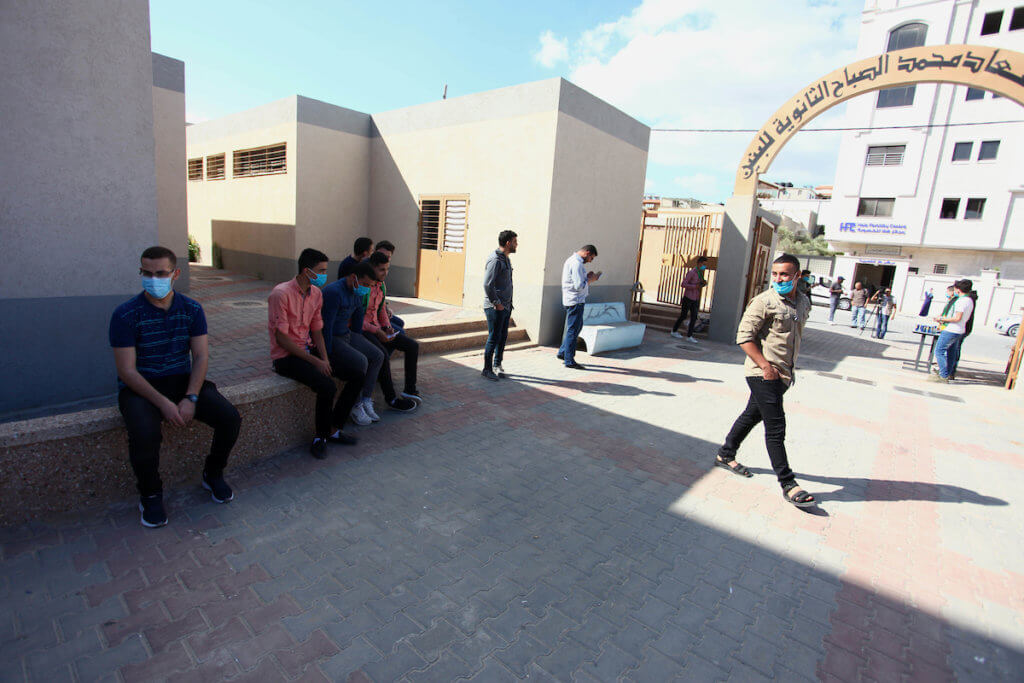
Palestinian students wearing masks wait for the start of final high school exams at a school in Gaza City on May 30, 2020. (Photo: Mahmoud Ajjour/APA Images)
The Latest:
- 72 confirmed cases of COVID-19 in the Gaza Strip
- 417 confirmed cases of COVID-19 in the West Bank
- 180 confirmed cases of COVID-19 in East Jerusalem
- 93 active cases across the West Bank, Gaza Strip and East Jerusalem; 5 have died
- 18,795 people in Israel positive for COVID-19; 300 have died
Since our last newsletter, there are only a few additional cases of COVID-19 infections among Palestinians, however Israel is considering going back to a broad scale lockdown as daily infection rates continue to rise.
For Palestinians, the smallest rate of growth came in East Jerusalem, where on only one new case was recorded. Gaza comes in a close second with two new cases in the last week, like all of Gaza’s confirmed cases, the latest pair who tested positive were already in a government quarantine center. In the West Bank, 23 new cases were reported.
While the economy is opening back up, the losses are significant. We reported last week on a World Bank analysis that estimated poverty rates and unemployment would spike. This week another report out from the Palestinian Authority to the Ad-Hoc Liaison Committee continues to paint a grim picture.
Ramallah’s deficit has hit $2.6 billion. The Palestinian Authority managed to cover $1.2 million in losses primarily through loans, which is also the amount of the expected deficit for this year, before the coronavirus pandemic. The PA still needs to find another $1.4 billion. The report, which is indeed intended to garner international aid (to the tune of $400 million) warns, “not receiving the urgently needed support is likely to result in massive hardship to our people, undermine the prospects of a rapid economic recovery, and may cause lasting damage to the institutions of the Palestinian state.”
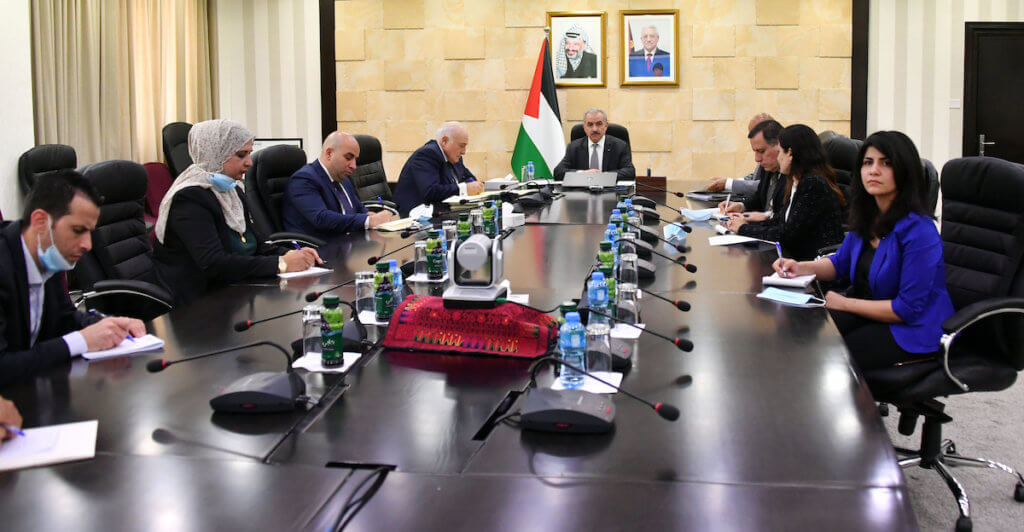
Enough time has passed that we can now look back at the PA’s containment strategy, which began rather early by instituting a state of emergency on March 5. We can see the turnaround point came during the first week of May, when the rate of increase in infections began to slow alongside a sharp increase in recoveries.
The Second Wave
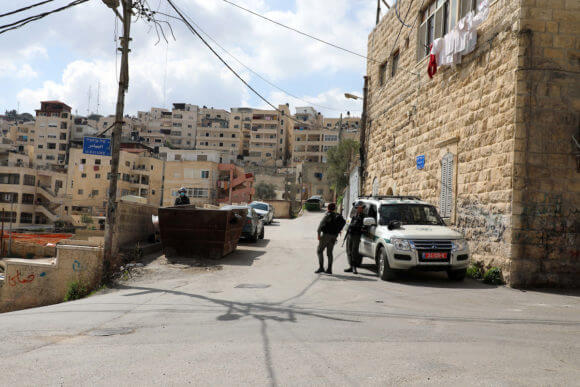
In Israel many are wondering if the economy opened prematurely, including Prime Minister Benjamin Netanyahu who spoke to reporters yesterday from Jerusalem bearing some bad news, or “not so good news” as he put it. By the end of the day, 214 people were diagnosed with COVID-19 in Israel.
At the onset of the pandemic, there were around 200 new infections each day. Within days Israel was facing 800 new COVID-19 cases a day and officials ordered wide closures that were effective in dropping the spread of the virus. That held until about two weeks ago when students and teachers went back to schools.
“When we got to a situation of about 20 people infected a day, or even less than that, we opened the economy,” Netanyahu said.
Now, Netanyahu explained, “about 220 people or 230 [people] a day” are testing positive.
“The rise is not as steep as it was before but it is sort of steep. We are no longer in a situation of just a few people here and there and a few schools. We’re talking about a few hundred and its rising quickly.”
By the time Netanyahu made the statement on Thursday, Israel declared specific areas red zones, re-implementing closure on a handful of localities and schools.
Scenes from a Gaza isolation center

This week we have a story out from Sarah Algherbawi from Gaza that details life inside of government-run isolation centers and a field hospital near the Rafah crossing with Egypt where COVID-19 positive patients are treated.
Health officials in Gaza seemingly have avoided a disaster by relying on stringent quarantine policies. All Palestinians returning from abroad were ordered into an isolation center. While quarantine can be as short as 21 days, when no COVID-19 tests are available to clear returning travelers, Palestinians are required to stay at the centers for 28 days. For some, multiple trips out of Gaza meant multiple stints in isolation.
Algherbawi reports: “Amjad Musallam had a brain tumor surgically removed at the onset of the pandemic, which set in motion a series of events that would require the 11-year-old to live in government isolation centers in Gaza for a combined total of two months.”
Another returning Palestinian, Mohammed al-Madhoun, a medical student in Egypt, described dismal conditions in a school where Palestinians slept on thin mattresses in classrooms.
“We mix with other people inside the quarantine center and if it turned out that one of us is infected that would mean infecting many others,” al-Madhoun said. “Schools are not equipped well enough to provide for people for 21 days. We don’t even have a good internet connection, I can’t follow-up with my university or submit my assignments.”
One of the more surprising details from her reporting is just how understaffed quarantine centers are. We already know from daily updates from the ministry of health in Gaza that a majority of staff at the isolation centers are police and security. But the head of the field hospital near the Rafah checkpoint, Mohammad Daher, an intensive care physician described working “alongside a skeleton crew of two more doctors, three nurses, and four janitors. One doctor and one janitor had quit on their first day.”
“I thought of all possibilities, including the fact that I may never return home again, but I decided to go on and only think about following up the cases and controlling the spread of the disease,” Daher said.
That’s it for this week. Stay safe, stay healthy.