
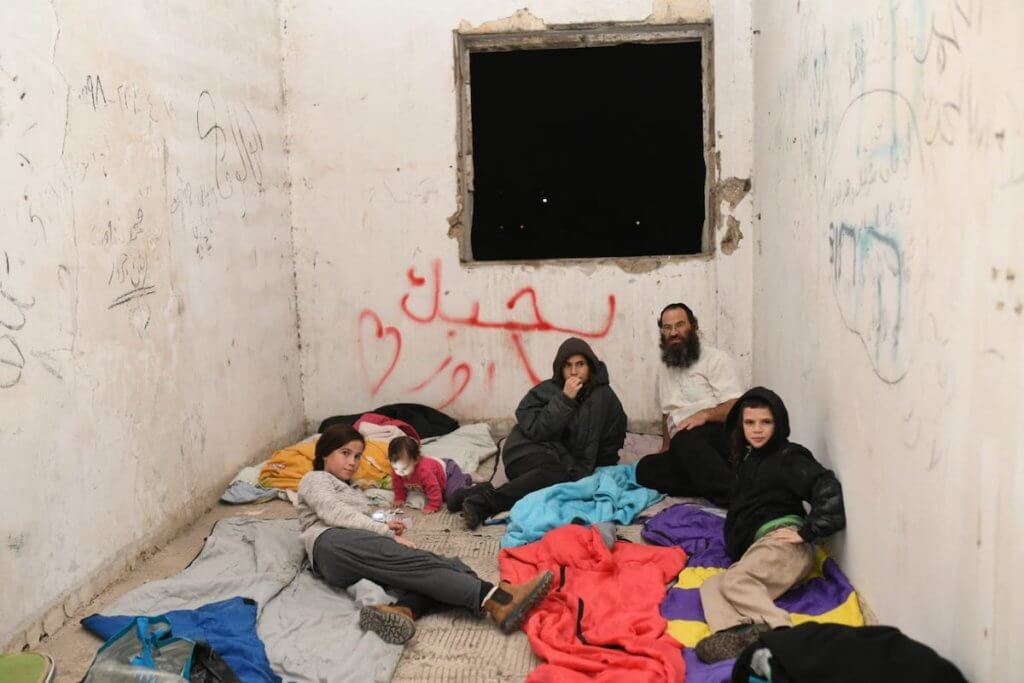
In the middle of the night on Monday, a group of Israeli settlers and right-wing activists squatted at the site of Sa-Nur, an illegal West Bank settlement that was evacuated in 2005 as part of Israel’s Gaza disengagement, in an attempt to resettle the area.
Israeli media reported that a group of around 20 families, including women, children, and Israeli government officials like Likud MK Ariel Kallner, arrived at the site of the settlement in the middle of the night and squatted there with the hopes of reestablishing a permanent presence there.
Palestinians in the nearby town of Jaba’, just south of Jenin in the northern occupied West Bank, told Mondoweiss that they saw the settlers arriving just past midnight, with mattresses, blankets, gallons of water, food, and other supplies in tow.
“By this morning we could see that they had started cleaning up the area and the remaining settlement buildings that still stand on the hilltop,” Tawfeeq Alawneh, 69, the mayor of Jaba’ told Mondoweiss, adding that some of the houses in Jaba’ are less than 100 meters away from Sa-Nur, giving villagers a decent view of what’s been happening at the settlement.
According to Alawneh, groups of settlers have visited the sight of Sa-Nur for years since its evacuation 15 years ago, when Israel unilaterally evacuated all the settlers from the Gaza Strip, along with four settlements in the northern West Bank, including Sa-Nur and its neighboring settlements of Homesh, Ganim, and Kadim.
But this time, Alawneh said, things seem different. “Prior to this, the settlers would often come for temporary visits, but this time they are clearly intending to stay for a longer period of time,” he said.
Haaretz reported that Israeli soldiers arrived at the site on Tuesday morning, seemingly with the intention to remove the group of settlers, whose presence violates the 2005 Disengagement Law which prevents the settlers from returning to the evacuated settlements.
But by noon, Alawneh said the soldiers had left the sight, dimming his hopes that the settlers would be evacuated swiftly.
“This settlement has been empty for 15 years, and it’s against Israeli law for them to be here, so we always thought we were on the safe side,” Alawneh said. “But at the end of the day we know that the soldiers and the government will always protect and help the settlers.”
Israeli right-wing activists and government officials have petitioned for years for the resettlement of Sa-Nur, Homesh, Ganim, and Kadim. Last year, 11 Israeli members of parliament visited the site of Homesh and declared their “mission” to return permanently. Two years before that, in 2017, hundreds of settlers and right-wing leaders made a similar statement in a demonstration at Sa-Nur.
In August of this year, on the 15th anniversary of the disengagement, a group of Israeli lawmakers filed a bill to repeal all portions of the 2005 Disengagement Law, except the ones relating to the compensation of the thousands of settlers who were evacuated at the time (it’s estimated that settlers were compensated upwards of $200,000).
The bill, which has been proposed and rejected numerous times, would pave the way for the resettlement of the four settlements in the northern West Bank.
Yossi Dagan, head of the local settler municipal council and longtime proponent of Sa-Nur’s resettlement, arrived to the site on Tuesday morning along with a number of Israeli MK’s, saying: “a clear majority of the Israel cabinet supports rectifying the crime that expelled and uprooted the communities in northern Samaria,” using the biblical name for the West Bank.
“As someone who was expelled from Sa-Nur himself in the criminal expulsion 15 years ago, I am waiting for a phone call from the Prime Minister’s Office informing me that I can issue construction permits, and it’s possible to return to Sa-Nur within a day because the area is under full Israeli control in any event,” Dagan said.
Despite indications that Israel’s defense establishment, as well as Prime Minister Benjamin Netanyahu himself, oppose the resettlement of places like Sa-Nur, Palestinians in the surrounding villages are still extremely worried about what Tuesday’s events could mean for them.
“If it comes down to it, we will fight this in court,” Alawneh said, “even though we know the Israeli court system does not uphold justice for Palestinians.”
While the land on which Sa-Nur was established is considered by Israel to be “state land,” the lands on the hilltops surrounding the settlement are privately-owned by Palestinian residents of the nearby villages, including Jaba’.
If the settlers were to be successful in their attempts to resettle Sa-Nur, Palestinians say it would spell disaster for their communities, who have lived in what they described as a “more peaceful life” ever since the settlers were evacuated 15 years ago.
“A lot of the people in our village have farmland that’s planted with hundreds of olive trees and other crops on the land around the settlement,” Alawneh said. “If the settlers were to return, we would return back to the days of being banned from accessing our land.”
“Everywhere in Palestine, wherever the settlers go, restrictions on Palestinian movement and access to our land follows,” he said, “along with settler attacks on our families, our homes, and our crops.”
Alawneh told Mondoweiss that he and his fellow villagers viewed Tuesday’s events as “just another crime of the Israeli occupation,” and “more attempts to steal Palestinian land.”
“This is another example of the daily attacks we face, and the constant attempts by the occupation to change the facts on the ground, and implement their annexation policy in the West Bank,” he said.
Alawneh said that the Palestinians of Jaba’ and the surrounding the villages are not going to accept what’s happening in Sa-Nur, and are going to protest the presence of the settlers, and “do everything we can to remove these settlers from our land.”

To Zionists who try to characterize the conflict as much too complicated for us out of the centers of power to understand, I always respond that the conflict can be described simply and completely in 2 words – land grab!