
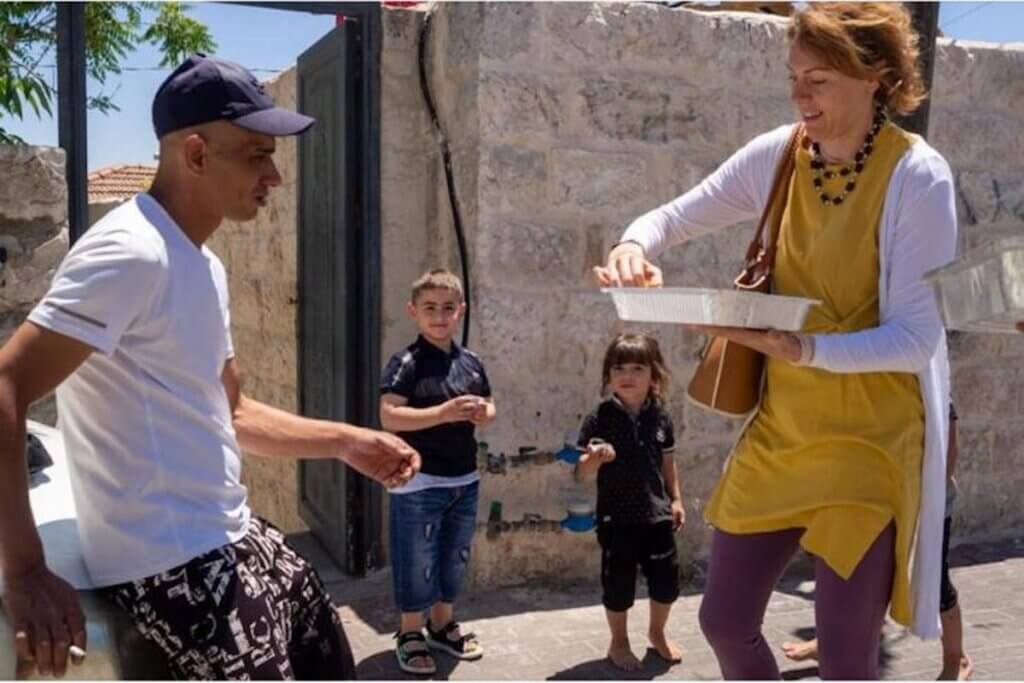
“Let them eat cake” is the famous misquote attributed to Marie Antoinette in the late 18th century. Even though it is unlikely she ever said this exact phrase, it perfectly captured the stark gap between the upper and lower classes of pre-revolution France. Perhaps the reason this quote became so famous was not the actual wealth gap that existed between the two, but rather the complete disconnection from the reality of everyday life for lower class people and their real needs. Cake has reared its head out of the annals of history and has re-emerged in my neighborhood of Abu Tor during the unrest that we see in Jerusalem today.
Abu Tor (also called A-Thori) neighborhood is unique as it is considered a “mixed” one between both Israeli Jews and East Jerusalem Palestinians. In reality, there is nothing mixed about it, as the Green Line snakes through the middle separating each community. The line is invisible but there is no mistaking where it runs:
“The two parts of the neighborhood are separate from each other in every way: socially, with respect to community activity, and economically. Each part has its own educational, welfare, and transportation systems, and the physical infrastructures, commerce, and services are also separate. The resulting gaps between residents of the two parts of the neighborhood, sometimes between those who live on the same street [there is one street in Abu Tor that is part Jewish and part Arab] create a severe sense of deprivation among the Arab residents that in some cases leads to violence.” (Issar, 2017, p.50)
The East side of the neighborhood is plagued with drug stations and suffers from the same injustices that all East Jerusalem neighborhoods face: house demolitions, lack of infrastructure and public spaces, sanitation and more. Abu Tor even has a gated community on the Palestinian side of the neighborhood that puts in shocking contrast the socio-economic differences between the two communities (to my knowledge only Israeli Jews and internationals, mostly Christian Zionists, live there).
Throughout the years a number of well-meaning residents have created a joint initiative called the “Good Neighbours of Abu Tor,” which attempts to bridge this gap through between the two sides. Language lessons, communal gardens and excursions are just some examples of what they have achieved. Having said that, there is no question on where the power and decision-making lie in this group and it is evident in how activities have been shaped.
In any bridge-building initiative, if the imbalance of power, privilege and root causes of the conflict are not addressed; there is little chance of real transformation. Even the most benign activities will only deal with minor symptoms and achieve shallow results. At the end of the day, this is part of the system that allows the powerful and privileged to remain where they are-unchallenged. Some have distanced themselves from these activities for this exact reason as they see themselves as maintaining the status quo.
The first warning sign for this is the endorsement and buy-in of authorities. In Jerusalem in particular, the municipality and police have been at the forefront of dispossessing Palestinians of their homes, neglecting their areas of living and brutally suppressing them. Three days ago, the Israeli Police’s Facebook page posted this photo:
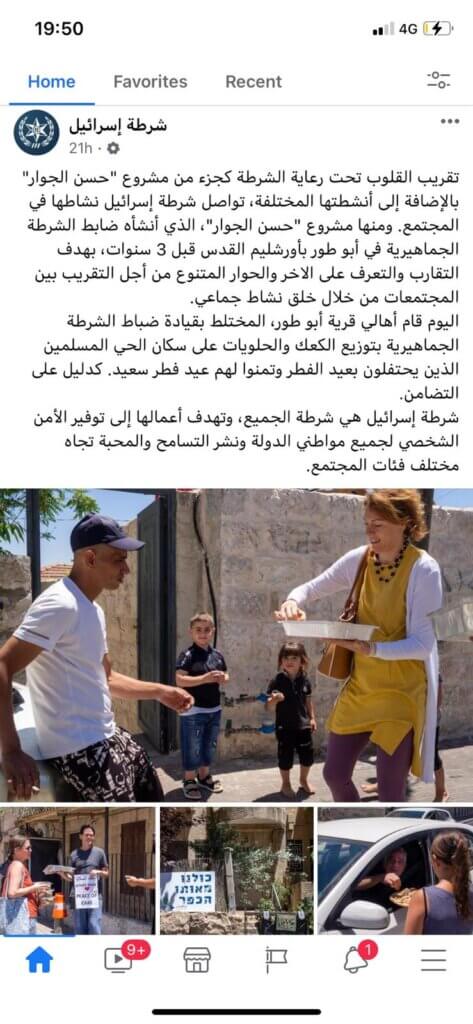
In this picture we can see many of the Jewish residents of Abu Tor delivering cake to the Palestinian residents. This was a spontaneous gathering of Jewish residents that was unilaterally done and perhaps independent of the Good Neighbour initiative. Many members of the initiative were shocked and outraged that the police had misappropriated these photos for their own propaganda and left the group. For us Palestinians in Jerusalem this is somewhat less of a shock.
Even without the police intervention, this is a gesture that ultimately serves the privileged members of this neighborhood. What about the last month has indicated to our Jewish neighbors that what Palestinians in East Jerusalem need right now is cake? Palestinians in Jerusalem are being suppressed by security forces and settlers perhaps like never before. Most are taking up non-violent actions to fight for their rights and we will need the support and actions of those who truly want a just peace and equality.
My wife and I bumped into two Palestinians residents in the park who commented on the initiative: “The Jews must really be scared that we will do something if they are bringing cake”.
I fear that part of the motivation of this cake giving was fueled by self-interest. Clashes have taken place in a few of our streets with damage to property, as was the case in the Intifadas. My wife and I bumped into two Palestinians residents in the park who commented on the initiative: “The Jews must really be scared that we will do something if they are bringing cake”. Similar so-called peace meetings, protests and activities are taking place across the country where the message in many of them seems to be “lets go back to how things were”. This is not acceptable to us and even if we could the recent events won’t allow us to.
Therein lies the problem! Similar to pre-revolution France, those that are in the more privileged position (well-intentioned or not) are unwilling or unable to really understand those that are “beneath” them or challenge their own status. I really do support initiatives that bring both sides together, but it must be done by challenging the status quo and imbalance of power.
If I were to make one or two recommendations it would be these: Spend some time to self-reflect on the root causes of the problem, the role of your privilege in this interaction and stand up to the injustices taking place against us. Surround yourself with Palestinians that will not appease you or be intimidated by your position in society, or else you will never fully understand us.
The photo below shows the result of last night’s clashes in our neighborhood, which in all likelihood was not perpetrated by the actual residents of Abu Tor. Nonetheless, I think the message of Palestinians in Jerusalem needs to be heard: We don’t need your cake, we need our rights.


1 of 2
The New Word Defining the Israeli-Palestinian Conflict – The Atlantic
“A New Word Is Defining the Israeli-Palestinian Conflict in Washington””Close observers of U.S. policy say the subtle shift reflects a progressive push to focus on human rights.” By Yasmeen Serhan, The Atlantic, May 21/21
EXCERPTS:
“In a conflict where words matter (so much so that even using the word conflict invites disagreement), it’s notable when the words used begin to change. And when it comes to discussing Israel and Palestine in the United States, the words have changed. The first, most obvious shift has come from Congress, where more and more (predominantly progressive) voices have criticized Israel’s human-rights abuses, as well as the U.S. government’s role in sustaining a status quo that human-rights groups and other high-profile leaders, including South African President Cyril Ramaphosa, have likened to apartheid. Staunch defenders of Israel within the Democratic Party now offer criticism of the scale of the country’s military response in Gaza (which caused extensive damage, and at least 230 deaths) or, just as strikingly, say nothing at all.
“But a subtle, and perhaps more revealing, shift has come from the White House itself. In an address announcing yesterday’s cease-fire between Israel and Hamas, President Joe Biden said, ‘Palestinians and Israelis equally deserve to live safely and securely and to enjoy equal measures of freedom, prosperity, and democracy.’ A readout from a call between Secretary of State Antony Blinken and his Israeli counterpart echoed those words almost verbatim, as did remarks by White House Press Secretary Jen Psaki.
“On their face, these statements aren’t extraordinary. Why wouldn’t the United States support freedom, prosperity, and democracy for Israelis and Palestinians alike? For close observers of U.S. policy on this issue, however, one word has stood out in particular.
“’All of the sudden, and I mean all the sudden, the word equal is appearing in [President Biden’s] rhetoric and the rhetoric of the secretary of state,’ Martin Indyk, a distinguished fellow at the Council on Foreign Relations who previously served as the U.S. ambassador to Israel and Barack Obama’s special envoy for Israeli-Palestinian negotiations from 2013 to 2014, told me. ‘That’s totally new.’
(cont’d)
2 of 2
“’All of the sudden, and I mean all the sudden, the word equal is appearing in [President Biden’s] rhetoric and the rhetoric of the secretary of state,’ Martin Indyk, a distinguished fellow at the Council on Foreign Relations who previously served as the U.S. ambassador to Israel and Barack Obama’s special envoy for Israeli-Palestinian negotiations from 2013 to 2014, told me. ‘That’s totally new.’
“Indyk isn’t the only person I spoke with who noticed the word equal appearing more and more in U.S. language on this issue. Yousef Munayyer, a nonresident fellow at the Arab Center in Washington, D.C., and a close observer of this conflict, told me that while its usage may be vague, equal nonetheless signals a shift from focusing on a political solution to focusing on human rights. ‘What we’re starting to see a shift toward is that [the conflict is] not just unsustainable,’ Munayyer said. ‘It’s also unacceptable. That’s the direction that this is going in, and they’re trying to find language now to help navigate that shift.'”
“Today, more and more U.S. lawmakers believe that the lopsided power dynamic between the Israelis and the Palestinians will sustain the conflict. They also argue that unless the U.S. uses its unique leverage to address these issues, a return of the kind of violence witnessed over the past couple of weeks is inevitable.”
“Biden and his allies ‘are going to come under increased pressure to align their words with their actions,’ Munayyer said. ‘They might be able to resist that pressure, but it’s going to grow.'”
“The East side of the neighborhood is plagued with drug stations”. This phrase “drug stations” is unfamiliar to me and to google. An editor’s role is to make the articles comprehensible to its readers.
The cake represents respect and good will. May be a campaign, civil in nature, with placards and song, would be joined by the chiefs, covered by media, making it even more powerful.