

We keep an eye on Jewish institutions that conflate the Jewish religion and Zionism, and here’s a glaring example.
In the month leading up to the High Holidays, it is Jewish tradition to recite Psalm 27 every day. The psalm is about a person seeking salvation through oneness with the Lord. Its verses includes a famous demand of God:
One thing have I asked of the LORD…
that I may dwell in the house of the LORD
all the days of my life
The video below of a singing of the famous Ask is from Park Avenue Synagogue on August 6. The video features rock star cantor Azi Schwartz (who has sung at the U.N. and for the Pope, and who grew up in an illegal Jewish West Bank settlement), along with cantor Rachel Brook, doing an inspired rendition of the psalm’s key lines.
Watch the video and you will see that the synagogue has stuck in images of the Damascus Gate in occupied East Jerusalem, and other images of the walls of the old city.
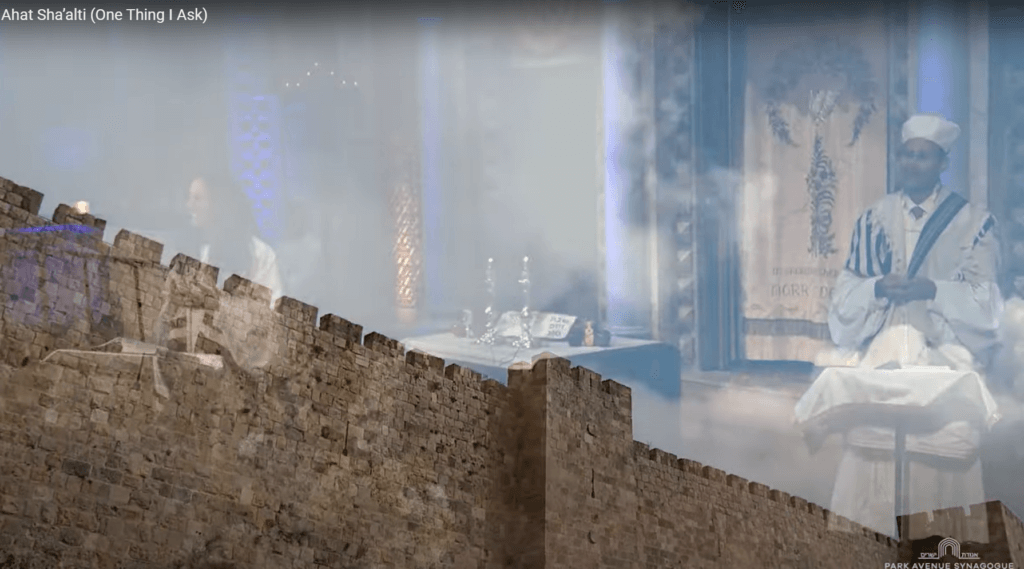
“I have never seen anyone link Psalm 27 to Zionism as this clip does thru the images, certainly not in this manner,” says a friend. “It’s a perfect one verse statement of contemporary synagogue Judaism. I have only one ask of God: Zionism.”
I’ve written twice before about Park Avenue Synagogue’s devout Zionism. For instance, during the latest Gaza slaughter, Rabbi Neil Zuckerman offered a sermon to the gun his son carries as an Israeli soldier.


Back in the 19th century and into the 20th century, Jewish New Year cards carried images of Muslim/Palestinian sites including some of the images of Jerusalem’s walls and gates in this video. Jews gazed from afar on Jerusalem with spiritual yearning but no plans of conquest. To this day, some anti-Zionist Jewish groups continue this tradition. But, since the occupation of Jerusalem and the disenfranchisement, deportation and even killing of Palestinian Jerusalemites became routine policy for Israel and its supporters, these images take on a sinister meaning. The iconic crenellations above Damascus Gate were built by a Muslim and are at the heart of Palestinian East Jerusalem.
There are people in the US (and elsewhere), plenty of them, who would like their country to be a Christian nation in the same way that Israel is a Jewish nation, with Christians being full citizens and non-Christians being allowed to live there on sufferance, with no rights that a Christian is bound to respect. Think of what those Park Avenue parishioners would think of that.
The link doesn’t say where in “Israel” Schwartz grew up, Phil. Do you really know it was in an illegal settlement? Can you supply a link?
On the whole, I don’t think the overlaid Jerusalem images were particularly offensive, or even particularly Zionist in character. Showing Damascus Gate and the western wall reflects a Jewish liturgical tradition that predates Zionism by many centuries. For example, saying “next year in Jerusalem” at the end of the Passover seder dates to the 15th century CE, according to Wikipedia. Until the advent of Zionism, it was a metaphorical, not a settler-colonial, aspiration. It would have been entirely different if the image had been of Israeli paratroopers celebrating at the western wall after occupying Jerusalem in 1967.
The verse refers to the House of the Lord or Heikhal Hashem, as they would enunciate on my side of the tracks. Which in a definitely mainstream interpretation refers to a specific location found on GPS of this planet, located in occupied Jerusalem. Though Judaism has passed through various iterations since the Psalmist wrote those words, (wherein the synagogue or other God’s presence situations dynamics replaces the GPS spot) such an interpretation of that verse in the year of their lord 2021, is not outlandish or weird. It is only the fact that the politics is loaded (understatement) that turns Jerusalem and the Temple Spot into something objectionable.
It is true that the period of powerlessness yearning for an unseen Jerusalem and its unseen parallel Jerusalem in exile conjures nostalgia for simpler times. The facts of Jerusalem are no longer hidden. We’ve had moving pictures for 120 years and Jewish bayonets in Jerusalem’s old city for half a century. It’s not avoidable. Can’t pretend the Temple Spot does not exist. Rationality and kumbaya are not the rule of humans on this planet. And associating the source of life with human bayonets is not a net plus to those whose hopes are higher than the status quo. But pretending that yearning for a physical part of Jerusalem is foreign to judaism is to say “my judaism is the real judaism and the physical Jerusalem Judaism is artificial”. Your dissent is duly noted, but a study of reality, human tribal reality is worthwhile too.