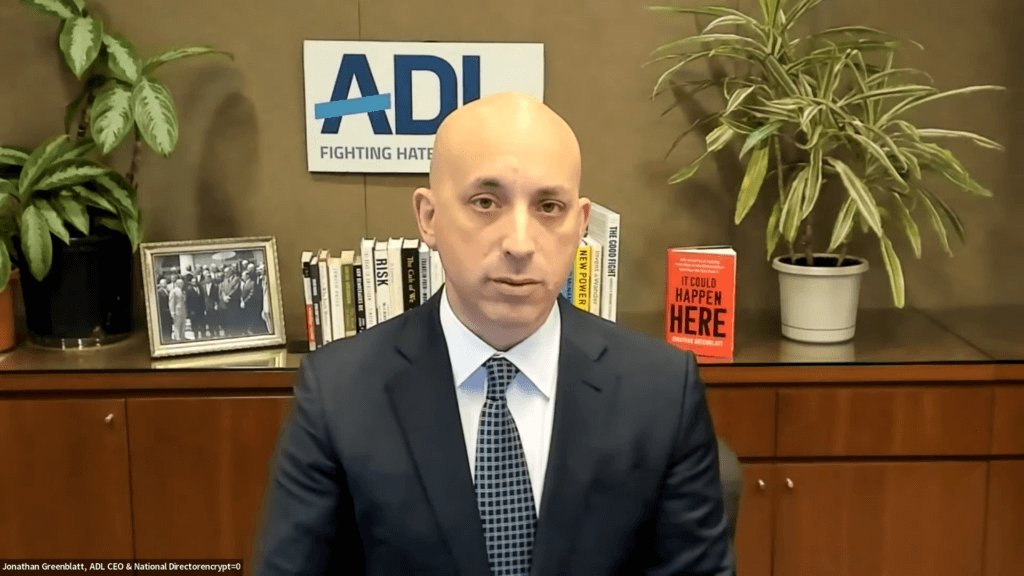
Earlier this month it was reported that Anti-Defamation League (ADL) leaders had debated ending their controversial police delegations to Israel two years ago.
Since 2004 the ADL has accompanied hundreds of American law enforcement executives to Israel as part of their National Counter-Terrorism Seminar (NCTS). They receive training from the country’s National Police and military. Activists have targeted trips like this in a campaign called Deadly Exchange, that was organized by Jewish Voice for Peace (JVP). “Successful organizing is about seeing where we can slow, stall, or chip away at the big systems hurting us, our communities, and our neighbors,” reads the campaign’s website. “Although we know that ending these exchanges will not end police violence or deportations in the U.S., abolish Israel’s violations of Palestinian rights, or terminate all security collusion between the U.S. and Israel, we must start somewhere.”
In The Guardian and Jewish Currents, Sam Levin and Alex Kane, report on an internal 2020 ADL draft memo which reveals that the organization quietly shared some of the same concerns as their critics. While protests over the George Floyd gripped the nation, George Selim, the group’s Senior Vice President for National Affairs, and Greg Ehrie, its Vice President of Law Enforcement & Analysis, wrote, “In light of the very real police brutality at the hands of militarized police forces in the US, we must ask ourselves difficult questions, like whether we are contributing to the problem. We must ask ourselves why it is necessary for American police, enforcing American laws, would need to [sic] meet with members of the Israeli military. We must ask ourselves if, upon returning home, those we train are more likely to use force. We hope that that is not accurate.”
The memo references JVP’s campaign against Deadly Exchange multiple times.
The ADL might have eventually developed private reservations about its own program, but it had publicly denounced the campaign targeting it for years. “JVP’s long-standing ‘Deadly Exchange’ campaign is little more than an exercise in anti-Israel propaganda that attempts to link legitimate concerns over policing practices impacting communities of color in the US with fictionalized accounts of information sharing conducted on a limited basis by some members of US law enforcement with Israeli peer organizations,” it declared in a 2019 report.
The ADL hasn’t carried out a police exchange program for three years, but they now claim they might begin them again soon. “We remain committed to law enforcement engagement and professional development nationally and internationally and are likely to expand our educational law enforcement programs,” Selim told The Guardian and Jewish Currents in an email.
Deadly Exchange activists say the news proves their campaign is having a real impact, as it helped cause enough consternation to stop the trips for a few years. However, they also believe that the leaked memo creates the momentum to bolster their fight even more. On March 21, JVP held a virtual movement rally to celebrate the victory while escalating their tactics.
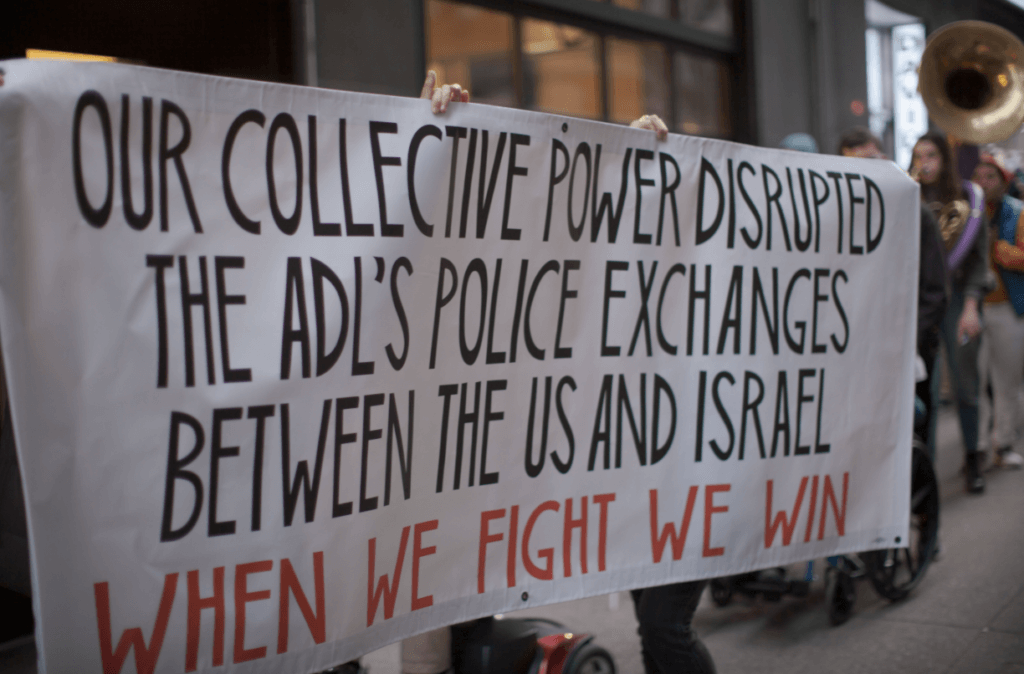
“The memo names our campaign over five times and makes it absolutely clear that our collective power made this program politically and financially costly” said JVP’s Director of Campaigns and Partnerships Eran Efrati at the event. “…the ADL chose the police, we choose the people. This is how we win! This is big! We have the ADL on their knees, backed into a corner, and admitting that our collective power forced them to stop these deadly exchanges, but we’re not done yet.”
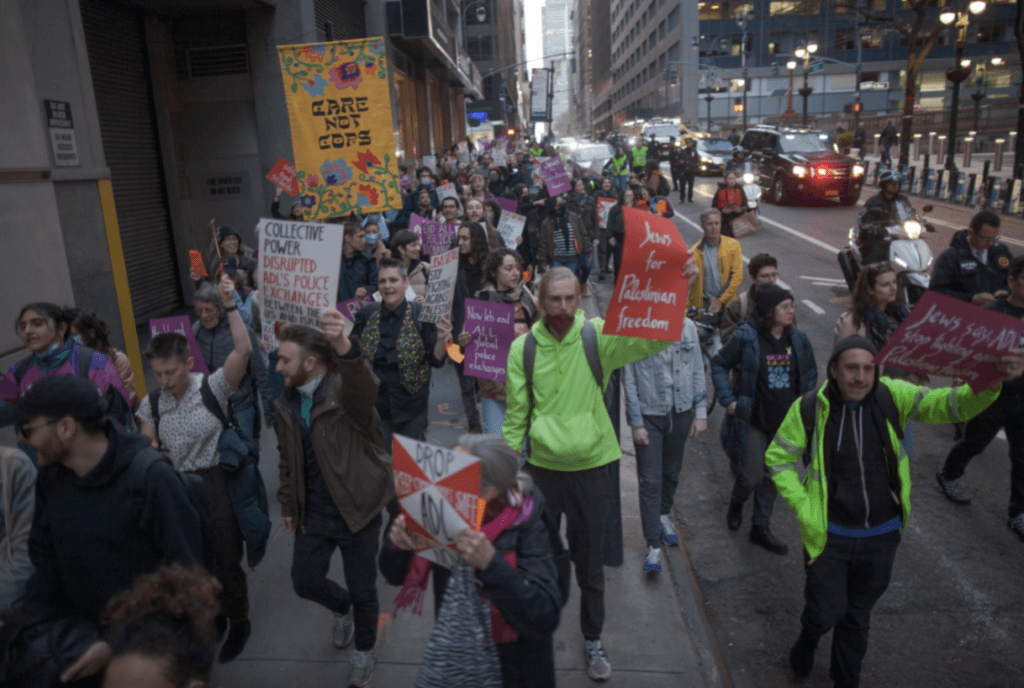
The next day hundreds protestors held an emergency march and rally in front of ADL’s Manhattan headquarters that featured speakers like Linda Sarsour (MPower Change), and Sumaya Awad (Adalah Justice Project). The group projected Efrati’s words across the building: “ADL chose the police; We choose the people.”
While the ADL’s involvement has been targeted by activists at a national level, organizers have also netted wins against the Deadly Exchange program within their local communities. In 2018 Durham, North Carolina became the first U.S. city to ban police training with the Israeli military. “We know that racial profiling and its subsequent harms to communities of color have plagued policing in our nation and in our own community,” read a resolution unanimously endorsed by Durham’s city council. In 2020 the student body at Tufts University overwhelmingly voted to end the school’s Deadly Exchange program.
ADL is not an ally
The fight to end Deadly Exchange programs isn’t the only effort to be bolstered by the memo revelations. For years there’s been an effort to get progressive groups to sever their ties with the ADL, which is still viewed as a civil rights organization by many. In 2020 the Drop the ADL movement published a primer detailing the ADL’s history of repressing Palestinian rights, aligning itself with the police, and trampling justice movements. A coalition of groups (including American Muslims for Palestine, Palestinian Youth Movement, Adalah Justice Project, and IfNotNow) also published an open-letter calling for action.
“Even though the ADL is integrated into community work on a range of issues, it has a history and ongoing pattern of attacking social justice movements led by communities of color, queer people, immigrants, Muslims, Arabs, and other marginalized groups, while aligning itself with police, right-wing leaders, and perpetrators of state violence,” it reads. “More disturbing, it has often conducted those attacks under the banner of ‘civil rights’.”
These kinds of attacks have been very apparent amid the Black Lives Matter protests of recent years, as the ADL has publicly advocated for civil rights while consistently criticizing the movement for alleged antisemitism. “First of all, ADL has not endorsed the Black Lives Matter movement,” the group wrote to New York Jewish Week in 2016. “We do not have an official relationship with the body of activists who claim membership in this effort. And we are well aware that a small minority of leaders within the Black Lives Matter movement have supported anti-Israel — and at times anti-Semitic — positions. We have repeatedly made clear that we take offense at those positions and have strongly condemned statements made by those who have expressed support for efforts to boycott and divest from the State of Israel. We will continue to call out such statements because they often are rooted in bigotry and do nothing to advance a peaceful resolution of the conflict. Rather, they only perpetuate hostility and hate.”
In 2016 the ADL accused the Movement for Black Lives (M4BL) of antisemitism because its platform referenced a “genocide” taking place against Palestinians. These kinds of smears aren’t a recent development, as the ADL has been criticizing racial justice movements for years. Their targets have included the Student Nonviolent Coordinating Committee (SNCC), the Black Panthers, and the African National Congress. Despite its track record groups like Color of Change and the NAACP have continued to collaborate with the ADL and liberal publications have continued to cite its work.
“Historically the ADL is a very consistent organization, it does not really change,” Emmaia Gelman, an activist and a post-doctoral lecturer at New York University in American Studies , told Mondoweiss. “In U.S. society on a whole, when organizations are doing wrong there’s an instinct to get them to do better. With the ADL we’ve seen that isn’t going to happen. The ADL is essentially one-hundred years old and it’s been doing the same thing for it’s whole history. That history is actually weirdly unexplored for an organization as politically important as the ADL. There was no real critical study of everything that it’s done until organizations came together recently to study it.”
Gelman said that the internal memo doesn’t actually represent a shift for the organization, as the ADL has quietly been adapting to public pressure for years. “When the Drop the ADL primer was published there was very little response from the ADL at all. It seemed like they were waiting to see what happened,” said Gelman, “I think it became more urgent for them to respond. They began by putting out a rebuttal, but then they also started to shift their public face so that their web presence was almost cleansed. Most of their most Islamophobic stuff, their attacks on Black Lives Matter, their pro-police material, those items became difficult to find. In fact, they became so hard to find that someone who had written an article about the ADL was having a difficult time helping a fact-checker for a newspaper locate the articles that referred to ADL work that had taken place. The ADL had fully disappeared that work and, instead, the ADL’s information on white nationalism and the January 6th insurrection became more visible.”
Executive Director of Arab Resource & Organizing Center (AROC) Lara Kiswani told Mondoweiss that the ADL’s willingness to resume the trips demonstrates why the organization’s public’s rhetoric can’t be taken seriously and why progressives should reevaluate their relationships with the group. “We’re in conversation with educators and communities of color across the country and they’re naming the ADL as a primary force in attacking and undermining their ethnic studies work. You also have their recent efforts to suppress Amnesty International’s very moderate report condemning Israeli human rights violations,” said Kiswani. “I think the ADL can continue to talk a good game, but I would encourage people to think about what the ADL is actually doing and saying. For people on the ground doing the work and trying to advance a progressive agenda, they are the ones on the receiving end of the attacks on social justice issues.”