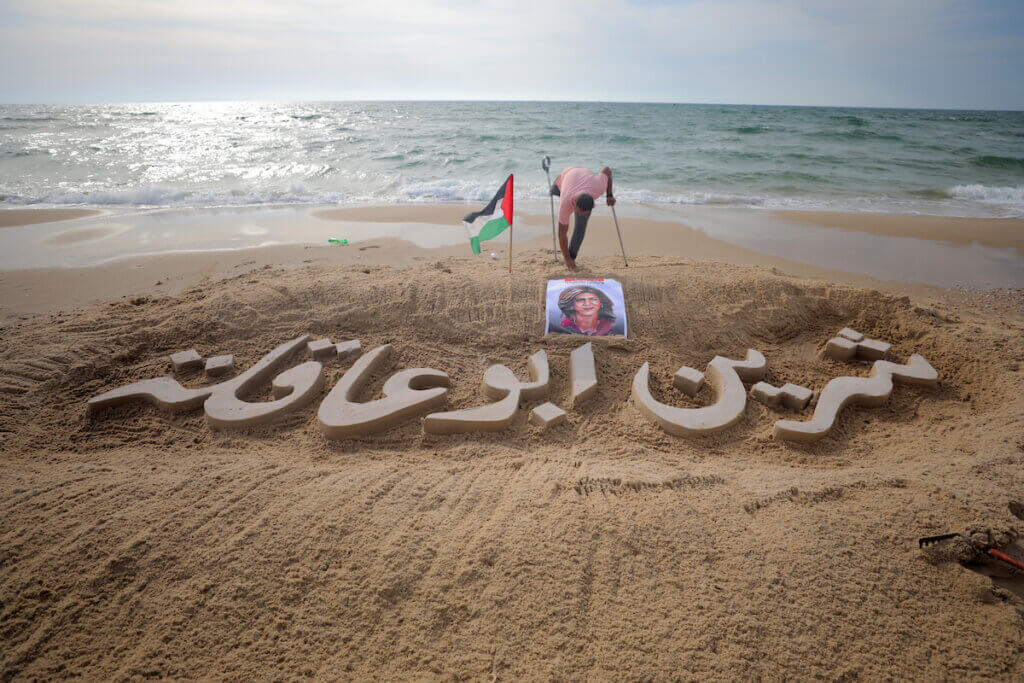
“I will never forget the volume of destruction, nor will I forget that death was sometimes very close to us.” – Shireen Abu Akleh
When Shireen Abu Akleh first started gracing our televisions, I was about two years old. All through my childhood, we only had access to the Arabsat satellite dishes, and all we knew was Arabic TV. At the time me and many of my friends and cousins were more interested in watching MBC 3, a channel of joy through cartoons and animation. Many times, our joy would be short lived as the channel would be changed to either MBC 1 or Al Jazeera Arabiya. This was our first interaction with Shireen Abu Akleh.
We were introduced to her through gatherings of community, where family would flock into the TV room to watch the news. We understood Arabic but partially, so many times it was just a background voice as we played and sat around the adults, but we listened and our memories grasped these voices both on and off the television.
Many Arab migrant and diaspora homes only had access to Arab/Middle-Eastern cable or satellite television. This was our biggest point of access to our lands and the ‘outside world’. Many of us relied on this transfer of information on television as a portal to our homelands, this was our biggest connection. In my parents’ Nairobi home, this was my first reminder that we are living, but this isn’t our home. We are always seen as disposable by these nation-states. We live but in essence our only true home is ruined by violence and war. This was a reminder that our homes are at war. Everywhere we are being fought, and this is a temporary frontier for us.
Shireen Abu Akleh brought us together, she brought us together as allies in struggle, as a reminder that liberation is our only true goal. She reminded us that we were away from our homes but our goal is to return.
Shireen Abu Akleh brought us together, she brought us together as allies in struggle, as a reminder that liberation is our only true goal. She reminded us that we were away from our homes but our goal is to return. In my years, there were many journalists’ voices we heard throughout my parents and grandparent’s homes, but Shireen’s stood out. Her voice formed the intricate fabrics of our childhoods, miles apart from war-torn Yemen. During the second intifada we saw her on our screens more and more, she reminded us that even our safety is temporary. Her voice gave us a sense of home, whatever that should mean now. As I grew up, Shireen’s voice was becoming a part of the voices that raised me. In madrassa, all the young girls would mimic her infamous closing remarks when she closed off her segments – “Anna Shireen Abu Akleh” [1] – while holding an imaginary mic, looking into an imaginary camera.
Shireen Abu Akleh reminded us of the intricate fabrics of trans-national solidarity that built our upbringing. We would forget our divisions and identification as migrant children; we saw ourselves in her. We saw ourselves as the people who can become voices for our communities. She taught us resistance, she insisted that Palestinians will stay on their land and I saw this for our people. It reminded me of Sana’a, and it reminded us that liberation is collective. She asked the world, “what did 12-year-old Muhammad Al-Durrah pose to the world?” Shireen introduced us to the struggle, the struggle of memory, the struggle to return, and more importantly the struggle to ensure the violations of empire against our people are documented.
Today and for the past three days, my childhood was re-ignited, Shireen’s voice filling our home and constant watching of Al Jazeera following her funeral services and processions. Today, our family looked for black pieces of fabric to tie on our front door – to symbolize mourning – but we’re battling with emotions, constantly asking ourselves, how do we mourn that who we only knew on television? We have lost someone, and we are grieving through our TVs because that is where we were introduced to her. We lack articulation, many of us remain inconsolable, but we’re holding each other. Even in her death, just like in childhood, Shireen brought us together. The continued repetition of her voice via past clips and tributes broke us. She brought back memories we thought we had lost.
As my grandmother readies to make her tea, it is visible that her tears are unbound, she likens the invasion of Shireen’s “beit al bika” [2] to the Sana’a funeral airstrike in October 2016. She insists that we must feel to remember, we must remember to resist. They attacked mourners to repress memory. They fought your coffin, but we will remember.
Empire denies us memory as they are actively trying to deny us the truth of what happened, but we are grieving so we can remember.
Empire denies us memory as they are actively trying to deny us the truth of what happened, but we are grieving so we can remember. The intentional killing of Shireen Abu Akleh by the Israeli occupation reminds us that whatever we deem as home is always fragile, always under the threat of invasion, and always under precarious violation. Shireen was our home and we will always resist dispossession of our homes.
Our grief remains a site of resistance regardless of borders. Even in her death Shireen continues her work to show the futility of the occupation, its disregard of human life, and even more so, its fragility. They refuse to allow her to rest in peace, they invaded the sanctity of her send off. We will remember this, inshAllah.
We all have stories and memories of and with Shireen. It’s not that we knew her personally, but it’s like she knew us, she knew what language we understood, she knew how to calm us during transmission of infuriating news. She was our friend. Her presence and memory will always be present in our homes. To fight for Shireen, is to fight the occupation. To fight for justice for Shireen, is to fight for liberation. For accountability, the occupation must fall, Israel must fall, because if it wasn’t for the occupation’s assault of Jenin, Shireen would be here today.
For Shireen, we will return.
Shireen and all martyrs, we loved you and we will continue to love you.
Notes
1. Transliteration of انا شيرين ابو عقله which means “I am Shireen Abu Akleh”
2. Meaning “funeral”