
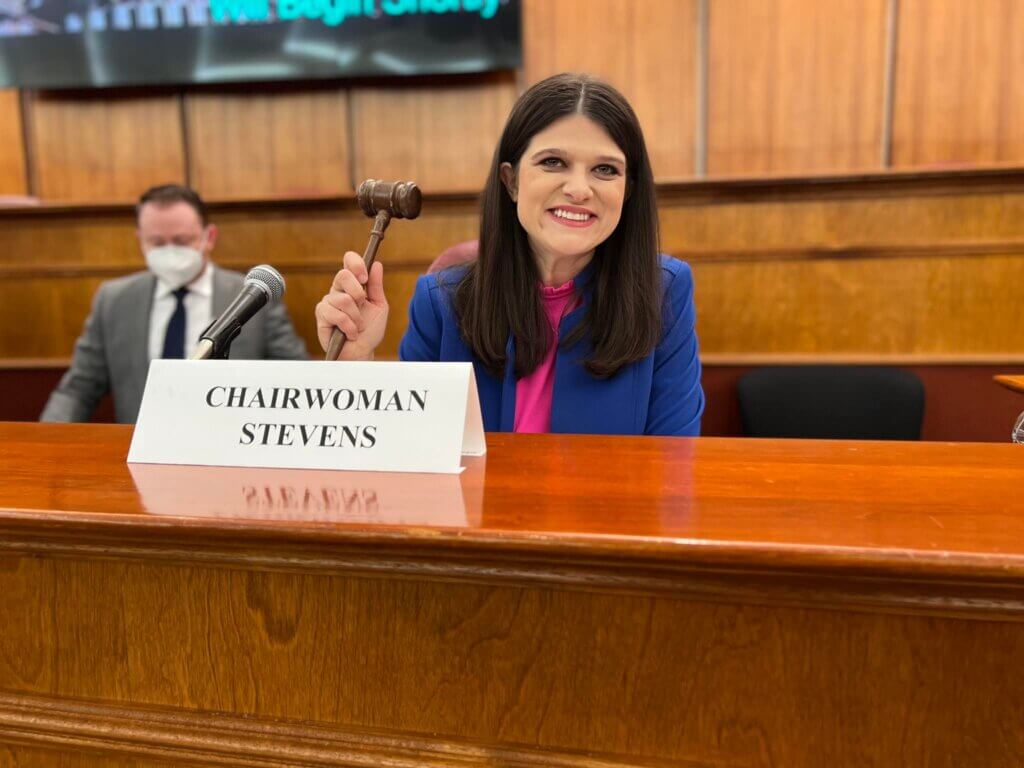
After pro-Israel Rep. Haley Stevens beat fellow House member Andy Levin in Michigan’s 11th district last night, with almost $5 million worth of help from AIPAC’s superpac, the Israel lobby group declared that Stevens’s win “reflects mainstream Democratic views and demonstrates that being pro-Israel is both good policy and good politics!”
But is it really good politics? In fact, it’s not. Let’s look at some recent polling.
The BDS campaign that targets Israel with boycott over human rights abuses is steadily gaining ground inside the Democratic Party. A survey of Democratic voters done a month ago by Brookings/the University of Maryland‘s Critical Issues Poll shows that among Dems who know what the boycott, divestment and sanctions campaign is, they are overwhelmingly for it. By 33 to 10.
Pollster Shibley Telhami also released numbers from a May survey (that he mentioned ahead of Biden’s visit to Israel and Palestine) showing that a large plurality of Democratic voters say that the White House and Congress do not represent them in their sympathies toward Israel.
Asked how they perceive “the position of the Biden administration on the Israeli-Palestinian issue, compared to their own,” about half of Dems said they didn’t know. But of those who did have an opinion, the proportion was staggering.
26% of Democrats said the Biden team was leaning more toward Israel [than they do], and 3% said it was leaning more toward Palestine.

And it’s even worse with Congress– 33-3.
Among Democrats who had an opinion, 33% said their representatives were leaning toward Israel more than they were, while 3% said their representatives were leaning more toward the Palestinians.
33 to 3, that’s a romp. We have continually charted this trend: Democrats are growing aware of Israel’s human rights abuses, and they don’t like them, they don’t want to pay for them, they don’t want their Congresspeople supporting those atrocities. Pollster Peter Feld tracked the trend among younger Democrats in Michigan recently: “[S]ix in ten (60%) voters under 45 want aid to Israel reduced or ended, compared to 33% who want it the same or increased, suggesting that, in time, support for Israeli military funding will fall further.”

Democrats across the nation are surely observing these changes at town halls. And it demonstrates why the Israel lobby is pouring $30 million into Democratic primary races, because Congress is the political entry point. That’s where people who care about Palestinian human rights are getting into the American political bloodstream, at last.
Interpreting the data in the wake of AIPAC’s big win
Shibley Telhami interprets his polling:
‘This explains why AIPAC is spending millions in the current primary cycle to defeat candidates deemed not sufficiently pro-Israel, and to elect others who are’
It also explains why AIPAC doesn’t mention Israel in its ads and decided to call its Super PAC the United Democracy Project (UDP), a name with no direct reference to its actual motivations. Despite all this, AIPAC obviously has a vested interest in pretending that Israel remains a slam dunk issue among Democrats.
The support for BDS, and Feld’s findings, line up with multiple polls on the issue of Israel/Palestine. A Pew survey from earlier this year found that most Democrats favor the Palestinians over the Israelis. A 2021 Gallup poll found that, for the first time ever, Democrats want the United States to apply pressure on Israel instead of Palestine. A 2019 Data for Progress poll found that 65% of Democratic voters support conditioning aid to Israel. A Center for American Progress poll from the same year had the number even higher, 71%. At this point, the evidence is overwhelming and the trend is clear.
While AIPAC’s line is that Stevens represents the mainstream Democratic voter, the numbers tell us that the mainstream Democratic voter is actually to the left of Levin at this point.
So while AIPAC’s line is that Stevens represents the mainstream Democratic voter, the numbers tell us that the mainstream Democratic voter is actually to the left of Levin at this point. Levin voted for an extra $1 billion in Iron Dome funding, opposes BDS, and did not cosponsor Rep. Betty McCollum’s historic bill promoting the human rights of Palestinian children. He has also resisted efforts to condition U.S. military aid to the Israel. In fact, just last year Levin signed an AIPAC-backed letter opposing such moves. “We recognize that not every Member of Congress will agree with every policy decision of every Israeli government,” it read. “Reducing funding or adding conditions on security assistance would be detrimental to Israel’s ability to defend itself against all threats.”
Levin became a target of AIPAC because he introduced a bill that calls for settlement expansion to be stopped and the occupation to be ended. This was a mainstream Republican position 20 years ago, but now it’s a bridge too far for a group like AIPAC. Levin is also Jewish progressive (and former synagogue president) who openly cites his faith while speaking up for Palestinian human rights. This kind of stuff also poses a potential existential crisis for AIPAC, as an increasing number of Jews (especially young ones) view Israel as an apartheid state. In addition to all this, Levin has repeatedly defended Rep. Ilhan Omar and Rashida Tlaib (two popular House members AIPAC knows it can’t beat) against antisemitism smears. Many of these smears come from groups like AIPAC and the culture they’ve helped to create.
Israel might be losing support among Democratic voters, but its reputation among Democratic lawmakers remains ironclad for the most part. A victory for someone like Levin means that disconnect becomes slightly more narrow. Like Telhami says, AIPAC’s spending millions to avoid the specter of his polling.


AIPAC sells Apartheid with a toothpaste ad.
Zionism in action:
https://toronto.citynews.ca/2022/05/29/visit-by-far-right-israeli-lawmaker-sparks-jerusalem-unrest/
“On 28 July 2022 we visited the ruins of the village of Maaloul in the Galilee.”
“The village of Maaloul was occupied by the Israeli army on 15 July 1948, two months after the violent creation of apartheid Israel. The houses of Maaloul were destroyed & its people were deported to Lebanon & to the neighboring city of Nazareth which is located 6 kilometers away.
“Since then, these internally displaced inhabitants of Maaloul, who are citizens of Israel, have been denied the right to return to their village & lands.
“In 1949 an Israeli military base was built on the site of the village. Later, the village’s agricultural land, which covers 5 square kilometres, was transferred to the Jewish National Fund that planted pine trees on them.
“The Muslim cemetery of Maaloul was totally destroyed except for one grave. The Christian cemetery is not accessible to Palestinian citizens since it is located inside the fenced Israeli military base.
“A mosque & two churches – a large Catholic Church & a smaller Orthodox Church – still stand, & were used intermittently as cow sheds by the residents of a nearby Jewish colony.
“The mosque property was expropriated by Israel after July 1948 since it was owned by the Muslim Religious Trust (Waqf) based in East Jerusalem, a city that fell under Jordanian control in May 1948. Palestinian citizens of Israel are thus not allowed to maintain the mosque & it has fallen into disrepair.
“The property of the Catholic & Orthodox churches falls under the control of the respective local Patriarchate & so Palestinian citizens of Israel have been able to maintain them & use them sometimes.
“The fate of Maaloul has been repeated in the 504 Palestinian villages that were occupied & destroyed by apartheid Israel after May 1948. As a result, currently one in four Palestinian citizens of Israel (around 400,000) are internally displaced who since 1948 have been denied the right to return to their villages & regain their lands.”
There are three relevant groupings: the general public, which for the most part does not think about foreign policy. the elected officials which for the most part go along with traditional support for israel. and third: the politically aware, which among democrats is predominantly against israel. so it is not getting the elected officials to reflect the wide public. the wide public doesn’t care. it is an attempt to get the elected officials to reflect the part of the base that is aware. being pro israel is mostly irrelevant to the election of congresspeople, only insofar as the funding that their position attracts.
Winning is good politics. It is that simple. Your mistake is looking at the polls on this one issue rather than looking at the priority of this issue for the voters. It’s true that the members of the Democratic party are turning more pro-Palestinian. At the same time the issue is so far down the list of priorities that it is unlikely to determine actual voting. At this point a politician has to consider his position. If he decides to take a decidedly anti-Israel position he will be facing an organized opposition with quite a few resources. He would get attacked on all sides for issues unrelated to Israel (and in some cases also related to Israel amongst the voters for whom Israel is one of the primary issues). His opponent would probably start raising more money and get additional political support. Suddenly the politician is on the defense while his opponent is getting stronger. So, just by taking this one position the politician has significantly hurt his chances of winning. Does that sounds like ‘good politics’?
Now imagine that despite the odds this politician manages to win a primary in his own party. At that point he needs to win the general election. Here he will once again face an organized opposition and the Israel issue is more likely to hurt him amongst the independent voters. But of course he will also get attacked on all other issues. Now it is true that this isn’t an issue in deep-blue districts, which is precisely where most of the pro-Palestinian members of the House are getting elected. But for everyone else who faces a competitive general election, does this really sound like ‘good politics’?
Now imagine that this politicians ends up winning a seat in the House. At some point in his career he will want to proceed to state-wide office. Here the process of primaries and general elections repeats itself in exactly the same way. All because the politician took a stand on an issue once that most voters don’t care about he is facing a much steeper hill in his entire political life. Does this really sound like ‘good politics’?
No, as long as this is a low priority issue for voters, taking an anti-Israel position is just dumb politics.