
Key Developments (Jan 10 – Jan 16)

- Nine Palestinians killed by Israeli army and settlers. Four of them were killed in a single day on January 12, followed by 3 on January 14, and 2 on January 15 – 16.
- The Israeli government announced that it will enforce a series of punitive measures against the Palestinian Authority (PA) in retaliation for its push for the International Court of Justice (ICJ) to issue an opinion on Israel’s decades-long occupation.
- Palestinian armed resistance groups continue to challenge and confront Israeli invasions to Palestinian towns and refugee camps, namely in the Nablus and the Jenin district.
- Israel demolishes more than 63 Palestinian structures and displaces 85 Palestinians in less than two weeks since the start of the year.
- The Palestinian Authority persists in the targeting of political activists and youth.
- Palestinian political detainees escalate disobedience in Israeli prisons amid the rise of abuses by prison guards and the denial of basic rights of detainees.
In Depth
As the second week of 2023 drew to a close, a total of 14 Palestinians were martyred since the start of the new year. From the north of the West Bank to the south, the Israeli onslaught against the resistance quickened. Between Wednesday and Thursday, 4 Palestinians were slaughtered in short order. On Saturday, 3 more followed, and then two others on Sunday and Monday, bringing that week’s total to 9 martyrs.
This makes last week one of the bloodiest since the killing of 11 Palestinians during the week of Nov 28 – Oct 5 last year. It is a clear indication that the Israeli military campaign in the West Bank will continue to unfold with greater intensity over the coming months.
At a certain level, this should not be surprising. The state of resistance in Jenin refugee camp remains as staunch as ever. The camp has become a “liberated area” of sorts, one where the Israeli army avoids venturing deep into it, while various other armed groups grow in the broader area around Jenin. Those resistance fighters from the camp who have been assassinated in recent months were killed on the camp’s outskirts or when venturing outside of it. But so long as Jenin remains a bulwark of armed resistance unbeholden to the PA, Israel will continue its attempts to eliminate it.
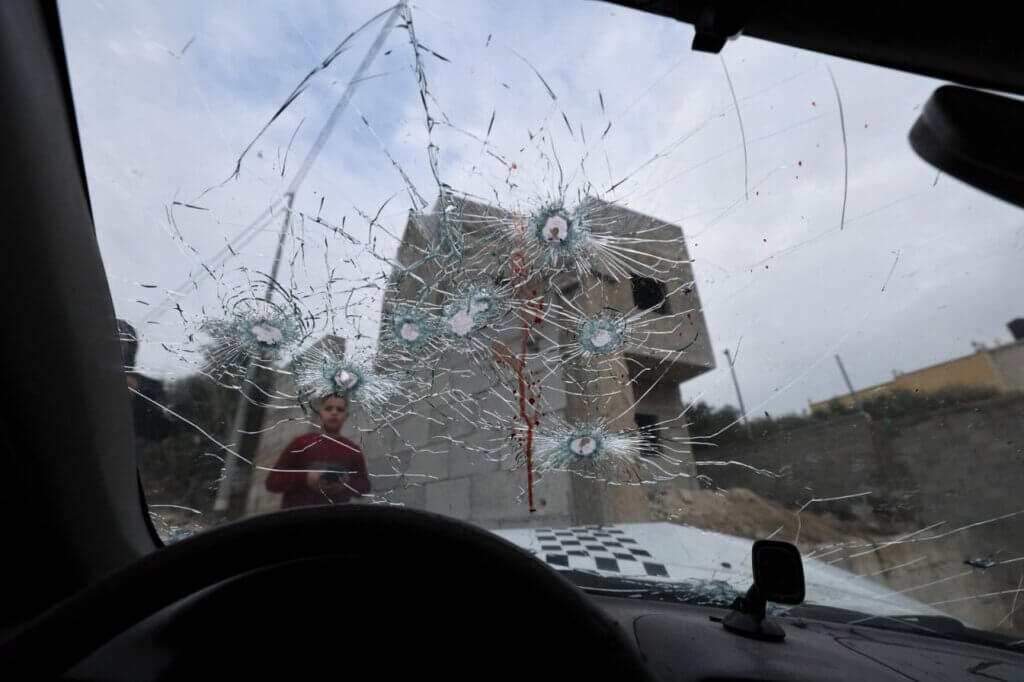
The Al-Quds Brigades of the Palestinian Islamic Jihad (PIJ) remain the most active, sprouting various “brigades” across the Jenin area, including the “Jaba’ Brigade,” two of whose members carried out a resistance operation on Saturday and were gunned down in their car by the Israeli army as they were retreating. The bullet-riddled car of the two slain fighters, Izz Eldin Hamamra and Amjad Khaliliyeh, was reminiscent of the Nablus assassination in February of last year, which took the lives of Ashraf Mubaslat, Adham Mabrouka, and Mohammed Dakhil, members of the “Nablus Brigade” that would later morph into the Lions’ Den.
Earlier in the week, four Palestinians were slain in a single day across the West Bank on January 12. In the northern West Bank, 2 Palestinians were killed in Qabatya in the Jenin district, and 1 in Balata refugee camp outside of Nablus. In Qalandia refugee camp outside Ramallah, a 41-year-old father was shot in the chest as he stood on the roof of his house while his son was arrested.
The other martyrs were from different areas of the West Bank — 19-year-old Yazan al-Ja’abari, who succumbed to injuries he sustained previously in an Israeli military raid of Kufr Dan in Jenin; 41-year-old Ahmad Kahla from Ramoun, Ramallah, who was killed by Israeli gunfire on January 15; and 14-year-old Omar Khmour from Dheisheh refugee camp in Bethlehem on January 16, who succumbed to a bullet wound to the head earlier in the day during an Israeli army raid.
But while the assault is generalized across the entire West Bank, the bulk of the military focus is on the Jenin area, the same region that has historically proven one of the most fierce in its resistance to colonial encroachment. One of the problems with the confrontation dynamics in Jenin, however, are that the refugee camp has no natural points of direct friction with the Israeli army, meaning that the camp has become more of a defensive haven that can only attempt to repel aggressors. This is perhaps one of the reasons why armed groups have extended to the areas surrounding Jenin, where other points of confrontation can be found, or created.
The danger in this ever-unfolding Israeli campaign is that Jenin’s refugee camp is now in a tenuous position as the resistance organizations remain holed up within it. In the coming months, the Israeli assault may escalate to the point of besieging Jenin , much like it did with Nablus last year. At the very least, it may lay siege to the camp in the hopes of “breaking the wave” once and for all.
Any escalation of this sort, however, is also bound to give way to increased resistance, and even the launching of more “lone wolf” attacks against Israeli targets, as was the case with Udai al-Tamimi’s operation at Shu’fat military checkpoint at the height of the siege of Nablus.
It is a delicate balance and one that Israel has failed to maintain throughout the past year.
Important figures
- 14 Palestinians killed in 2023, including three children.
- 173 Palestinians killed in West Bank and East Jerusalem alone in 2022

