Key Developments (February 14 – 20)

- 17-year-old Mahmoud Ayed was shot and killed in the Far’aa Refugee Camp in Tubas.
- 25-year old Harun Abu Aram succumbed to wounds he sustained in 2021 when he was shot by Israeli forces in Masafer Yatta
- Israeli forces impose collective punishment on Palestinians in East Jerusalem, including mass arrests, checkpoint closures, harassment, and increased home demolitions
- Palestinians in East Jerusalem engage in a mass civil disobedience campaign, announcing a general strike in several neighborhoods, and increased confrontations with Israeli forces.
- Israeli forces prepare for punitive demolition of the home of two Palestinians in Nablus, accused of shooting and killing an Israeli soldier near the Shave Shomron settlement in October 2022.
- Palestinian prisoners engage in mass disobedience campaigns in response to growing repression inside Israeli prisons.
- Israeli settlers launch a series of attacks across the West Bank, including in Hebron, the Jordan Valley, Bethlehem, and other districts.
- At least 85 Palestinians detained during Israeli army raids in the West Bank and East Jerusalem.
In-Depth
Itamar Ben-Gvir does not disappoint. While he has fallen short of his promise on February 10 of launching an “Operation Defensive Shield 2” — itself ridiculed by opposition figures as an empty rhetorical flourish — last week he declared war on East Jerusalem following a string of attacks against Israeli settlers that were carried out by Palestinian Jerusalemites. For all of Israel’s repressive measures as part of “Operation Break the Wave,” Israel’s counterinsurgency strategy in the West Bank has failed to do what the operation set out to achieve, and now Jerusalem has emerged as Israel’s second front — an entirely different beast when it comes to security.
For one thing, Jerusalem has no organized “resistance infrastructure” that is similar to Jenin and Nablus — no formal or centralized organizations that can be effectively monitored, mapped out, and connected to a wider network.
Instead, most attacks coming out of Jerusalem have been conducted by “lone wolves” (starting with the “Knife Intifada” of 2015 in Jerusalem and the West Bank, and continuing with the subsequent popular uprisings in the years that followed). Often they are spontaneous, with little prior planning and relying on little to no networks. In other words, these “lone wolf” attacks are impossible to predict and prevent, representing a security nightmare for the Israeli establishment.
What this has meant is that following an attack, all of the immediate family members and close social circles of the Palestinian accused of the attack are arrested, partly as a punitive form of collective punishment, and partly as a haphazard and belated attempt to gather intelligence after the fact — arresting everyone from the attacker’s social environment to try and map out their lives and networks and build a “profile” of future potential attackers.
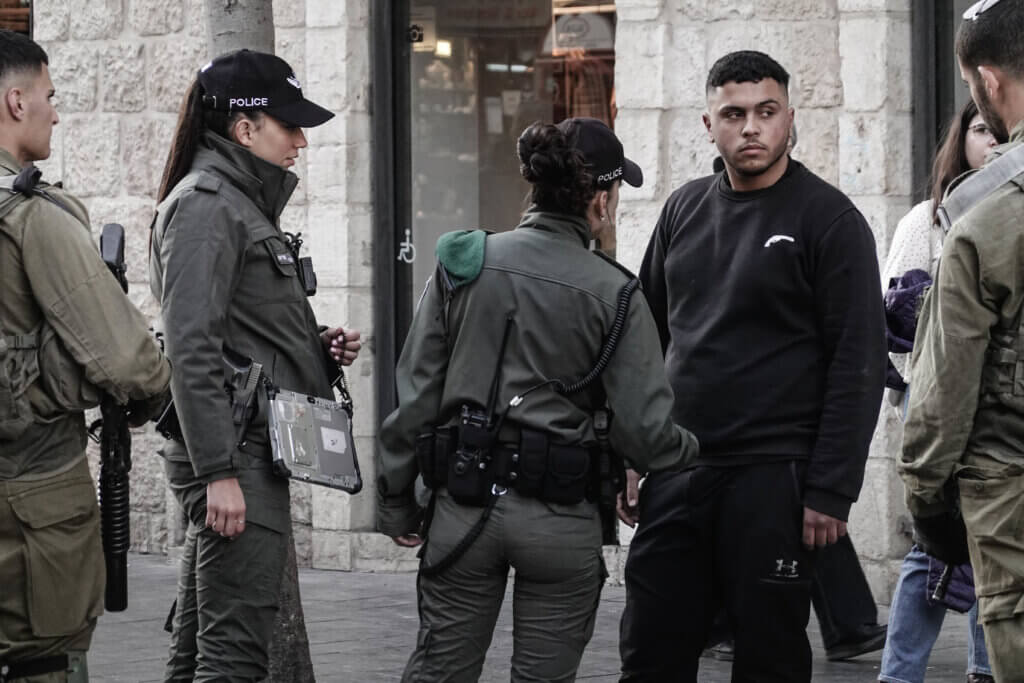
This policy has proven futile. Virtually all the youth in Jerusalem fit under this “profile” of a disaffected generation that sees the enemy for what it is — a colonizer. The result is that Jerusalem has become a highly policed and militarized city, one that is in a constant state of war with its people, who in turn are in a constant state of war with their colonizers. In comes Ben Gvir, who has ramped up an already aggressive Police policy, turning it into an all-out assault on the Palestinian presence in Jerusalem.
This has included expediting home demolitions, conducting mass arrests, setting up checkpoints and roadblocks, and frequently raiding the Issawiya and Silwan neighborhoods.
The people of Jerusalem are not taking this lying down. On Sunday, February 19, Palestinians in the city announced a state of collective civil disobedience.
The Israeli establishment has expressed worry at the rise in tensions. The director of the Shin Bet, Ronen Bar, made a rare direct appeal to Ben-Gvir, urging him to curb his crackdown, which he feared would cause a “broad flare-up.” Bar’s entreaties were echoed by the military chief of staff and the commissioner of the Israeli Police. Ben-Gvir’s response was irreverent, stating that these establishment figures have become “prisoners” to the prevailing security paradigm, and that the past actions of Bar have not ensured security in Jerusalem.
In recent years, rising tensions in the city have directly followed Israeli provocations relating to the Al-Aqsa Mosque and settler invasions of its compound. While Ben-Gvir has certainly contributed his fair share to these provocations, now, as Minister of National Security, he has chosen to step up the forever war on Jerusalem and its people.
Important figures
- 49 Palestinians killed in 2023
- 11 children have been killed in 2023.
- The highest concentration of Palestinians killed this year are from the Jenin governorate, which continues to face daily incursions.
- 173 Palestinians were killed in the West Bank and East Jerusalem in 2022, as part of Operation Break the Wave, while 49 were killed in Gaza.