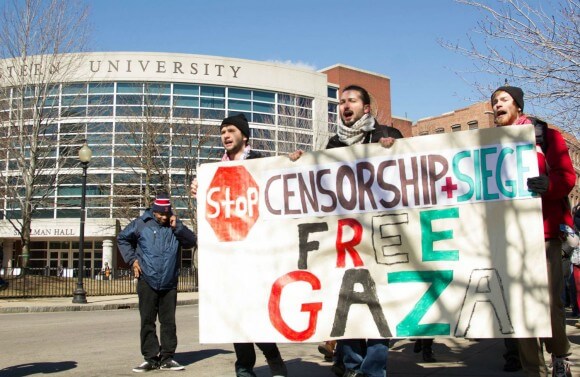
These days you can hardly walk without tripping over a debate about the state of free speech in America. Hundreds of thousands of words get typed on this topic, often with a specific focus on campus free speech, but the topic of Palestine is rarely considered.
In last week’s newsletter, I wrote about a recent situation involving the Palestinian human rights lawyer and International Solidarity Movement co-founder Huwaida Arraf. She spoke at a diversity event at Bloomfield Hills High School in Michigan and made the mistake of mentioning the perils of living under occupation and a blockade. This unspeakable indiscretion prompted the school’s principal to issue an apology to all students, staff, and faculty.
This wasn’t nearly good enough. “On Tuesday night, Principal Lawrence Stroughter apologized to parents, students, staff and the community for Arraf’s off-script rant targeting Jewish people and Israel,” read a story about the situation on Fox News’ website. “However, in the lengthy apology, Stroughter never mentioned Jewish people or Israel.”
This horror had to be rectified so the school’s superintendent issued his own apology, this one citing Israel an appropriate number of times.
“The presenter spoke about a very tumultuous and complex situation, the conflict in the Middle East involving Palestinians and Israelis,” explained Superintendent Pat Watson. “A situation of this complexity, with various sides, perspectives, hundreds of years of suffering, war and tragedy is not one well-suited to be presented at a diversity assembly and should have been eliminated as a potential topic for discussion.”
“As the adults responsible for the safety, success, and well-being of our entire student body, we have failed in demonstrating how to highlight diversity in a positive way and how to address sensitive topics appropriately.”
Watson also referred to Arraf’s presentation as “antisemitic.”
Here’s the punchline: the school asked Arraf to address “an oppression or discrimination they have faced and what the people around you could have done to make this better?”
At Bard College Professor Nathan Thrall was under attack from pro-Israel organizations (like the Ulster Jewish Federation) and right-wing websites because he is teaching a class called “Apartheid in Israel-Palestine.” They tried to get the school to terminate the class but failed.
The Executive Board of Academia for Equality wrote to Bard College President Leon Botstein and commended him for not caving to the pressure. “This is yet another attempt to conflate criticism of Israel with antisemitism,” tweeted the group. “These groups weaponize false allegations of antisemitism, seeking to silence dissent, curtail critical engagement with Israeli policies and prevent solidarity with Palestinians on US campuses.”
Finally, we turn to the case of Kareem Tannous, who was an assistant business professor at Cabrini University in Pennsylvania. Tannous says he was fired by the school last year, not because of something that happened there but because of tweets he made on his personal account. Tannous called Zionism a disease and for Israel to be dismantled. He also compared the policies of the Israeli government to those of the Nazis. Once the tweets were unearthed, leaders of the Jewish Federation of Greater Philadelphia sent the school a letter requesting action. He’s preparing to file a wrongful termination lawsuit against Cabrini.
There’s a short Philadelphia Inquirer piece on the Tannous situation by Susan Snyder and it deserves credit for acknowledging that this is not an isolated incident. She mentions Ken Roth losing his fellowship at the Harvard Kennedy School, the Marc Lamont Hill situation from 2018, and Steven Salaita’s saga.
Human Rights Report
The State Department released its annual human rights report this week. It does not cite Shireen Abu Akleh’s death as an extrajudicial or arbitrary killing. It also does not mention the death of Omar Asaad, an 80-year-old Palestinian-American who died in Israeli custody. However, it does acknowledge that “The Israeli military and civilian justice systems have rarely found members of the security forces to have committed abuses.”
Acting Assistant Secretary for Democracy, Human Rights, and Labor Erin Barclay made some remarks about the report at a State Department briefing on March 20. There were some follow-up questions about Palestine.
Al Quds‘ Said Arikat asked if punitive home demolitions were a war crime. Spoiler alert: the United States government can’t say one way or another. Here’s the exchange:
Arikat: On the West Bank, the occupied West Bank, a very quick question. Does this administration consider a – the demolition of a Palestinian perpetrator’s home or the arrest of his siblings or his parents to be collective punishment? And if so, does that fall under the – does that qualify as a war crime?
Barclay: Thanks very much for your question. The U.S. is committed to advancing human rights is Israel and in the West Bank and the Gaza Strip. As the President and Secretary Blinken have said, Israelis and Palestinians deserve equal measures of freedom, security, opportunity, justice, and integrity.
Promoting human rights and fundamental freedoms is critical to their own right, and it also helps to preserve space for a two-state negotiated solution.
Arikat: Does the demolition of homes and arresting of relatives and parents and siblings and so on qualify as collective punishment, in your view?
Barclay: I’m not going to comment on that at this point, but I’m happy to talk to you —
Collective punishment is forbidden under international humanitarian law through Article 33 of the Fourth Geneva Convention.
Odds & Ends
???? Last week Israeli Finance Minister Bezalel Smotrich told a crowd in Paris that there is “no such thing as Palestinian people.” The idea of the Palestinians as an “invented people” is a common refrain from Zionists. In 1969 the late Israeli Prime Minister Golda Meir told reporters that, “There were no such thing as Palestinians. When was there an independent Palestinian people with a Palestinian state? … It was not as though there was a Palestinian people in Palestine considering itself as a Palestinian people and we came and threw them out and took their country away from them. They did not exist.”
In February, Representatives Debbie Wasserman Schultz (D-FL) and Andrew Garbarino (R-NY) introduced a bill directing the Secretary of the Treasury to mint coins as a tribute to Meir. “Golda Meir’s story is a testament to the progress of the Jewish people, and that of Jewish women in particular,” said Wasserman Schultz in a statement. “As a founder of the State of Israel, she modeled leadership for future generations and was fundamental in strengthening the United States-Israel partnership. I’m proud to sponsor this legislation to cement her place in history.”
The effort has already gained six additional cosponsors, including Rep. Katie Porter (D-CA).
???????? At Axios Barak Ravid reports “U.S.-Israeli relations are in full crisis mode.” The U.S. summoned Israeli Ambassador to Washington Mike Herzog to meet with Deputy Secretary of State Wendy Sherman after Israel recently repealed a 2005 law that dismantled four illegal settlements in the West Bank.
“Sherman and Herzog’s meeting was very tough, with Sherman saying the new law is a violation of the commitment the Israeli government made to the U.S., Egypt and Jordan just last Sunday during the summit in Sharm el-Sheikh, a source with knowledge of the meeting said,” wrote Ravid. “That commitment included avoiding steps that could escalate the situation in the West Bank.”
???? AIPAC announced its first round of political endorsements for 2024.
???? Amjad Iraqi in +972:
“In the topsy-turvy Israel of today, boycotts, divestments, and sanctions — though not explicitly named as such — have become central strategies of the Israeli protest movement. Large swathes of society are not just distancing themselves from the government’s agenda, but are actively pursuing nationwide disruption and international intervention to stop it. The economy, security, and day-to-day life are all necessary sacrifices in the name of saving ‘democracy.’ At this scale, the movement has gone beyond merely ending public complicity; it is, in effect, a civil revolt.”
“Ironically, these methods of civil resistance are being encouraged by figures who spent years undermining those who used them. Yair Lapid, the Knesset opposition leader and former prime minister, is continuing to call for mass demonstrations and strikes, and has urged municipalities not to cooperate with certain government ministry units, later describing such political expression as part of Israelis’ ‘deep democratic instinct.’ This is the same Lapid who accused Israeli anti-occupation groups of ‘subversion’ for exposing military abuses; oversaw the outlawing of Palestinian human rights NGOs as ‘terrorists’; and demanded American anti-BDS laws be used to punish the ice cream company Ben & Jerry’s for not selling products in illegal West Bank settlements, blasting the divestment as a “shameful surrender to antisemitism.”
☎️ AJP Action launched an Israeli Discrimination hotline for Palestinian Americans navigating challenges faced at the Israeli borders or within the occupied territories. You can watch a video explainer on the effort here.
???? For the first time ever, Democratic voters sympathize more with Palestinians than Israelis. That’s according to Gallup’s annual poll on U.S. attitudes toward the Middle East.
56% of Democrats view Israel favorably, but that’s down from 63% in 2022. 49% of Democrats said their sympathies lie with Palestinians, while 38% said they sympathize with Israelis.
Rep. Rashida Tlaib (D-MI) on Twitter: “Fellow Americans are recognizing now more than ever that Palestinians face violence and racism from the Israeli government. New polling reflects the shift we’ve seen in our communities, with Democrats increasingly supporting Palestinian human rights.”
Rep. Betty McCollum (D-MN): “More than ever before, Americans do not want the U.S. to be complicit in Israel’s mistreatment of Palestinian children & families. Not $1 of U.S. aid should be used to imprison Palestinian children in military detention facilities, or used to tear down their homes.”
???? Sen. Chris Van Hollen (D-MD) to Blinken after State Department criticism of Netanyahu government on settlements. “It seems to me that we look very weak when we continually make statements without any kind of consequence.”
The Senator is getting dangerously close to a big realization here.
???????? It’s the 20th anniversary of the U.S. war on Iraq.
Elise Swain at The Intercept on the Iraqis who were tortured by the U.S. at Abu Ghraib and never got justice.
Jeremy Earp on the media’s complicity.
Responsible Statecraft asked a wide range of historians, journalists and authors — who was the most underrated culprit in the debacle? Some interesting responses…
Andrew Bacevich said Colin Powell:
“Only one person in the innermost circle of the Bush administration could have dissuaded President Bush from invading Iraq. That person was Secretary of State Colin Powell, a seasoned soldier-statesman who had an inkling of the risks that war was likely to involve. Quiet opposition by Powell did not suffice to sway the president, however. The clamor from other senior officials and from media warmongers was too great. But just imagine if two or three weeks before the invasion, Powell had resigned in protest. Imagine if he had then made a series of presentations arguing against the prospective war on political, strategic, and moral terms. Maybe, just maybe, he might have averted the debacle that ensued.”
John Mearsheimer said the Israel Lobby:
The Israel lobby played an important role in causing the Iraq war and this was widely recognized at the time. In recent accounts of that disaster, however, the lobby’s influence is hardly mentioned or greatly minimized. In fact, two months before the war, AIPAC’s executive director, Howard Kohr, said that “quietly lobbying Congress to approve the use of force in Iraq” was one of “AIPAC’s successes over the past year.” AIPAC was not alone in its efforts to sell the war, as a 2004 editorial in the Forward notes: “As President Bush attempted to sell the … war in Iraq, America’s most important Jewish organizations rallied as one to his defense. In statement after statement, community leaders stressed the need to rid the world of Saddam Hussein.”
Unsurprisingly, top Israeli officials — including Ehud Barak, Benjamin Netanyahu, Shimon Peres, and Ariel Sharon — lobbied hard to push the United States into war. Yet even then, few people talked publicly about the lobby’s influence. As the journalist Michael Kinsley put it, Israel “is the proverbial elephant in the room: Everybody sees it, no one mentions it.”
Sarah Leah Whitson said Joe Biden:
The American people have still failed to hold President Biden, then-Senator Biden, accountable for championing the resolution authorizing President Bush’s war in Iraq in 2003, which he quizzically justified as an effort to “strengthen diplomacy.” Not only did his push undermine broad public opposition to the war, it paved the way for decades of misused force authorization in Iraq, where U.S. troops still remain, and the country, decades later, is still in shambles.
Sadly, his unprincipled, wobbly approach to the Middle East has remained consistent, with broken promises to end U.S. support for Saudi’s war in Yemen. Today, the Biden administration continues to prioritize arms sales and Israel’s interests ahead of all other national interests, and risks ever deeper entanglement in the region’s conflicts with the prospect of unprecedented security guarantees for Saudi Arabia and the UAE in service of the Abraham Accords. We should have realized that Biden’s approach would be a repeat failure in the Middle East.
Phil Weiss writes about the war at the site.
There’s a new paper from Costs of War Project at Brown University about the impact of its overall impact. The numbers include Syria, as ISIS emerged as a result of the invasion, then took over parts of the country. The group’s website summarizes some of the results.
This paper examines the total costs of the war in Iraq and Syria, which are expected to exceed half a million human lives and $2.89 trillion. This budgetary figure includes costs to date, estimated at about $1.79 trillion, and the costs of veterans’ care through 2050. Since the United States invaded Iraq in 2003, between 550,000-580,000 people have been killed in Iraq and Syria — the current locations of the United States’ Operation Inherent Resolve — and several times as many may have died due to indirect causes such as preventable diseases. More than 7 million people from Iraq and Syria are currently refugees, and nearly 8 million people are internally displaced in the two countries.
This report also estimates that 98 to 122 million metric tons of carbon dioxide equivalents (MMTCO2e) were emitted from U.S. military operations between 2003 and 2021 in the war zone, calculated as 12 to 15 percent of the DOD’s total operational greenhouse gas emissions.
The U.S. war in Iraq began on March 19-20, 2003. Most allied and U.S. forces left Iraq in 2011, but the U.S. returned to significant military operations in Iraq and Syria in late 2014 in fighting that was undertaken to remove Islamic State from territory it had seized in those two countries. The war continues, with a nearly $400 million budget request from the Biden Administration this month to counter ISIS.
Of course, like Vietnam, we will never know the true level of death and destruction.
The New York Times has a story about how George W. Bush has never second-guessed himself on the issue.
Stay safe out there,
Michael