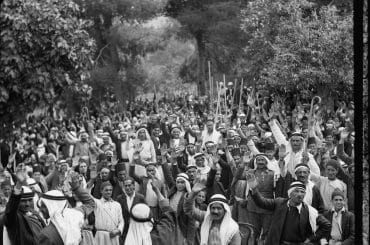
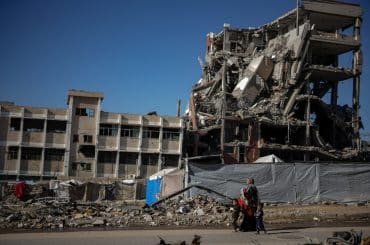
Narratives are compelling stories, a means by which humans form ourselves and our societies. They are stories we believe in–like those underlying the Palestinian-Israeli struggle.
Now an art institution in Woodbridge, CT, The Palestine Museum US, is challenging the Zionist Israeli narrative about the state’s formation by telling the diametrically different Palestinian story through the arts.
The prevailing Israeli narrative reads like this: historic Palestine was a land without a people for a people without a land, divinely promised to Jews who are exclusively entitled to all of it.
Even though historical facts support the Palestinian narrative, opposing Israel’s narrative has been extremely difficult, especially in the United States, whose government unequivocally supports Israel.
But the tide is turning. And the Palestine Museum US is contributing to that change.
It was founded in 2018 by Palestinian-American businessman Faisal Saleh, who also serves as its director. When asked why he founded the museum and what he hopes to accomplish with it, Saleh replied, “A great vacuum existed when it came to Palestinian artistic presence in the West in general and the United States in particular.” Continuing, he said, “About 70 museums in the U.S. support the Israeli narrative, and not a single Palestinian museum existed to present the Palestinian perspective, not just in the U.S. but in all of the Americas and much of the Western Hemisphere.” Saleh’s vision was to create a museum to preserve Palestinian history and culture and tell the Palestinian story to the global Western audience through the arts.
Thus, with 6,500 square feet of exhibition space, it is the largest Palestinian museum in the Americas.
In addition to its permanent exhibition-specific collections, the Palestinian story is told through international art exhibits, weekly films, and other virtual programming.
Venice Biennale Arte
In 2022, the Museum participated in one of the art world’s biggest events, the Venice Biennale Arte 2022, which had never had a Palestinian pavilion in its 125-year history (Palestine is not eligible to have an official pavilion — only countries recognized by Italy can have a pavilion at the Biennale.) The Museum’s Biennale Collateral Event exhibition is the closest Palestinians can get to a pavilion to showcase their national art. “From Palestine with Art” featured 19 Palestinian artists and 30 works of art, including an 1877 map of Palestine covering the gallery floor by Palestinian cartographer Salman Abu-Sitta, who explained:
“The significance of this map is that it shows Palestine before Zionism. There is not a single settlement on it;. . . . . It’s the Palestine that Palestinians belong to, from the river to the sea. This is a very strong statement that the Palestinians are not willing to give up their land.”
The impact of the exhibition was immense. Statistics show that over 100,000 visited the Palestine “pavilion” and wrote over 1,000 pages of guest book comments and best wishes for a free Palestine in over 30 languages.
Following the end of the seven-month Biennale Arte 2022, the Museum secured a three-week exhibit slot at the Accademia di Belle Arti di Roma, one of Italy’s most prestigious art establishments. The entire art collection exhibited in Venice was moved to Rome for a show curated by the director of the Accademia Cecilia Casorati.
Now, the upcoming event “From Palestine: Our Past, Our Future,” an art/architectural exhibition hosted by The European Cultural Centre’s Venice Biennial Architectural Exhibition (Time Space Existence), will be held from May 20 to November 26 in Gallery A of the historic Palazzo Mora in Venice, Italy. This exhibition commemorates the 75th anniversary of the Palestinian Nakba, when over 400 villages and towns were depopulated and most destroyed initially by Zionist forces and later by the Israeli army. Saleh elaborated:
“Using maps, architectural rendering, virtual reality, photographs, textiles and artwork, this project exhibits and exposes information about lost Palestinian towns and villages and reimagines a future where descendants of the original population return to redesigned architecture, and urban planned communities, giving hope in the face of indefinite intractable odds.”
Events and screenings
The Palestine Museum US also features live events, including those portraying the questioning by Jewish Americans about Israel and its treatment of Palestinians. A most recent example was the Museum’s presentation of Sandra Laub’s play “Picking Up Stones: An American Jew’s Moral Dilemma,” a one-woman play performed by Sandra Laub.
Film is another way the Museum brings the Palestinian story to a global audience.
Every weekend since March, 2020, the Palestine Museum US has shown feature and documentary films telling the Palestinian narrative, including some with actual footage of Palestine towns and cities before the Nakba as well as those showing Israelis who participated in Palestine’s destruction.
A feature film like Mai Masri’s “3000 Nights” portrays a pregnant Palestinian teacher who births and raises a son in an Israeli prison; and documentaries of the Nakba like Sahira Dirbas’ “Deir Yassin Village and Massacre” and the Norwegian animated film “The Tower” which depicts the history of a girl living in a Lebanese refugee camp–all presenting different aspects of Palestinian suffering, historical and ongoing.
There have also been a number of Israeli films that aid in telling the Palestinian narrative.
Films like “The Law in These Parts” about the architects of the military legal system in the occupied Palestinian territory, and “Tantura” which tells the story of that Palestinian village’s depopulation by Israeli soldiers—including some of its participants—and, importantly looks at the question of why ‘Nakba’ is a taboo word in Israeli society.
“Blue Box” chronicles how the director’s great-grandfather, Yosef Weitz–head of the Jewish National Fund—acquired hundreds of thousands of acres of Palestinian land before and after Israel’s creation. The eponymous “blue boxes” were fundraising receptacles for diaspora Jews to help “forest over” destroyed Palestinian villages. Drawn from Weitz’ diary, the film confirms that as late as 1933, it was Palestinians who were “turning rocky hills into vineyards” and making the desert bloom–not Jewish immigrants as the Zionist narrative claims.
The film series has been shown to audiences in over 40 countries (with rebroadcast for audiences in Australian time zones) via Zoom followed by lively discussions with the films’ directors, thereby exposing large international audiences to the Palestinian narrative–often for the first time. Blue Box had 300 viewers; Tantura had over 500.
Faisal Saleh says, “Some of our followers have told us that after viewing more than 150 films they feel like having received the equivalent of a degree in Palestinian studies.”
The power of art is not that it tells people what to do yet, as artist Olafur Eliasson reminds us: “Engaging with a good work of art can connect you to your senses, body, and mind. It can make the world felt. And this felt feeling may spur thinking, engagement, and even action.”
Most Americans have known only the Zionist telling of the Palestinian-Israeli conflict until now. The Palestine Museum US is here, inviting truth-loving people to tune in.