Key Developments (September 15-18)

Palestinian prisoner and hunger striker Khalil Awawdeh was released from Israeli prison last week, after nearly two years in administrative detention, during which time he underwent a 172-day long hunger strike. Awawdeh was released on Friday, September 15 and was immediately taken to a hospital in Ramallah to undergo medical treatment. According to a statement from Awadeh following his release, he is still suffering from the effects of his prolonged hunger strike in 2022, including muscle weakness, difficulty walking, hand tremors, and kidney issues. Awawdeh was arrested by Israeli forces from his hometown of Idhna in the Hebron governorate of the West Bank in December 2021. He was immediately handed down a 6-month administrative detention order, which is used by Israel’s military courts to imprison Palestinians indefinitely without charge or trial. After undergoing a hunger strike that lasted for more than 170 days in protest of his wrongful detention, the Israel Prison Service (IPS) agreed to release him in October 2022. However, during a prison transfer Israeli authorities allegedly found a contraband mobile phone on Awawdeh’s person, leading the courts to charge him with an additional 16 months in prison. In total, Awawdeh has spent approximately 15 years in and out of Israeli prisons. According to prisoner’s rights groups, there are currently 1,200 Palestinian prisoners being held under administrative detention, a policy that has been described as cruel and inhuman. At the moment, there are at least two Palestinian administrative detainees who are undergoing a hunger strike in protest of their detention and have so far reached 47 consecutive days on strike. Among the hunger strikers is Kayed Fasfous, a 34-year-old husband and father of one daughter, who, in 2021, underwent a 131-day hunger strike in protest of his administrative detention.
The Palestinian Authority arrested at least three Palestinian men affiliated with various armed resistance groups in the West Bank over the weekend, with one incident sparking armed confrontations in Jenin. On Friday, September 15, local reports said that PA forces re-arrested Munther al-Nabulsi, the cousin of slain resistance fighter Ibrahim al-Nabulsi, just two days after he was released from PA jails. Al-Nabulsi had reportedly been detained in PA custody since he was arrested in late July of this year. The next day, PA forces reportedly arrested a wounded resistance fighter from the Tulkarem refugee camp, which has been the site of increased PA and Israeli arrest raids following the growth of local resistance groups in the refugee camps in Tulkarem city. Following the arrest of the man, fighters in Tulkarem refugee camp released a statement condemning the arrest but saying they would refrain from taking action while activists in the camp negotiated with PA security forces on the release of the fighter. “Instead of pursuing honorable people, we call for directing our compass on the corrupt and the traitors,” the group said. On Sunday, September 17, Palestinian fighters reportedly opened fire toward PA headquarters in Jenin after a local resistance fighter, Ahmed al-Jadoun, was reportedly abducted from a cafe in the city by PA security forces. In recent months, the PA has jailed dozens of Palestinian fighters, along with political dissidents, activists, journalists, and university students. Over the past few weeks, the PA’s targeting of resistance fighters has been concentrated in the northern districts such as Jenin, Tulkarem, and Nablus, where resistance groups maintain a more established stronghold.
Despite the PA and Israel’s arrest campaigns, Palestinian resistance activity has continued to proliferate across the West Bank. Over the weekend, a number of smaller operations, like planting or throwing explosives toward Israeli military targets, were reported across the West Bank. Among several operations that took place were in the Hebron-area town of Beit Ummar, which notably has been the site of increased reports of resistance activity over the past two weeks following the establishment of the “Bani Naim Brigade,” which is named after and seemingly operates out of the nearby town of Bani Naim. On Monday morning, Palestinian gunmen reportedly carried out three separate shooting operations targeting Israeli military posts in the northern West Bank. Following reports that shots were fired toward a military checkpoint near the Nablus-area town of Deir Sharaf, Israeli forces closed at least three major checkpoints in the area, and began stopping and searching Palestinian vehicles in the area. In addition to operations being claimed by local militias and resistance groups, “lone wolf” operations are also ongoing. On Monday, an unidentified Palestinian man was shot and seriously injured by Israeli soldiers at the Mazmouria checkpoint south of Jerusalem after he allegedly pulled out a knife and attempted to stab soldiers stationed at the checkpoint. The injured man was arrested and reportedly taken to an Israeli hospital for treatment. No Israeli injuries were reported.
In-Depth
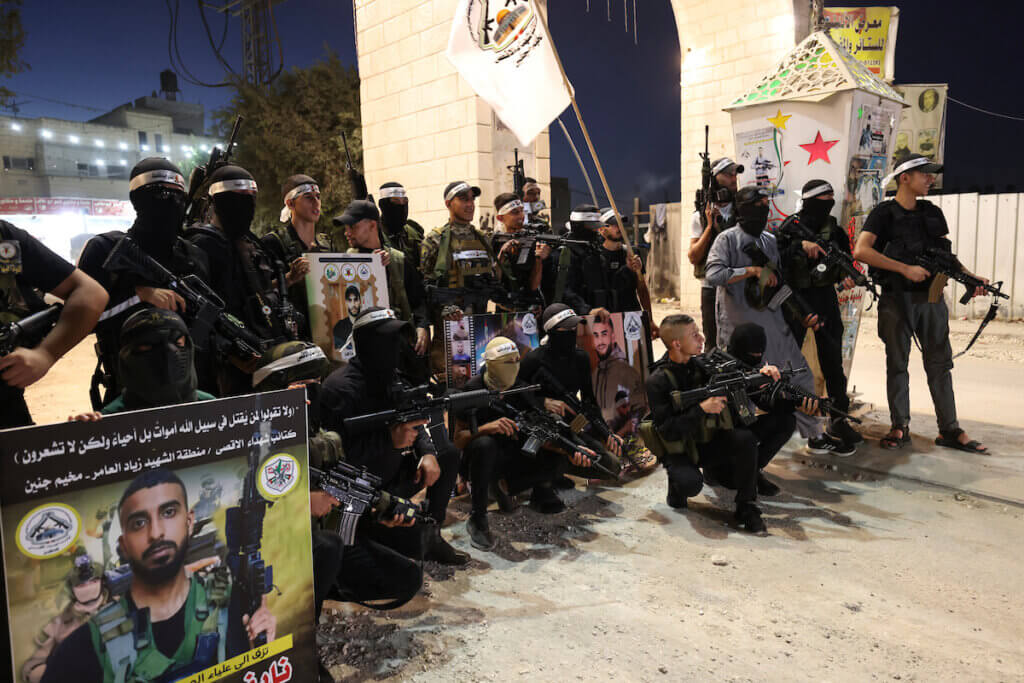
At 9 p.m. on Monday, September 18, the resistance factions in Jenin refugee camp held a press conference to address the recent PA wave of arrests and abductions of resistance fighters in Jenin, Tulkarem, and elsewhere in the northern West Bank. During the conference, masked members of the Jenin Brigade condemned the PA’s pursuit of resistance fighters in the aftermath of the battle of “The Fury of Jenin,” calling on “the honorable” in the PA Security Forces to take the path of Ra’ed al-Karmi (the slain Fatah commander killed by Israel in 2002) and Ziad al-Amer (the slain Aqsa Martyrs Brigade commander who led the defense of Jenin refugee camp during Operation Defensive Shield in 2002), while warning the commanders of the Security Forces that “if you think that the arrest of resistance fighters will hurt us, our response is to hit you where it hurts, which is the occupation, with which you coordinate.” The Jenin Brigade statement also added that the campaign of arrests “does not represent the honorable within the Fatah movement, nor those in the al-Aqsa Martyrs Brigade,” and that the Brigade does not “doubt the patriotism” of “the honorable” within the Security Forces, but that “we do not have any confidence in your leadership.”
The press conference then ended with a warning, as the only unmasked fighter emerged from the crowd of gunmen, sporting his rifle, and said:
“I don’t want to say much. I just wanted to send a message to the Security Forces. Abduction will be met with abduction, killing with killing, and blood for blood…if you want war, then you will have it, and it will be fierce.”
He then raised his rifle above his head and said, “If a member of my religion wants to kill me, then he is not of my religion; if a son of my people wants to kill me, he is not of my people.”
The conference is the latest event in a series of mounting tensions between the PA and the armed resistance in the West Bank. Ever since the Jenin operation in July, the PA has launched a concerted campaign of arrests of resistance fighters. The campaign saw the increased involvement of the PA and its Security Forces in the effort to quell the Palestinian armed resistance in the West Bank, which, up until that point, had been Israel’s domain since the start of 2022.
The period following the battle in Jenin, however, marked a new phase in the campaign to repress the resistance — and it would come from within. This also comes on the back of the decision of the current Israeli government to prevent the collapse of the PA, the objective of which was to facilitate the return of PA control to areas where resistance fighters have, up until now, enjoyed free rein, such as Jenin refugee camp, and to play an active role in arresting resistance fighters and keeping them from launching resistance operations against Israeli targets.
So far, the resurgent resistance movement in the West Bank has made a point of stressing that its rifles are pointed toward the occupier and not toward the PA, and even angry anti-PA protests in Jenin refugee camp have seen resistance fighters demand that PA Security Forces “get out of the way” to prevent intra-Palestinian bloodshed. But sooner or later, the uninterrupted campaign of PA repression was bound to be met with a response from the resistance. Even now, the recent ultimatum of the Jenin Brigade is couched in the language of addressing “the honorable” within the PA Security Forces. Yet, as the PA continues in its attempts to reestablish its control over areas like Jenin, the two worlds will inevitably collide, possibly paving the way for a more wide-ranging confrontation.
Important Figures
- Israel has killed at least 234 Palestinians since the start of the year.
- 5,100 Palestinian political prisoners are currently being held in Israeli jails, including 1,200 administrative detainees.