
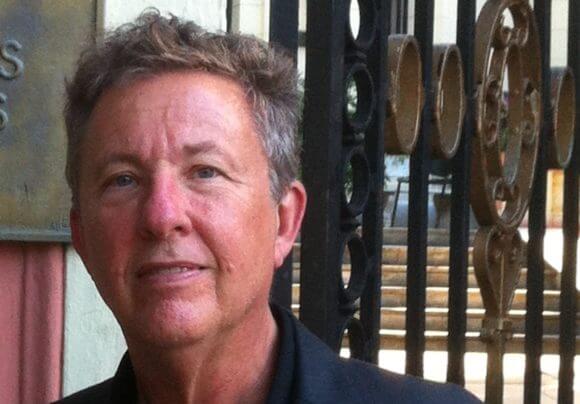
This week Jewish theologian Marc H. Ellis died at the age of 71 following an extended illness. Marc’s work strived to define a Jewish theology of liberation. His writing and speaking over several decades influenced a countless number of people all over the world, myself included.
We were very lucky to have Marc as a writer at Mondoweiss for several years where he wrote a column called Exile and the Prophetic. That name speaks to a great theme of Marc’s work: the battle between Empire and the prophetic within contemporary Jewish life.
For Marc, the prophetic, or the challenge to power, was the true meaning of Judaism. This is a topic he and I would debate. His belief in a Jewish particularity versus my admittedly secular belief in the universality of the call to justice (which in truth he would never deny). And yet, he would insist that it was this prophetic imperative that Jews are uniquely called to wrestle with, especially in the present age with the advent and domination of Zionism. In his first column for us he wrote, “The prophetic is our indigenous. It is exploding right before our eyes.” This is the story he told through the decades of his work.
To Marc, the true core of Judaism was being sacrificed at the altar of Zionism, or as he often called it Constantinian Judaism, the toxic marriage of religion with state power. If you ever saw him speak or read his writing you are likely familiar with the vision he would recount of imagining an Apache helicopter gunship flying out of a Torah ark during a sabbath service. As you can imagine his work is more relevant today than ever.
There is one article of his that we published more than 10 years ago that I’ve thought about often over the last 8 months of the Gaza genocide. In that article, titled “Burning Children,” Marc returned to one of the great themes of his work – how American Jewish life and theology has been shaped by the experience of the Nazi Holocaust and the challenge that Jewish oppression in Palestine presents to this worldview. In the article he references Rabbi Irving Greenberg who helped shape post-Holocaust Jewish theology in the U.S. and writes:
It was in a 1974 essay that Rabbi Greenberg first wrote about the burning children of the Holocaust as a challenge for the Jewish future. I have quoted this passage often:
“After the Holocaust, no statement, theological or otherwise, should be made that is not credible in the presence of the burning children.”
Rabbi Greenberg’s invocation of burning children came to life in a different way for me when I visited Palestinian hospitals during the first Palestinian Uprising in 1988 and 1989. There I saw Palestinians of all ages but mostly teenagers who had been shot by Israel’s “rubber” bullets. Some were struggling for life. Others were already brain dead. I visited with the parents and siblings of the injured. Above the beds were martyr photos of the children framed by kefiyas.
After I left the hospitals, I wrote a poem about my experience. I used Rabbi Greenberg’s haunting word about burning children to express my experience in the hospitals. In the poem I asked if these Palestinian children weren’t, like the children of the Holocaust, burning too. I felt the Palestinian children I saw were in many ways “our” children. We share a common humanity as starters but for Jews I knew that their “burning” was our responsibility.
Though unintended by Rabbi Greenberg, his Holocaust statement has broadened to include Palestinians who are “burning,” this time at the hands of Jews. What theological statement can we make about God that makes sense to the burning children of the Holocaust – and Palestine?”
And he ended the article, written in 2014:
Chastened by history, indeed, Jews are – by the Holocaust and now by Palestine.
For in Gaza right now children are burning everywhere.
I thought about Marc often this past week as we published, and imagined the discussions we would have had. How can one not mourn and rage at the unimaginable crime of burning children after reading Reem Hamadaqa’s devastating recounting of the Israeli attack that killed 14 members of her family, or in the essential reporting Tareq Hajjaj shared from the massacre in Nuseirat refugee camp. In that report, 11-year old Tawfiq Abu Youssef told Mondoweiss, “I stayed under the rubble for hours. I did not think for a moment that I might survive and see life again. I had lived through death enough while I was under the rubble. That was death.” I imagine Marc would summon these stories to demonstrate the fight against empire remains central which is why the repression we face, even in the U.S. continues to deepen.
He would also be the first to point out that the prophetic, even if weakened, refuses to submit. I know he would have responded vigorously to Anna Rajagopal’s searing indictment of the discourse over “Jewish values,” and despite the Jewish community’s overwhelming embrace of “Empire Judaism” he would raise up those charting a different path forward.
One moment I will never forget with Marc was a conversation he and I had years ago, as I was editing one of his articles. He told me, whether we knew it or not, our work at Mondoweiss was documenting the end of Jewish ethical history. I was struck then at the power of the statement and remain so today. As I reflect on Marc’s passing this is not a responsibility I take lightly.
Marc will be missed deeply and yet it has never been more clear that his legacy and work will live on. As Marc would likely say, the prophetic cannot die. In fact, Marc told us as much in his own words, “The Jewish prophetic will survive; it will continue to accompany and haunt those Jews who enable and perpetuate injustice against Palestinians.”
Adam Horowitz
Adam Horowitz is Executive Editor of Mondoweiss.


“To Marc, the true core of Judaism was being sacrificed at the altar of Zionism, or as he often called it Constantinian Judaism, the toxic marriage of religion with state power.”
For a visual representation of this idea you can’t do better than Eli Valley’s recent cartoon in Jewish Currents:
https://jewishcurrents.org/israels-defense
I always loved Marc Ellis and his insights, regardless of whatever criticisms I made of any of his articles, and will miss him a lot. I loved his sense of the “Prophetic”, which was in the vein of the ancient prophets criticising their rulers.
Eternal Memory.
🕎🕯️🕯🙏🙏🏻🙏🏼🙏🏽🙏🏾🙏🏿🛐
Sad news; I only knew him by his writing, and that meant much. He found an academic home at Baylor of all places (a very Baptist place, where Jews are few); I hope it was a happy home for him. His voice was that of a prophet in the fullest sense. How much better if that voice had been heeded; but prophets rarely are.
This afternoon I’ve been watching “Israelism,” a film I saw reviewed somewhere (probably on this site). It’s available online now at various outlets. There’s little in it that would be news to those who frequent this site, but it is well done. It could be called another form of prophetic message. Those responsible for it saw a problem and did what they could, and that is no small thing. The same is true for those responsible for this site. We are grateful.
I am sorry to hear this. I always read his illuminating articles here.
Sad to hear about his passing. I may not have agreed with his views but his writing was serious, knowledgeable , and rooted in Jewish culture. His voice will be missed.
To his family and friends: May the Almighty comfort you among the mourners of Zion and Jerusalem.