


Israel’s provocative assassinations of Hamas leader Ismail Haniyeh and Hezbollah senior commander Fouad Shukr has raised the risk of a wider war in the Mideast that could draw in the U.S., but the U.S. mainstream media is characteristically botching its reporting — with one surprising exception.
The New York Times and others are nowhere explaining the context, history, and possible motivations behind these assassinations — among them that Benjamin Netanyahu may have ordered the attacks for his own selfish political reasons and to put off his trial for corruption. Other media don’t hesitate to make that connection, including a leading newspaper in Israel itself.
What’s more, much U.S. coverage frames Israel’s killings as heroic actions of self-defense, instead of the truth — that the assassinations are violations of international law and an enormous threat to global security.
[The New York Times’s Ronen] Bergman, whose ties to Israeli intelligence are an open secret, could scarcely hide his glee at the successful assassination.
Let’s start with the New York Times. One of its longer reports waits until paragraph 9 to explain “that the killings. . . have threatened to engulf the Middle East in a wider war,” but there’s no effort at all to reveal Netanyahu’s (possible) personal motivation. Even worse was Ronen Bergman’s assertion in another article (he collaborated with two other Times reporters, but the story was clearly his) that Haniyeh was actually killed by a bomb planted months earlier, not an air or drone strike into Tehran. Bergman, whose ties to Israeli intelligence are an open secret, could scarcely hide his glee at the successful assassination. His tone throughout was respectful of Israel’s derring do; the report read like a movie script. Bergman nowhere reminded readers that governments that kill people in other countries are violating international law.
What’s more, Ismail Haniyeh was Hamas’s lead negotiator in the ongoing talks about a hostage release and ceasefire. Many are pointing out that if you are seriously trying to reach an agreement you shouldn’t murder the other side’s top negotiator.
Journalists know that they can slant their coverage by deciding which experts to quote. In another Times report, Peter Baker found four people, all of them centrists or rightists. The least unreasonable, former U.S. negotiator Aaron David Miller, was buried in the last two paragraphs. Baker quoted no Palestinians, no Lebanese, and no Iranians.
Also, the U.S. mainstream did not sufficiently emphasize that Israel’s assassinations, especially the killing of Haniyeh, apparently came as a surprise to the U.S. government — even though our country has soldiers in the region who could (and have in the past) become targets if Iran (or others) retaliate. Couldn’t the New York Times and others find U.S. experts who could denounce this scandalous behavior, especially as America is continuing to pay for Israel’s war on Gaza, even after its mass killing of civilians has severely damaged the Biden-Harris administration’s electoral prospects?
After several days of this media malpractice, and the mainstream narrative had been set, someone at the Times must have felt a twinge of conscience. Steven Erlanger’s headline yesterday was: “Netanyahu, Defiant, Seems to Have Gone Rogue, Risking a Regional War.” And, down in paragraph 6, Erlanger did admit that Netanyahu’s defiance “is fueling suspicions that he is keeping the country at war to keep himself in power” — although he left out the long-standing suspicion that the Israeli prime minister also wants to lure the U.S. into any fighting. (What’s more, the paper put Erlanger’s article on page 11 in today’s print edition, instead of on the front page where it belonged.)
The Washington Post was a little better. The paper did at least quote the respected Mouin Rabbani, who pointed out that Israel’s past assassinations of leading Palestinian figures “has tended to have at best limited impact on [Hamas’s] abilities, on its development . . . I would not equate killing leaders with eradicating a movement.”
Meanwhile, the Israel paper Haaretz did not hesitate to run a story headlined: “Is Israel Deliberately Provoking Escalation That Might Drag the U.S. Into the Conflict?”
There was one pleasant surprise. Trita Parsi is an Iranian-American and a distinguished and prominent academic. But somehow the mainstream U.S. media can’t seem to find his email address or his telephone number. Right after the Haniyeh killing, Parsi posted a quick, detailed response on X, formerly Twitter, which began: “The assassination kills the ceasefire talks. Netanyahu has sabotaged ceasefire talks because ending the war will likely end his political career.”
This site has long indicted National Public Radio’s coverage of Palestine as being even worse than the low bar set for the mainstream media. But for once, NPR’s Steve Inskeep did interview Trita Parsi on air. Parsi was able to tell NPR’s big nationwide audience that Netanyahu had “deliberately killed” the talks about a ceasefire and a return of the hostages. “Netanyahu has systematically undermined these negotiations,” Parsi said. “Israeli media has even reported how he has selectively released intelligence to sabotage the talks. But nothing will have sabotaged the talks more than killing the guy on the other side of the negotiating table.”

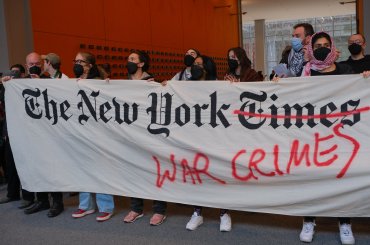
It’s worth checking the reader comments on the NYT articles James cites (those which have comments). Many comments – especially those most upvoted – are highly critical of Israel’s actions. The NYT looks increasingly feeble when its readers know more about the topic than its journalists.
Overall, the silent and blind West is GUILTY by association.
Replace the word Muslim with Jew and the word Hamas with Israel and see just how distorted it all is and how demonising some is accepted and telling the truth about others is not.
“the assassinations are violations of international law and an enormous threat to global security.” Israel is formally at war with Hamas, and Iran considers itself to be at war with Israel. International law appears to be something that Mr. North interprets very selectively. He has nothing to say about murders that Iran has committed and attempted within the United States and other countries (https://www.npr.org/2024/02/25/1233171784/state-sponsored-assassination-plot-doj and https://www.cbsnews.com/news/iranian-dissidents-abductions-assassination-attemts-60-minutes-transcript/). Moreover, why mourn the deaths of terrorist masterminds who plan and oversee the murders and kidnappings of innocent civilians?
If anyone had asked me I would not have approved the killing of Ismail Haniya. Not because he didn’t deserve it. He was a bloodthirsty (and corrupt) terrorist. But I would have asked whether such an operation would advance the cause of freeing our kidnapped hostages. It looks like the answer is no.
I would point out certain made-in-USA operations: from Admiral Yamamoto to Osama bin Laden to Qassem Suleimani.