
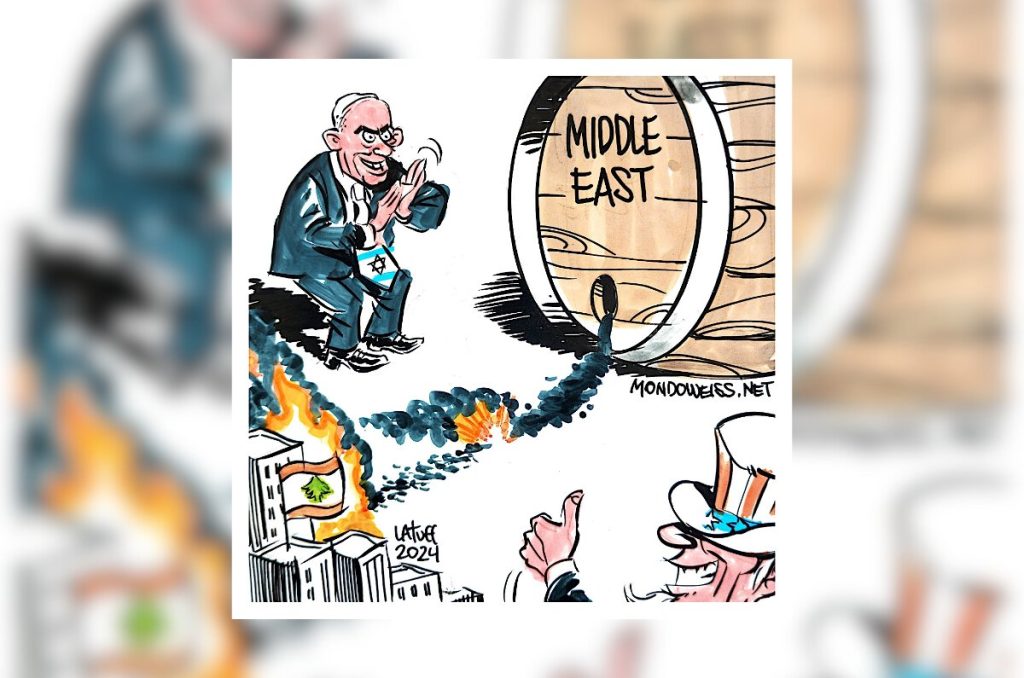
This week the back-and-forth attacks between Hezbollah in Lebanon and the Israeli military turned into a war in all but name. As our readers undoubtedly know, Israel began striking deep inside Lebanese territory. They crossed the “red line” by hitting Beirut’s southern Dahiya neighborhood, the center of Hezbollah’s base. Israel used enormous “bunker buster” bombs to flatten an entire block of residential buildings, targeting and killing Hasan Nasrallah, Hezbollah’s co-founder and Secretary General. As of this writing, Hezbollah has not directly responded to Nasrallah’s killing.
It seems clearer now that the Biden administration is happy to let this violence continue so long as no wider regional war breaks out. Israel is certainly degrading the military capabilities of resistance groups in Gaza and now Lebanon. But to what end? Iran continues to offer a diplomatic path to ending this violence and reshaping the political landscape of the Middle East. So long as Israel maintains its colonialist desire for expansion, and faces zero accountability for its actions, there is no future in that direction.
And that is the crux of the problem. Unless the international community deals with Israel’s occupation and apartheid regime – the underlying causes of all this instability and violence – everything else is just a bandage on a wound that won’t heal.
This week our writers explored these events and themes. Please give some of the stories below a read or a listen.
Remembering Refaat Alareer on his birthday

Asem Alnabih is an engineer and PhD researcher from Gaza. He currently works for the Gaza City Municipality, serving as its official spokesperson, a member of its emergency committee, and the Director of Public Relations and Media. He wrote about his friend and mentor, Refaat Alareer, ten months after Israel murdered him and members of his family on the occasion of his birthday.
If Refaat were alive right now, he would be taking care of us. I will never forget his gesture just three days before I lost him. Refaat came over to my home when he heard my grandmother had passed. Our house in al-Shujaiya was still largely intact at the time, while he was displaced and moving between a school shelter and other people’s homes. He came over on foot to say to me: I am always here for you. I am by your side.
So instead of telling you how much we miss him and the type of friend he was, I will continue to visit others and try to lift their spirits when they’re alone. I’ll encourage them to hold their heads high and endure like he did in his lifetime.
Don’t miss these important stories
🇱🇧 Qassam Muaddi filed a report on the killing of Hezbollah Secretary General Hasan Nasrallah in a massive Israeli bombing in southern Beirut.
🇮🇱 Craig Mokhiber says that Israel’s justifications for its indiscriminate attacks on civilians are failing. After the “pager attack” in which Israel remotely detonated explosives hidden in thousands of pagers across Lebanon, Mokihiber writes, “If Israel can sneak into the supply chain and booby-trap personal devices, so can everyone else. If Israel can commit audacious acts of transnational terrorism, so can everyone else. If Israel can maim and murder civilians, label them “human shields” or “collateral damage” and walk off scot-free, so can everyone else.”
🎙️ Abdaljawad Omar joined the Mondoweiss Podcast to discuss the effects of Israel’s attacks on Lebanon. Its a great discussion worth listening to in its entirety. I was struck by this piece where Omar talks about the psychological impact of the October 7 attack on both Israelis and Palestinians:
October 7 peeled away the Iron Wall that Israel surrounds itself with. The Zionist movement has theorized this iron wall from its inception, in the writings of Ze’ev Jabotinsky, the leader of the revisionist Zionist movement in the 1920s and 30s. He wrote about this iron wall and the need for military power to be used extensively, repeatedly, until the Arabs surrendered.
There’s a kind of dialectic, if you want, between the Iron Wall and Palestinian Arab attitudes toward Israel. That Iron Wall started to dissolve after October 7.
But today, the situation among Palestinians is one of disorientation. People don’t know what the future holds. There’s a lot of anxiety and fear. And this is reinforced by a military occupation that is actually a regime of terror. It chooses who to arrest and who not to arrest, who to kill and who to leave alive, whose home to destroy, and who is spared…
🚮 Ahmed Abu Abdu, the head of health and environment management for Gaza City, reports on the growing health disaster in Gaza caused by the mountains of waste piling up. “With over 150,000 tons of waste piling up in Gaza City, the environmental and health consequences are dire. As we approach winter, these waste piles will block drainage systems, leading to potential floods in an already devastated city.”
🇱🇧 Tareq Hajjaj looks at how Palestinians in Gaza are viewing Israel’s attacks on Lebanon. “What is happening in Lebanon is what is happening in Gaza,” says Khaled Salama, 33, from a tent encampment in Khan Younis. “Genocide and forced displacement are taking place in Gaza and Lebanon. The Zionists want to annihilate all Palestinians, as well as those who stand with them and support them.”
🇮🇷 Mitchell Plitnick writes that Joe Biden is more interested in preserving Israel’s impunity than he is in stopping a regional war. Iran continues to open the door to a broad diplomatic resolution, even offering to set aside its weapons “so long as Israel will do the same” at the United Nations. But Israel, with Biden’s support, seems intent on ignoring this.
🫏 Ethan Eblaghie says the Uncommitted Movement failed because it wouldn’t break away from the Harris campaign and the Democratic Party.
🏛️ James North follows the dishonest smear campaign targeting Rep. Rashida Tlaib. The Jewish Insider ran with a story claiming Tlaib attacked Dana Nessel, the Michigan Attorney General, because Nessel is Jewish. Jonathan Greenblatt at the ADL repeated the claim in a tweet, which then, predictably, made its way into CNN’s coverage via Jake Tapper and Dana Bash. Rashida Tlaib said nothing about Nessel’s religion in the original interview, and the author of that piece attempted to push back and fact-check their shoddy attempt at propaganda. Michael Arria also looked at this story in this week’s The Shift newsletter.
🎓 Amira Jarmakani and Emmaia Gelman write that the recent avalanche of civil rights lawsuits in response to Palestine campus protests is the result of an intentional Israel advocacy strategy to criminalize anti-Zionist politics by contorting the idea of civil rights.

Why does the US still control every penny of Iraqi oil revenues?
In July, the Iraqi Central Bank halted all foreign transactions in Chinese Yuan, succumbing to intense pressure from the US Federal Reserve to do so. The shutdown followed a brief period during which Baghdad had allowed merchants to trade in Yuan, an initiative intended to mitigate excessive US restrictions on Iraq’s access to US dollars.
While this Yuan-based trade excluded Iraq’s oil exports, which remained in US dollars, Washington viewed it as a threat to its financial dominance over the Persian Gulf state. But how has the US managed to exert such total control over Iraqi financial policies?
The answer lies in 2003, with mechanisms established following the illegal US-led invasion of Iraq.
A legacy of ‘Operation Iraqi Freedom’
Since the signing of Executive Order 13303 (EO13303) by President George W Bush on 22 May 2003, all revenues from Iraq’s oil sales have been funneled directly into an account at the Federal Reserve Bank of New York.
EO13303, titled “Protection of the Development Fund for Iraq and Other Property in Which Iraq Has an Interest,” has been renewed annually by every US president, including Joe Biden in 2024. This executive order essentially places control over Iraq’s oil revenues under the discretion of the US President, leaving Baghdad with limited control over its resources and earnings.
https://thecradle.co/articles-id/27007
I learned from this article in Foreign Policy that U.S. policy is even more deeply one-sided, and in more ways, than I had realized:
https://foreignpolicy.com/2024/10/01/israel-hamas-gaza-ngo-usaid-biden-double-standards-are-failing-palestine/
“So long as Israel maintains its colonialist desire for expansion, and faces zero accountability for its actions, there is no future in that direction”.
____________________________________________________________
It has been clear there has always been an iron wall to counter diplomacy (yearn for peace baloney and was repeated at UN recently). Been clear since 1988, armed resistance is a necessary component to the strategic plan to achieve greater Israel.
Will the Palestinian strategists see opportunity in what’s unfolding and present a plan to isolate the zealots? One that could divide and conquer at this point in time.
I see Biden getting more and more fed up with Netanyahu. Today especially. Reminded of the axiom, a enemy of an enemy is my friend.