
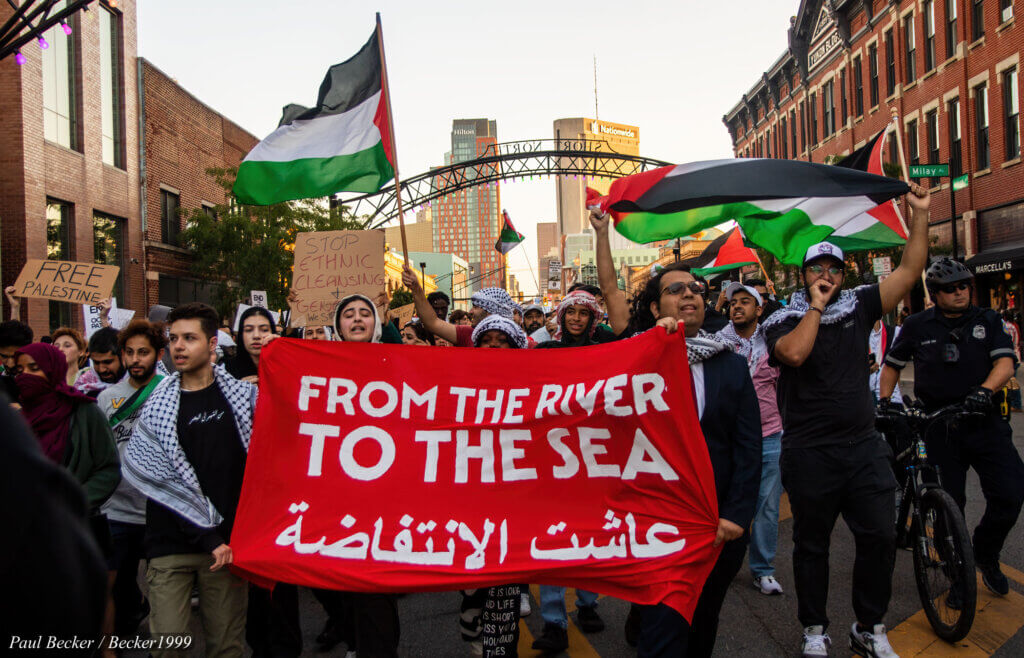
When I was asked by the editors of Mondoweiss to write my reflections on the one-year anniversary of October 7 invasion of Gaza by Israel, while the genocide continues with no end in sight, I thought of all the hundreds of relatives, comrades, friends, colleagues, and students who have been killed by Israel over the last year – each and every one of them! From the 5-month-old Ellen Eid to my former students Khail Abu Yahya, Tasneem Thabet, and Reem El Farra, to my friend and Orthopedic Surgeon Dr. Adnan El Bursh, my colleague Refaat El Areer, my two cousins Takween and Haifaa and their families, my nephews Fouad and Mustapha and their whole families….

I thought of writing all the names, but that will not be enough to do them justice. I have tried to count how many people I personally have lost, a task I do not wish on my worst enemy. I even wrote a while ago that “I’ve lost count of the number of the people I have lost!” They have become torches on our long walk to freedom from occupation, colonialism, and apartheid.
I, together with my family, have been displaced four times, three of them in Gaza itself, until I was evacuated by the South African government from Rafah in the second month of the genocide, December 2023. I have been living with a survivor’s guilt complex since then.
So much has been written on the events of October, 7th, and more will be added. I have my own take too, a position that goes against the decontextualized analysis of the mainstream media, which happens to be white and colonial and which tends to fully endorse the Israeli narrative. After 76 years of Israel’s existence, we have arrived at the point of no return for all living in historic Palestine. The colonial West refuses to see the objective conditions of being subjugated to occupation, settler colonialism, and apartheid. It refuses to see Gazans as human beings entitled to their basic rights like the rest of human beings only because they are not born to Jewish mothers. As Salman Abu Sitta reminds us on his Facebook page: There are two million Palestinian refugees in the Gaza Strip, who came from 247 towns and villages in southern Palestine. expelled by Israel in 1948, through dozens of massacres. They are crammed in a concentration camp called the Gaza Strip at a density of 8000 persons/km2. Its area is 1.3% of Palestine, or 365 km2. They are now forced by Israel to move down south, then up north in the tiny strip at a density exceeding 20,000 p/km2. Then he goes on to ask: “Who occupies their home?” East European settlers from Romania, Poland, Ukraine and Russia. Their number is only 150,000, at a density of only 7 persons/km2, one thousand times less than the owners of the land, who are the refugees in Gaza.
One also ought to ask tough questions within the historical context of the unfolding events. Would the genocide have taken place had the Oslo Accords not been signed in 1993?
I believe that post-Oslo, Palestine is struggling to overcome the past because the material conditions of occupation, apartheid, and settler colonialism at present are hegemonic, but also because the intellectual conditions created by Oslo have legitimized those conditions. The accords themselves are a Trojan horse that has turned out to be little more than a war machine with which we have come to make a premature “peace”. Since then, we have been searching for a form of freedom that points towards an exit from the constraints of apartheid, occupation, and settler colonialism. Unfortunately, the founders of contemporary Palestinian nationalism never grasped the form of Zionism they were dealing with when they signed the accords. That led to the spread of a form of false consciousness among a large portion of the population that Oslo would lead to “independence” for Palestinians by 1999. Yasser Arafat’s arrival in Gaza in 1994 was met with the thunderous euphoria and welcome of the post occupation (postcolonial!) world that so eagerly awaited a new promise of the future. Since then, we have been dealing with the sophistry of a mastery political narrative that claimed to have established peace through partition, the two-state solution.
It has become very obvious now that no solution to the so-called Israeli-Palestinian “conflict”—to use mainstream media’s favorite term– can be envisaged under these terrible circumstances created by genocidal Israel in historic Palestine. Surely, you cannot expect colonized Palestinians to compromise on their basic human rights.
There remain two, really three, opinions. One is the one above that argues for statehood on a portion of the land of historic Palestine which does not guarantee Palestinian basic rights, and which ultimately prolongs the oppression of the Palestinian people. This is the position adopted by mainstream political organizations in Palestine, western countries, and a tiny section of liberal Zionism. But why are we Palestinians expected to accept solutions that take no account of the reality of our situation?
The second perspective argues for implementing international law, which would give Palestinians their right of return, right to equality, and ultimately their right to self-determination like any other people on Earth.
And, a third genocidal position is being implemented right now by apartheid Israel and expressed openly by its fascist PM and ministers. For them, the objectives of the ongoing genocide are:
- Reoccupying the Gaza Strip
- Forced removal of a large portion of the population and encouraging them to leave by preventing any food from entering Gaza, by bombing institutions of education and health care, and by obliterating the right to security and work….
- Slicing the Strip onto cantons like in the West Bank and invading and carrying out regular massacres inside these cantons
- Creating a loyal, local government
While it is important to focus on the present, as things on the ground are getting worse every day, having a clear strategy and political vision is crucial if we want people around the globe to see what is possible. People keep asking the same question: “what is the future of Gaza?” How can that be discussed without relating it to the future of Palestine in general? And what kind of Palestine do we want to see in the future (the day after)? Can Palestinians and white, Ashkenazi settlers coming from Europe share the same land, like what happened in South Africa, without dismantling apartheid and settler-colonialism?
Working on this piece while Israel is indiscriminately carpet bombing my people in Gaza has been extremely difficult. One source of inspiration, or rather motivation behind these thoughts, is Edward Said’s “Permission to Narrate” in which he called upon us Palestinians to take our struggle to the world of representation and historical narratives. As he argued very eloquently, the existing imbalance of political and military powers does not mean that the subaltern, the marginalized, do not possess the ability to struggle over the production of knowledge.
Sometimes I seriously wonder: Am I the only one who has been unable to read a book, watch a movie, enjoy a meal, play with my kids, since October 7?
Let me close with a quote from the late martyr Shireen Abu Akleh:
“We’re in it for the long haul, keep your spirits up!”


In my opinion an important fact about the situation is that many people predicted it. Charles de Gaulle, for example, in regard to the ’67 war:
De Gaulle’s lonely predictions…It was not easy for President de Gaulle to make himself heard.“France will not give its approval to – and still less support – the first nation to use weapons,” he had said in a cabinet meeting on 2 June. True to his word, he imposed an arms embargo on both sides. Months later de Gaulle said: “Israel is organising an occupation of the territories it has captured, which can only result in oppression, repression and expulsion, and there is resistance in those territories that Israel is calling terrorist.” Yet the only line of that speech people remembered was a controversial statement about the Jews being “sure of themselves and domineering”.
https://mondediplo.com/2007/06/10degaulle
Haidar’s opening paragraph is sobering. It is so like the experience of so many Jews in the last century. We read it in the books and articles of British author Michael Rosen, as he searches for traces of the lives of so many of his extended family who were in continental Europe rather than Britain. We see it in the now regular obituaries of lucky children who came to Britain on the Kindertransport trains organised by Nicholas Winton.
That the people of Israel are now visiting the same horror on Palestinians and Lebanese is, frankly, unfathomable.
Thanks for this moving report and analysis. Unfortunately, it seems that the past, the current, and likely future U.S. policy is to enable the third option.
Raja Shehadeh said that there were no lawyers present in Oslo. Things might have been different if there had been. Many of us, including me, rejoiced because we thought there was a just peace coming. Edward Said knew there wasn’t.
As for “Creating a loyal, local government” – that means a puppet government. It won’t be hard for Israel to find people willing to be puppets. But they won’t be able to govern, because they won’t be respected by the people.
Think of Mahmoud Abbas. To give him the benefit of the doubt, which he may or may not deserve, he probably thought that by giving Israel what it said it wanted, security – the PA’s job is to provide security for the Jewish settlers, not for the Palestinians – he would get something for his people. It didn’t work, did it?
IMO, this best move toward a struggle for equal citizenship in one country, as was Erekat’s fallback from the 2SS. Anyone anywhere with the right of return, original position of PLO.
Any means necessary cannot work.