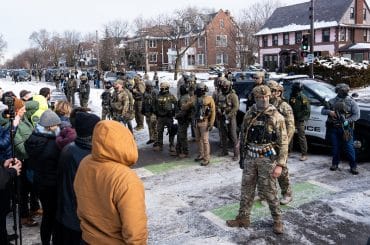
As students across the nation who are protesting the genocide in Palestine are facing violent repression, the movement for including Arab American Studies and Palestine in Ethnic Studies is facing strident censorship as well. Amid the physical forms of repression, such as the taking away of bodies at the hands of federal authorities or police violence, there is a less tangible form of censorship seen in the attacks on Arab American and Palestine studies. The censorship of Arab American Studies and Palestine in Ethnic Studies is not done in isolation from the repression of the student movement in solidarity with Palestine. The censorship of education represses critical thought about Palestine in an attempt to stifle the growth of the student movement.
A field born in protest
Ethnic Studies is the only field that was created from student protest. In the 1960s, students at San Francisco State University formed the Third World Liberation Front (TWLF) to demand a restructuring of the university from exclusionary admissions, curriculum, and structures of power. They recognized their university as an institution to be complicit in the Vietnam War, and in their call for ethnic studies education was not only a desire for increased representation but a need for education that brought them closer to collective liberation. At the core of students’ dissent was the university itself.
In their movement, students of the TWLF were met with violent repression including arrests and police force. Amid their demands for ethnic studies and the end of the Vietnam War, students fought for each other and their collective future, guided by a belief in the power of education that can move society toward liberation. The ethnic studies student movement is guided by praxis – study and practice. It is the combination of these two that the university often fears. As students learn about their histories, build solidarity with one another, question power, forces of settler colonialism and imperialism, students will locate where power lies closest to them. In the case of the university, that power lies directly in front of students: their universities are complicit in funding genocide, built on Indigenous land, and now producing the technology for war. This knowledge leads students to action which is why at the core of the repression of student movements lies the censorship of education.
The struggle over Ethnic Studies in California
Educators have been advocating for implementing Ethnic Studies education in K-12 in California, with AB 101 passing in 2021 which would require California high school students to take a semester of Ethnic Studies in order to graduate by the 2025-2026 school year. Within the University of California system, ethnic studies students and faculty have been advocating for an Ethnic Studies proposal titled “Area A-G/H Ethnic Studies”, which would require high school students to take one semester of Ethnic Studies for admission into the UC as part of their A-G admissions requirements. This process has been marked by repression that goes “beyond censorship,” as members of the UC Ethnic Studies Faculty Council described receiving emailed threats of violence and death following their advocacy for Arab American studies in Ethnic Studies.
While Area A-G/H Ethnic Studies received overwhelming support when it was initially introduced, the proposal and its advocates were met with strong repression within and outside the UC system. The Daily Bruin in 2022 reported that Li Cai, a UC Los Angeles professor serving on the UC Academic Senate, broke senate policy by leaking internal emails about the Ethnic Studies proposal to its strong opponents, including Tammi Rossman-Benjamin, co-founder the AMCHA Initiative – an organization that claims to protect Jewish students on college campuses by documenting and investigating antisemitism. The AMCHA initiative previously described the proposal as “ill-conceived,” “antisemitic” and “dangerous” in a 2022 letter.
Jewish studies professors across the UC system criticized AMCHA’s definition of antisemitism as “so undiscriminating as to be meaningless” in a 2014 letter. Through their databases of documenting college campuses, AMCHA has continuously attempted to repress Palestinian scholarship at college campuses while also attacking pro-Palestine student groups and student governments that have passed BDS resolutions. AMCHA’s attempts to repress student activism in solidarity with Palestine have been coupled with attempts to censor and repress Palestinian scholars and Arab American Studies curricula. These efforts work hand in hand to repress the Palestinian student movement by instilling fear through documentation while attempting to prevent the movement from growing by attacking the knowledge that evokes actionable change.
Jewish American groups like Jewish Voice for Peace Bay Area have supported the California Ethnic Studies model curriculum, describing the inclusion of Arab American Studies as “essential” in a 2019 letter to the Davis Vanguard as “Arabs have been coming to the United States since before it was formed as a nation.” As university administrations and the federal government attempt to repress the student movement and censor curriculum in the name of protecting Jewish students, Jewish American students, organizers, and faculty are saying, “not in our name.”
Within the UC system, Ethnic Studies has faced strong institutional opposition. In October 2023, The UC Ethnic Studies Council wrote in a letter to the UC Regents to “uplift the Palestinian freedom struggle, and to stand against Israel’s war crimes against the ethnic cleansing and genocide of the Palestinian people.” In response, Regent Jay Sures wrote in a letter, “Let me be clear, I will do everything in my power to never let that happen,” calling their letter “appalling and repugnant.” In January 2024, Sures proposed a policy that targeted and censored the speech of UC faculty – specifically Ethnic Studies departments who published departmental solidarity statements for Palestine. Members of UC Ethnic Studies Faculty Council have stated that Sures, through this policy, “declared war on Ethnic Studies.” Ethnic studies departments are one of the few spaces in higher education where critical conversations about Palestine can take place. Amid UC regental attacks on Ethnic Studies, UC’s pro-Palestine student groups who call for the UC to divest $32 billion from genocide have been suspended and met with police force.
The attack on Ethnic Studies, and the greater student movement, has existed long before the Trump administration. In 2023, The Louis D. Brandeis Center for Human Rights Under Law and the American Jewish Committee filed a lawsuit against Santa Ana Unified School District for ethnic studies curricula that included Arab American and Palestinian diaspora studies. Most recently, Ethnic Studies censorship has appeared in California’s Assembly Bill 1468, introduced by democratic lawmakers in February 2025. The bill attempts to create a version of multicultural studies that erases any discussion of Palestine. But Palestine is essential to Ethnic Studies – a field that critically analyzes power, imperialism, and settler colonialism. AB 1468 claims to “focus on the domestic experience,” yet the domestic experience of historically marginalized communities can only be explained through a critical analysis of power structures. If California wishes to separate itself from a state of repression, it must commit to uplifting the students leading the movement in solidarity with Palestine and decolonizing education.
In student movements throughout time, it is the students who become our teachers, teaching us about a world that can exist free of imperialism, free of genocide, and free of colonialism. It is at the student encampment where the university is restructured, where students and faculty learn from one another, and the classrooms can give rise to revolutions. Institutions attempt to instill fear in their students and faculty through repression, but perhaps it is the universities that fear its inevitable restructuring. Ethnic Studies and the movement for Palestine teach us that educational change is societal change. To educate is to not repeat a past and to give life to a collective future.