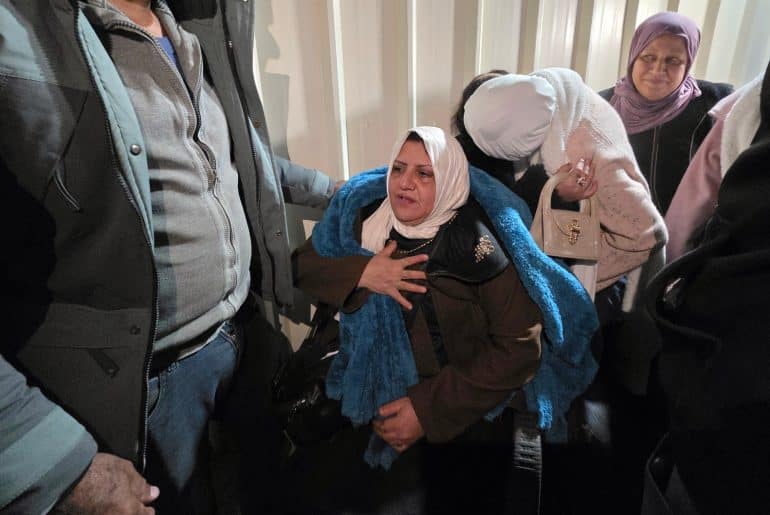
Ras Ain al-Ouja is one of the largest Palestinian Bedouin villages in the occupied West Bank. Nestled amid a ridge of high silt hills just north of Jericho city, the village is facing intensified Israeli government-funded settler efforts to expel its residents.
The community’s 1,200 residents are surrounded from all sides by the illegal Yitav settlement and four illegal settler outposts, the most recent of which was built one year ago.
Settlers descend onto the village and raid residents’ homes on a daily basis, physically attacking people, stealing sheep, and terrorizing families. They also took over the nearby spring of Ain al-Ouja, one of the main springs in Palestine and a major water source for the entire area that drew local tourism. Today, all Palestinians are barred from accessing it.
In February, the Israeli government seized the land upon which the village sits and declared a large portion of it as land for settlers to graze their sheep. Less than a month later, on March 7, settlers stole 1,500 sheep from the village in one night.
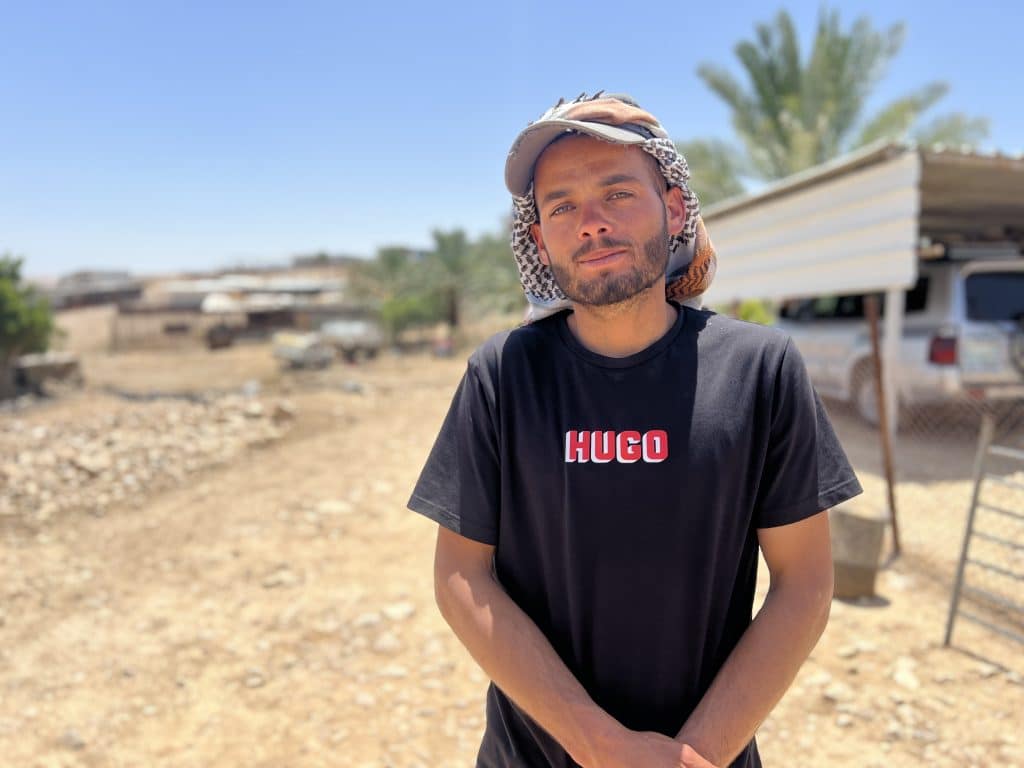
“The land we live on and our fortunes are being taken from right before our eyes,” Haytham Zayed, a 24-year-old lawyer and resident, told Mondoweiss from Ras Ain al-Ouja. “We’re just watching, unable to do anything. We have been living here for 40 years, on private Palestinian land, and we still have no rights to it.”
As the unofficial village spokesperson, Zayed can recite the history of Israel’s attempts to erase them since the community was first built in the 1970s. He remembers the exact date of every single large-scale attack that took place against them and the surrounding village families over the years.
Slim and soft-spoken, with striking green-hazel eyes, Zayed speaks with the calm certainty of someone far older than his years. Every word lands with weight, shaped by conviction and a political awareness that marks a generational break with his forefathers.
“What is happening is extremely dangerous. They are annexing the West Bank to Israel,” said Haytham. “They operate like cancer — expanding slowly, bit by bit.”
Haytham observed that Palestinians living in the cities only witness army violence and are not exposed to the daily settler harassment that characterizes places like these. “If they see what is happening outside the cities, they will know that they are next,” Haytham noted.

Creeping annexation
Ras Ain al-Ouja, like other Palestinian Bedouin villages, is located in “Area C” of the West Bank, which makes up over 60 percent of the territory and is under the direct control of the Israeli army and settlers.
As per the 1993-1995 Oslo Accords, Israel split the occupied West Bank into areas A, B, and C. While A and B consist of the built-up areas of Palestinian cities and villages, Area C consists of all the areas just outside of those boundaries. It is where Israel’s hundreds of illegal settlements and military bases are located, at times less than a kilometer away from the last Palestinian home.
Area C also includes almost the entirety of the Jordan Valley, which makes up 30 percent of the occupied West Bank. Owing to the shepherding and farming lifestyle of Palestinian Bedouins, the geographic divisions of the Oslo Accords meant that these communities are on the front lines of Israel’s ethnic cleansing campaigns.
Over the past few years — and particularly since the election of the current Israeli government into office in 2022 — armed illegal Israeli settlers, directly funded by the state, have been forcibly expelling Palestinian villages in Area C, building illegal herding outposts and taking over large swathes of land, at unprecedented rates. These systematic policies have only exponentially increased since the genocide in Gaza.
Since mid-2022, more than 60 Palestinian villages in Area C have been expelled, the majority of them after the genocide. The latest expulsion took place on May 24, when the entire Bedouin village of Maghayir al-Deir near Ramallah was forcibly displaced after a year-long series of attacks by settlers and the building of a new outpost right on village land.
According to settlement watchdogs, a few hundred herding settlers have come to directly control around 14 percent of the occupied West Bank — four times the area occupied by all of Israel’s illegal settlements combined.
Meanwhile, the Israeli government, as well as the World Zionist Organization (WZO) and the Jewish National Fund (JNF), gave Israelis more than 93 million shekels ($26 million), to settle in these areas and expel Palestinian residents.
These systematic and centralized efforts come as part of a series of moves made by the Israeli government to slowly annex the occupied West Bank.
Ever since the war on Gaza, settlers have even built outposts in Area B, which is meant to be under the control of the Palestinian Authority. Additionally, in the pipeline is a law allowing settlers to purchase and own land in Area C, and most recently, the government resumed land registration in Area C to consolidate its unlawful annexation.
’10 million shekels’ in losses
As settlers receive tens of millions of dollars to attack and displace Palestinians, the latter are, in parallel, suffering severe economic losses.
In less than a year, between August 2024 and May 2025, settlers stole more than 2,200 sheep from Ras Ain al-Ouja in at least five separate attacks.
“Including the water they cut off, the homes they burned, the cars and solar panels they destroyed, the sheep they stole… it is no less than 10 million [Israeli] shekels [almost $3 million],” said Zayed.
“I personally had 400 sheep stolen from me, worth no less than 650,000 shekels [$184,000],” he added.
In another part of Ras Ain al-Ouja, resident Mahmoud Salameh Mahmoud Kaabneh’s livestock are visibly weak. He is unable to release them from their pens for up to 12 hours a day due to the relentless presence of an illegal Israeli herding settler with his sheep in and around the village at all times.
The latest settler-outpost was built less than a kilometer away, directly opposite Kaabneh’s home.
“All these hills that you see around us were once ours for herding our sheep,” Kaabneh told Mondoweiss. “We would come and go as we pleased. Today, we are being deprived of everything. We are deprived of our right to life.”
He explained that Ras Ain al-Ouja has received zero help to remain on their lands, not from the Palestinian Authority nor any international organizations, despite the major importance of safeguarding these areas.
“We are on the front lines of defense. We are remaining here to confront the settlers and prevent them from taking over all these lands,” said Kaabneh.
“If, God forbid, I am forcibly expelled, the settlers will not stop at that. They will go to Jericho city next.”
Zena al-Tahhan
Zena al-Tahhan is a freelance TV reporter and writer based in occupied Jerusalem.