
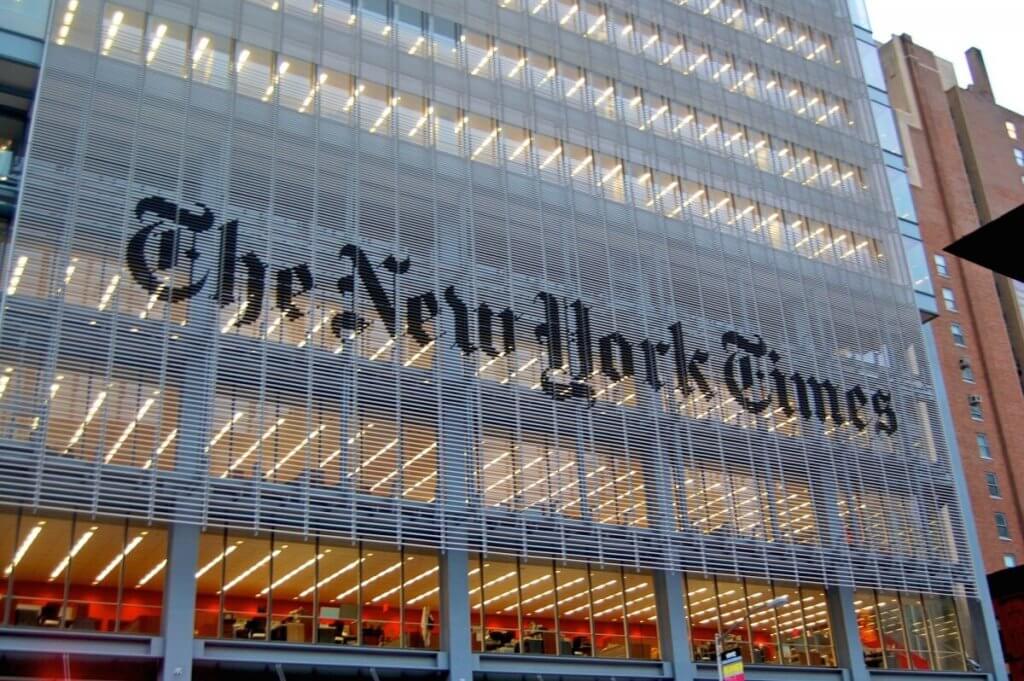
On June 14, the New York Times published a long editorial denouncing antisemitism, focusing part of its attention on the political left. Not surprisingly, it was badly flawed. If the Times had stuck with the real examples of antisemitism from both left and right, their editorial could have been a valuable contribution, but unfortunately, and quite predictably, they include criticism of Zionism and Israel as part of the problem.
To be sure, they condescendingly allow that anti-Zionism and antisemitism are not the same and inform us that they, too, have condemned mass killings in Gaza. But with that out of the way, they begin explaining how there have to be limits on just how you can criticize an apartheid state in the midst of committing genocide. The notion that one could criticize Israel too harshly under these circumstances is difficult to understand, and the Times fails to show that it is happening.
Here are excerpts from the editorial—
“One explanation is that antisemitism has become conflated with the divisive politics of the current Israel-Hamas war. It is certainly true that criticism of the Israeli government is not the same thing as antisemitism. This editorial board has long defended Israel’s right to exist while also criticizing the government for its treatment of Palestinians. Since the current war began, we have abhorred the mass killing of civilians and the destruction of Gaza. Israel’s reflexive defenders are wrong, and they hurt their own cause when they equate all such arguments with antisemitism. But some Americans have gone too far in the other direction. They have engaged in whataboutism regarding anti-Jewish hate. They have failed to denounce antisemitism in the unequivocal ways that they properly denounce other bigotry.
Natan Sharansky, the former Soviet dissident, has suggested a “3D” test for when criticism of Israel crosses into antisemitism, with the D’s being delegitimization, demonization and double standards. Progressive rhetoric has regularly failed that test in recent years. “Americans generally have greater ability to identify Jew hatred when it comes from the hard right and less ability and comfort to call out Jew hatred when it comes from the hard left or radical Islamism,” said Rachel Fish, an adviser to Brandeis University’s Presidential Initiative on Antisemitism.
Consider the double standard that leads to a fixation on Israel’s human rights record and little campus activism about the records of China, Russia, Sudan, Venezuela or almost any other country. Consider how often left-leaning groups suggest that the world’s one Jewish state should not exist and express admiration for Hamas, Hezbollah and the Houthis — Iran-backed terrorist groups that brag about murdering Jews. Consider how often people use “Zionist” as a slur — an echo of Soviet propaganda from the Cold War — and call for the exclusion of Zionists from public spaces. The definition of a Zionist is somebody who supports the existence of Israel.
More excerpts—
Muslim Americans were the victims after Sept. 11, 2001. In those periods, a few fringe voices, largely on the far right, tried to justify the hate, but the response from much of American society was denunciation. President George W. Bush visited a mosque on Sept. 17, 2001, and proclaimed, “Islam is peace.” During Covid, displays of Asian allyship filled social media.
Recent experience has been different in a couple of ways. One, the attacks against Jews have been even more numerous and violent, as the F.B.I. data shows. Two, the condemnation has been quieter and at times tellingly agonized. University leaders have often felt uncomfortable decrying antisemitism without also decrying Islamophobia. Islamophobia, to be clear, is a real problem that deserves attention on its own. Yet antisemitism seems to be a rare type of bigotry that some intellectuals are uncomfortable rebuking without caveat. After the Sept. 11 attacks, they did not feel the need to rebuke both Islamophobia and antisemitism. Nor should they have. People should be able to denounce a growing form of hatred without ritually denouncing other forms.”
Note they say that “Israel’s reflexive defenders are wrong, and they hurt their own cause when they equate all such arguments with antisemitism.” At first glance, that sounds fair. It isn’t. The problem is not that Israel’s defenders are hurting their own cause. The problem is that they are falsely accusing people of antisemitism, but far worse than that, by attempting to suppress critique, they are acting as apologists for apartheid, war crimes, and, according to many scholars and human rights organizations, genocide.
Is it simply that supporters of Israel have the right to slander human rights defenders with false accusations of bigotry, and all we say in response is that they hurt their own case?
The New York Times editors don’t see this. They just seemed to state that Israel is guilty of mass killing of civilians, and they say that reflexive defenders of Israel are wrong to dismiss this criticism of Israel as antisemitic, but then they quickly move on, so that no one stops and asks “Isn’t it extraordinarily racist to make false accusations of antisemitism in order to absolve Israel?” If it isn’t anti-Palestinian racism, what is it? Is it simply that supporters of Israel have the right to slander human rights defenders with false accusations of bigotry, and all we say in response is that they hurt their own case? Is it not a fact that we are constantly bombarded with justifications for supporting Israel, and the leading justification is that they are not guilty of war crimes?
The Times editors have no interest in these questions if they cross their minds at all. They then say that some Israel critics are guilty of delegitimization, demonization, and double standards.
Note that the editors have just said that there has been mass killing of civilians in Gaza, and now they are complaining about the demonization of Israel. How does one demonize a country that engages in the mass killing of civilians? Doesn’t demonization mean “ making a country seem worse than it actually is”? So, how exactly are people making this apartheid state’s committing mass killings seem worse than it is?
How does one demonize a country that engages in the mass killing of civilians?
Then we come to double standards. Our government supports Israel and could probably have stopped or at least greatly lessened the atrocities, so we ordinary citizens have more responsibility to criticize both Israel and our own government. This is not true in the other cases they mention. One could find cases which were similar— U.S. support for the Saudi bombing and blockade of Yemen, but it was the press itself which gave extremely sporadic coverage of this, and supporters of Israel often favored the policy since they saw it as a war on an Iranian proxy, the Houthis. In my personal experience, if Yemen ever came up, it was because I mentioned it, and people never knew about it. Yemen is not on the New York Times list.
The Times condemns defenders of Hamas as antisemites. It is not uncommon to find people who defend Hamas’s actions as resistance to Israel, and Mondoweiss has published many voices from this perspective. Whatever one thinks of this, and I think at times it ends up resulting in defending war crimes, this is a common attitude taken by some leftists in similar wars like the Algerian War against the French colonizers, where both sides attacked civilians. The Times editors have just referred to reflexive defenders of Israel who deny Israel’s mass killings and use the antisemite charge in an attempt to suppress criticism, but we don’t see people who do this described as racist by the Times, only as people who are wrong and hurt their own cause. It looks like a moral hierarchy where apologetics for crimes against Israelis are morally despicable and antisemitic, but apologetics for crimes against Palestinians are mistaken and bad because they hurt the pro-Israel cause, not morally despicable and also racist. This seems like a double standard.
On delegitimization, surely a government that practices apartheid and is committing genocide is delegitimizing itself. I don’t recall if that apartheid government of South Africa defended itself by saying that South Africa has a right to exist, as though the country and its apartheid system were the same thing. Countries have the right not to be invaded or attacked, but they have no inherent right to oppress a group of people or engage in mass killings of civilians.
The New York Times says a Zionist is one who supports the existence of Israel, which is a silly, insincere definition that leaves out the central point and the entire controversy, almost as though Palestinians who had to be expelled to make Israel a majority Jewish state are an annoyance that should be ignored. One notices a pattern in the editorial.
The Times also gives an inaccurate description of the Islamophobia issue in the Bush era— for one thing, it wasn’t limited to the extreme right. There were people perceived as liberals, such as Bill Maher and Martin Amis, who were Islamophobes (though Amis apologized later for his hateful remarks). It was and is mainstream in Western culture. And while Bush said Islam was a religion of peace, there was this little incident called the Iraq War, part of the war on terror, and issues like Abu Ghraib, and Islamophobia was a part of all of that, just as anti- Palestinian racism is the central reason why Israel has bipartisan support for its mass killings in Gaza.
The Times was right to think that antisemitism is a serious problem in the U.S., even if the worst crimes — the murders or attempted murders in D.C. and Colorado — may have been motivated by anti-Zionism more than antisemitism. Ultimately, that is no comfort— human rights advocates want Americans to become aware of the crimes of Israel, but no sane person wants this to be twisted into an excuse for yet more political violence and hatred in a country where political violence is becoming a pattern.
The fact is that, despite what the New York Times says, when two or more forms of bigotry are linked by current events, you need to take a consistent moral position on all of them. In this case, hatred of Jews, hatred of Muslims and hatred of Palestinians are all closely linked because of events in the Middle East, and you can’t be in favor of human rights without opposing hatred in all its forms and being very clear about this. The New York Times editorial is a disaster because it doesn’t understand this and because of its own double standards.


The assertion that ‘State X has the right to exist’ is no different from claiming ‘State X has the right to defend itself.’ Both are simplistic assertions that focus on the ‘what,’ while conveniently avoiding the more important ‘how.’ History has demonstrated that there is no unconditional right to national existence or defense. Such statements often serve to justify immoral actions by framing them as absolutes, thereby shutting down critical discussion and accountability.
And if we were to apply Sharansky’s idiotic 3D criteria to Israel’s behavior towards Palestinians… well, so much for demonization, delegitimization, and double standards.
The constant refrain that Israel has a right to exist (even current poster-boy Mamdani has said it) is irritating nonsense. If Israel has a right to exist, then so does Palestine, which Israel has denied for decades, since admitting that would be a confession that the state of Israel, carved from Palestine through violence, is illegitimate. So Israel’s defenders invent the ahistorical nonsense that Palestine never existed, plus its more extreme denial of reality, that Palestinians don’t exist either.
More sad news today:
https://edition.cnn.com/2025/06/30/us/boulder-firebomb-attack-woman-death