
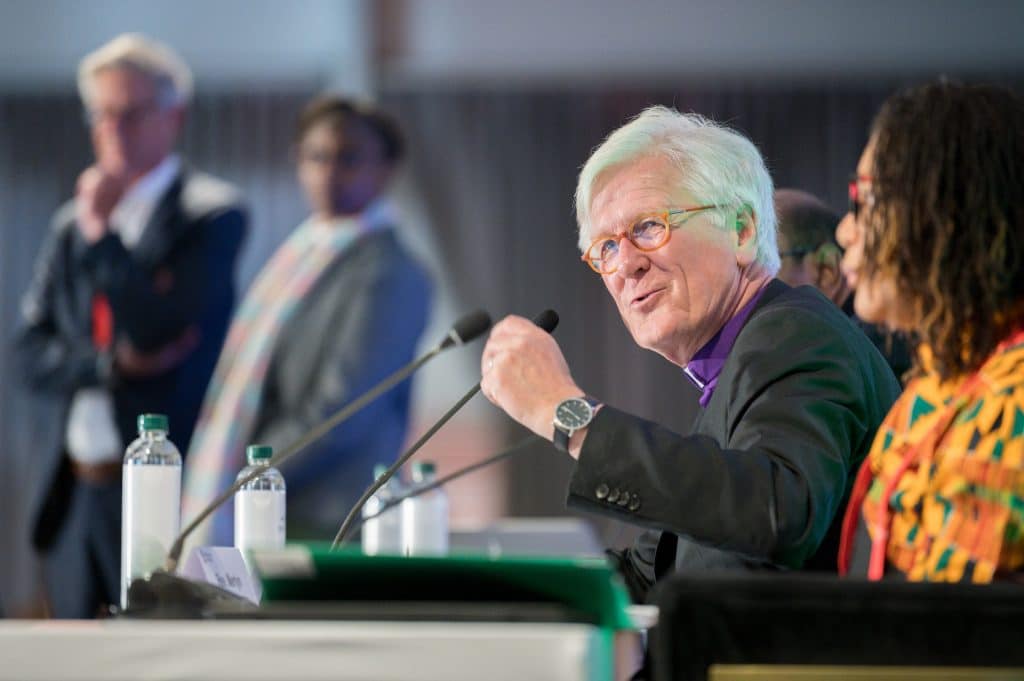
Meeting in Johannesburg, South Africa earlier this week, the Central Committee of the World Council of Churches (WCC) issued a bold statement naming the reality of apartheid in Israel, demanding the end of Israel’s occupation and the lifting of the unlawful blockade of Gaza, and calling on states and churches “to impose consequences for violations of international law, including targeted sanctions, divestment, and arms embargoes.”
The statement acknowledges the WCC’s commitment to “inter-religious dialogue and cooperation”—a nod to its Jewish partners, many of whom can be expected to condemn the statement. “However,” the text reads, “the unbearable suffering inflicted on the people of Gaza, and the escalating violence and oppression in the West Bank and in Jerusalem compel the global fellowship of churches to speak with clarity, urgency, and commitment to the principles of justice under international law and ethics.”
Despite spirited dissent during the CC’s formulation of the statement, leaders of the WCC declared that Israel’s actions “flagrantly violate international humanitarian and human rights law as well as the most basic principles of morality.”
“The Government of Israel’s military campaign in Gaza has entailed grave breaches of the Fourth Geneva Convention,” the statement reads, “which may constitute genocide and/or other crimes under the Rome Statute of the International Criminal Court (ICC).”
“Simultaneously,” the statement continues, “the occupied West Bank and East Jerusalem continue to experience intensified violence, illegal settlement expansion, and systemic human rights violations. These actions defy international legal norms, including the United Nations Charter, the Geneva Conventions, international human rights treaties, and numerous Security Council and General Assembly resolutions.”
Therefore, the statement insists, “Full support must be given to the International Criminal Court and UN mechanisms investigating potential war crimes and crimes against humanity.” The Central Committee goes further to “commend the leadership of the South African government in seeking justice and accountability to international law through the International Court of Justice (ICJ), and [to] urge all states to comply with the ICJ’s rulings.”
The statement calls on states, churches, and international institutions to take four actions: name the reality of apartheid; implement sanctions and accountability; affirm Palestinian rights and freedom; and support the resilience and witness of Palestinian Christian churches and communities, upholding their right to remain on their land and to freely practice their faith.
The statement marks a sharp turn in the WCC’s response to the crises Palestinians have endured for decades. On its website, the WCC describes its work as “Inspiring the worldwide fellowship of churches to work together for unity, justice and peace.” However, Palestinians and their allies have argued that, when it comes to the suffering in Palestine, the WCC has consistently chosen to walk the path of unity rather than justice. It’s not just the WCC. Many churches and ecumenical organizations across the globe have treaded lightly around “the issue” — both to keep the “peace” in their congregations as well as to avoid offending their Jewish colleagues and risking the charge of antisemitism.
Credit for the change in the WCC goes in large part to Kairos Palestine (KP), the broadest ecumenical, Christian nonviolent movement in Palestine, and its partner, Global Kairos for Justice, an international coalition of allies who, together with other Christian leaders, advocated for years for the WCC to issue a clear, truthful recognition of the roots and realities of Palestinians’ suffering and a call for justice.
In a press release, Kairos Palestine welcomed the statement “with deep appreciation and hope.” The CC action, KP wrote, “marks a turning point in the moral and theological witness of the global church.”
“We commend the WCC for declaring, clearly and courageously, that the term ‘apartheid’ is appropriate and prophetic in describing the situation imposed on the Palestinian people. This step acknowledges the reality that Palestinians have endured for over seven decades: systematic oppression, displacement, segregation, and denial of basic human rights.”
“Churches must speak with one voice in opposing occupation, apartheid, and genocide. Anything less is complicity, and silence now is a betrayal of both justice and faith.”
Rifat Kassis, General Coordinator of Kairos Palestine
Rifat Kassis, General Coordinator of Kairos Palestine, told Mondoweiss, “This moment presents a critical opportunity for more denominations to stand in bold solidarity with the Palestinian people. We call for an immediate campaign, led by the WCC, to end the war in Gaza and the West Bank and to support the work of the ICC and ICJ in holding perpetrators accountable under international law.”
“The time has come for moral clarity,” Kassis said. “Churches must speak with one voice in opposing occupation, apartheid, and genocide. Anything less is complicity, and silence now is a betrayal of both justice and faith.”
Asked by Mondoweiss to offer his reflection on WCC Central Committee’s statement, Michel Sabbah, Latin Patriarch Emeritus of Jerusalem, co-author of the Kairos Palestine Document and a member of the Kairos Palestine board, said, “We thank the WCC for their courage to see the truth of what is going on in our land, the Land of the Redemption of all peoples. We thank them for seeing the truth and affirming it.”
“We still cry and appeal to all Churches in the world,” Sabbah continued, “to speak truth to the powerful of this world, to the tyrants who oppress human beings created in the image of God. Help us have what God Almighty gave us: our dignity, our freedom, our humanity. From Jerusalem, the place of the Redemption, and new life of humanity, we pray for all, and implore you, brothers and sisters, to deliver us from the hands of our oppressors.”
The WCC meets in plenary session every seven years. During the intervening time, its Central Committee (CC) is empowered to speak on behalf of the 352 member churches, which together represent more than half a billion Christians around the world.

The statement is unimpressive. It does not mention anti-Palestinian racism. It only refers to targeted sanctions. It buries the accusation of genocide in the third paragraph and proposes no rational aid for Gazans in the face of the destruction of Gaza.
At this point there is only one way forward. At least half of Gazans are refugees from pre-1967 Israel. Gazans must be resettled in pre-1967 Israel. Is there any other possible solution?
What a total useless waste of time, effort and money – even though well-meant. World-wide NO PROTESTS, in whichever form, have brought positive results in defense of Palestinians. NONE! Obviously, remaining passive/non violent is NOT THE ANSWER!!! Constantly turning the ‘other cheek’ just invites more abuse by those ‘protecting’ israel.
Whatever one’s views on the existence of a divinity, church leaders with a real understanding of morality have often been at the heart of liberation movements: Martin Luther King, Desmond Tutu, Trevor Huddleston, Derek Warlock, to name but a few.