
After twenty-two months of unprecedented carnage, three things are clear: (1) the Israeli regime will not end the genocide in Palestine of its own will, (2) the U.S. government, Israel’s principal collaborator, as well as the majority of Israelis, and the regime’s proxies and lobbies in the West, are fully committed to this genocide, and to the destruction and erasure of every remnant of Palestine from the river to the sea, and (3) other Western governments like the UK and Germany as well as far too many complicit Arab states in the region are fully dedicated to the cause of Israeli impunity.
That means that genocide (and apartheid) will only end through resistance against the Israeli regime, the steadfastness of the Palestinian people, the solidarity of the rest of the world, and the isolation, weakening, defeat, and dismantling of the Israeli regime.
As was the case in apartheid South Africa, this is a long-term struggle. But even in the face of Western government obstruction, there are things that can be done right now. Things like boycott, divestment, sanctions, demonstrations, disruption, civil disobedience, education, prosecutions under universal jurisdiction, and civil cases against Israeli perpetrators and complicit actors in our own societies. And yes, we can also demand intervention and protection for the Palestinian people.
Established by a Cold War-era resolution adopted in 1950, the Uniting for Peace mechanism authorizes the UN General Assembly (UNGA) to act when the Security Council is blocked by the veto of one of its permanent members. Under this mechanism, the UNGA could mandate a UN protection force to deploy to Palestine, protect civilians, ensure humanitarian aid, preserve evidence of Israeli crimes, and assist in recovery and reconstruction.
And the upcoming deadline set by the UNGA last year for Israeli compliance with the orders and findings of the International Court of Justice, with a promise of “further measures” in the wake of non-compliance, provides a critical moment for action. Indeed, the time for intervention is long past due.
Models of intervention
As I have written previously, any country can legally intervene (individually or in concert with others) to stop the genocide, crimes against humanity, and war crimes of the Israeli regime. Indeed, under the Geneva Conventions, the Genocide Convention, and other sources of law, states are legally obliged to do so in the face of such atrocities. International law requires intervention, the State of Palestine has invited intervention, and Palestinian civil society has appealed for intervention. But few states have met this solemn obligation, while Yemen, under Ansar Allah, has been mercilessly attacked by U.S. forces for doing so, and the genocide has been allowed to rage on for almost two years now. Thus, a multilateral mandate could provide the legal, political, and diplomatic cover that most states would need to participate in an intervention.
Here, caution is warranted. There are many proposals for intervention. But some of these are not about protection for the Palestinian people, let alone their liberation.
Some have called for civilian monitors for Gaza, essentially a few dozen observers in blue vests armed only with clipboards and radios. But there have been human rights monitors in the West Bank and Gaza for decades, before and throughout the current genocide. While these perform valuable work, they have no deterrent effect, and the Israeli regime views them as no impediment at all to its nefarious designs.
Others, including the French and the Saudis, have called for a so-called “stabilization force.” But the details of their proposal suggest that such an intervention would not be designed principally to protect the Palestinians from the Israeli regime, but rather to keep an eye on the Palestinian resistance, and to restore the cruel status quo ante before October 2023, with the caging of the Palestinian people, and their slow, systematic annihilation.
At the same time, many such proposals appear to be designed in large measure to resume the process of normalization of the Israeli regime, and to resuscitate the ruse of Oslo. Needless to say, a return to a kind of Oslo 2.0, as yet another smokescreen for Israeli impunity, wherein Palestinians are told they must negotiate for their rights with their oppressor, as their rights and land are continuously eroded and the regime’s status increasingly solidified and normalized, is not the answer.
Then there is Donald Trump’s proposal for direct U.S. occupation, ethnic purging, and colonial domination of Gaza, revealing once again the dangerous and deeply racist delusions of the U.S. empire. Finally, the Israeli regime itself has suggested the deployment of a proxy occupation force manned by forces from Arab states that collaborate with the regime. As is self-evident, these proposals are not about ending genocide and apartheid. They are about entrenching them.
The UN options
That brings us to the United Nations.
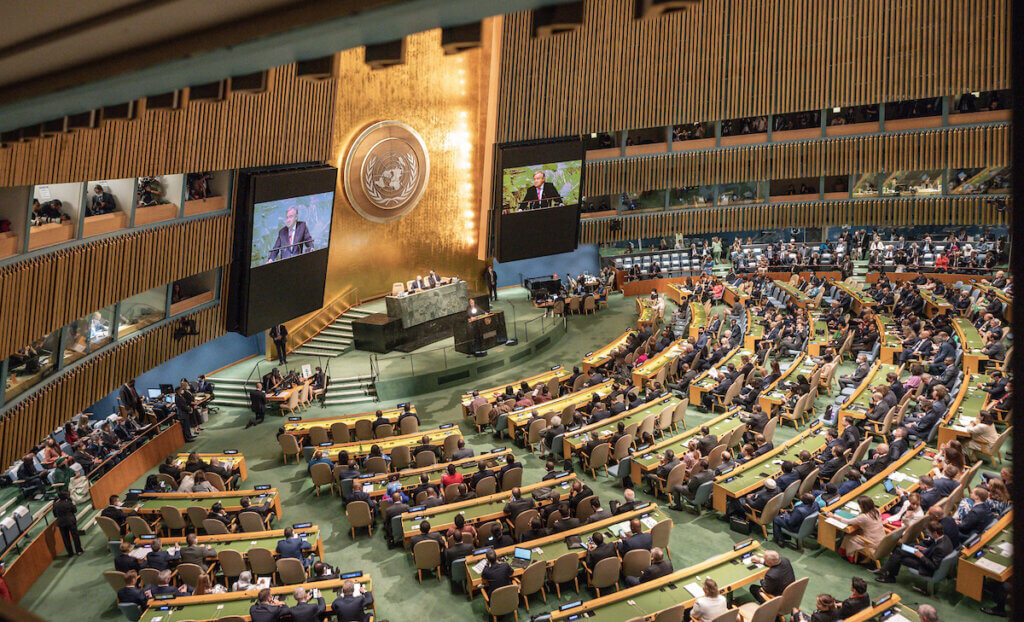
Mid-September will see the expiration of the deadline set last year by the General Assembly for Israel to comply with the demands of the International Court of Justice and of the UNGA or face “further measures.” Western delegations are scurrying to forestall this ratcheting up of Israeli accountability by shifting the focus to recognizing Palestine or by trying to resuscitate the long-dead corpse of Oslo and the so-called “two state solution,” i.e., another political process that normalizes Israel, marginalizes Palestinians, provides a smokescreen for continuing Israeli abuses, and offers an amorphous promise of a Palestinian Bantustan somewhere down the road. But the UN need not fall for this ruse.
Of course, the UN itself has much to answer for in this genocide. To be sure, some in the UN have been absolutely heroic: like the UNRWA workers, who have been murdered in their hundreds by the Israeli genocide, many along with their families; other UN humanitarians who have continued to work to relieve the suffering of the people of Gaza, in the face of enormous risk; the UN’s International Court of Justice, which has issued historic decisions affirming the rights of the Palestinian people in the face of enormous pressure not to do so; and the UN special rapporteurs, like Francesca Albanese, who have endured two years of smears, slander, harassment, death threats, and U.S. sanctions, just for telling the truth and applying the law.
But the political side of the UN has failed miserably. Some, like the UNSG, his senior advisors (on genocide, children in conflict, sexual violence in conflict, political affairs, etc.), the High Commissioner for Human Rights, and other senior political leadership, have failed miserably, not because they could not do more, but because they chose not to. And, of course, the enduring symbol of UN failure is the Security Council, rendered entirely useless under the constraints imposed on it by the U.S. and its Western allies. Uniting for Peace offers a chance to right the UN ship, and to rescue the legacy of the organization from the potentially fatal blow of yet another genocide on its watch.
Security Council scenarios
Of course, under Chapter 7 of the UN Charter, the Security Council has the power to deploy an armed force and to impose that force even against a country’s will.
But given that the U.S., UK, and France (all genocide complicit states) have veto power in the Council, there are only two possible outcomes from the Security Council in addressing a proposal for intervention: (1) A mandate that pleases the U.S., as Israel’s proxy, and which therefore would be framed in a way disastrous for the Palestinians, and could be imposed against the will of the Palestinians, under Chapter 7, or (2) A U.S. veto of any force that would actually be helpful.
Clearly, the Security Council, by design, is no friend to the occupied, the colonized, or the oppressed. As such, the road to protection and justice travels not through the Security Council, but around it.
Uniting for Peace in the UNGA
Thus, meaningful UN Security Council action is effectively impossible in a body dominated by the U.S. veto.
But here is the point: the world need not surrender in the face of that veto.
The UN General Assembly (UNGA), that will meet in September, is empowered under the Uniting for Peace resolution, to act when the Security Council is unable to act owing to the veto. There are historical precedents. And taking such extraordinary action has never been more urgent.
A UNGA resolution adopted under Uniting for Peace could
1. Call on all states to adopt comprehensive sanctions and a military embargo against the Israeli regime. While it lacks the power to enforce sanctions, it can call them, monitor them, and supplement them as required.
2. Decide to reject the UNGA credentials of Israel, as the UNGA did in the case of apartheid South Africa.
3. Mandate an accountability mechanism (like a criminal tribunal) to address Israeli war crimes, crimes against humanity, apartheid, and genocide.
4. Reactivate the UN’s long-dormant anti-apartheid mechanisms to address Israeli apartheid, and
5. Mandate an armed, multinational, UN protection force to deploy to Gaza (and, ultimately, to the West Bank), acting at the request of the State of Palestine, to protect civilians, open entry points via land and sea, facilitate humanitarian aid, preserve evidence of Israeli crimes, and assist in recovery and reconstruction.
All of these actions could be adopted by the UNGA with a two-thirds majority, thereby circumventing the U.S. veto in the Security Council. As Palestine has requested intervention, no Chapter 7 action by the Security Council is needed to deploy a protection force. Palestine would retain full authority over when and for how long the mission was to be deployed, obviating fears of yet another occupation force.
Very importantly, as affirmed by recent World Court findings, Israel would have no legal right to refuse, obstruct, or influence the mission. The Court has affirmed that Israel has no authority, no sovereignty, and no rights in Gaza or in the West Bank.
The process is simple: (1) First, a proposal is vetoed in the Security Council (this is inevitable, given the role of the U.S. as a proxy for Israel in the Security Council); (2) States call for an emergency special session (ESS) of the UNGA under the Uniting for Peace mechanism (this too is easy, as the 10th Emergency Special Session remains active, and can be easily resumed at the request of a member state); (3) A resolution is proposed by one or more sponsors, in close consultation with the state of Palestine; (4) The resolution is adopted with a two-thirds majority (a threshold required by the rules for “important matters” such as this. Previous voting patterns on Palestine indicate that this margin is achievable); (5) The UN Secretary-General is instructed to solicit troop contributions from countries, in consultation with the State of Palestine as the requesting entity, and: (6) The mission is assembled and deployed (while likely to be politically challenging due to predictably active U.S. interference, this is technically easy).
Legally, there are no hurdles. The rules allow it, the UNGA’s Uniting for Peace power has been repeatedly affirmed, and there are precedents, most notably the UNGA’s mandating of the 1956 UN Emergency Force to the Sinai (UNEF) over the objections of the UK, France, and Israel.
Of course, the U.S. and the Israeli regime will use every available carrot and stick to try to prevent the securing of the necessary two-thirds majority, seeking to water down the text, and bribing and threatening states to vote no, to abstain, or to be absent for the vote. The current lawless government in Washington may even threaten sanctions on behalf of the Israeli regime, as it has already done vis-à-vis the International Criminal Court and the UN’s Special Rapporteur. And they are likely to try to obstruct the protection force itself, once mandated.
As such, the global majority of states will need to stay the course in the face of U.S. and Israeli threats. And global civil society will need to be steadfast in its demands for protection and justice, ensuring the glare of public exposure under which states will be forced to vote for or against a force to protect the Palestinians from genocide. None will be allowed to hide behind the U.S. veto, throwing up their hands with the familiar refrain of “we tried but the U.S. vetoed it.”
Once mandated, let the protection force be deployed by air, land, and sea, accompanied by international media and supported by all diplomatic avenues to ensure its successful deployment and to press the regime and its Western backers to stand down. The world has a chance, belatedly, to stop a genocide and other crimes against humanity. All it needs is the will to do so.
Conclusion
In the face of historic atrocities such as these, that threaten the very survival of a people, and that could bury the nascent project of human rights and international law in their wake, every tool available must be deployed. The world has not done so. It must try, and quickly
Of course, we are not naïve. Success is not assured. But failure is guaranteed if we do not try.
And time is of the essence. Genocide continues to rage in Gaza and is spreading as well in the West Bank. Famine has been declared in Gaza. Israel is expanding its military presence in Gaza and is rampaging across the West Bank. And September 18 will mark the end of a one-year deadline set by the UNGA for Israel to comply with their demands and that of the World Court or face “further measures.” The time to act is now.
Why not just have the State of Palestine file a contentious case against the State of Israel? The UN Charter does not require states to provide it with “Declarations” regarding their establishment. Palestine and Israel were both required to submit Declarations to acknowledge their legal undertakings of the Religious and Minority Rights agreements and stipulations, including the compromissory clauses in Part C. Declaration of resolution 181(II). Palestine is already a state party to the ICJ Statute and rights guaranteed by resolution 181(II) were accepted and acknowledged in Declarations made by the accredited representatives of Israel and Palestine. FYI, the UN already acknowledged that the Declaration of the State of Palestine had been supplied in line with resolution 181(II) – and the Secretary General had already listed that resolution as a UN minority rights legal instrument in a 1950 report about the LoN and UN undertakings. Despite the ICC prosecutors claim, the UN had already recognized Palestine and consummated treaty agreements with it and Israel.
I’ve written about the LoN Minority Treaties in the past. The Council of the League unanimously approved a resolution that required each mandated state to submit a declaration accepting a legal undertaking to establish religious and minority rights as a fundamental law. That was a prerequisite to terminate a LoN Mandate regime. Even after the French had granted Syria and Lebanon their independence during WWII, it attempted to reimpose its control, and was bombarding the capitals, when both countries ratified the UN Charter. The Council of the League no longer existed, because two of its members had been declared enemy states The founding members of the UN could not submit membership applications and their mandates were terminated when they established sovereign equality as founding members (see Article 77 of the Charter). Transjordan was granted independence, but Poland voted against it’s UN membership application. It stated the General Assembly had taken up the Question of Palestine, and it claimed Transjordan was still under Mandate that had not been legally terminated.
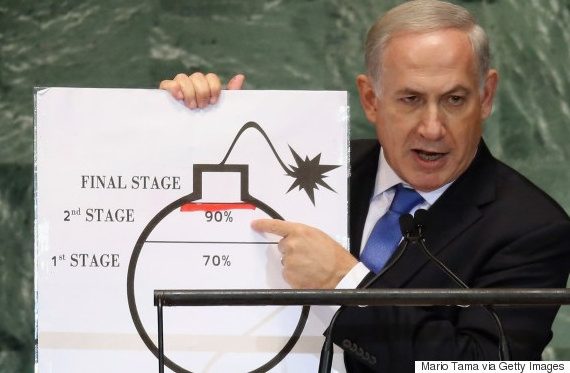
MW has published articles that outlined the UAE’s involvement as a party to Israel’s joint criminal enterprise in Gaza. So it is ironic that the UAE explained to the ICJ in the 2024 Palestine Occupation case that a veto was incompatible with a state party’s legal obligations to put an end to a grave violation of international law:
“53. As the Permanent Representative of a country that has just completed its term on the Security Council, I wish to invite the Court to consider the following: the obligations to co-operate and to ensure respect for international law carry implications for States in the exercise of their vote in the Security Council. Voting against or preventing the adoption of a Security Council resolution that seeks to put an end to serious breaches of international law cannot be compatible with such obligations.”
Note that the UAE did not hesitate to subsequently invoke its own reservation to avoid ICJ jurisdiction under the compromissory clause of the Genocide Convention. Remarkably, the ICJ upheld it, despite the Law of Treaties prohibition against reservations intended to defeat the object or purpose of a treaty, much less a jus cogens prohibition.
Many people don’t realize that Truman was the U.S. President at the time of the San Francisco Conference, which established the terms of United Nations Charter in 1945. The official archival record of his administrations foreign policy decisions establish that membership applications were considered a procedural vote on a mere Security Council recommendation. They were that not intended to be subject to a veto. The USA stated that situation could be resolved by a General Assembly resolution (a 2/3rds vote on any question):
“We have proposed in this connection the elimination of the veto from decisions on membership applications and from decisions made under Chapter VI of the Charter dealing with peaceful settlement, but not from decisions concerning enforcement measures. We are seeking a limitation of the veto through the implementation of a resolution by the GA which goes far to solve the controversial problem of what matters are now properly subject to the veto, and in addition call for the non-exercise of the veto through voluntary restraint in certain fields including that of membership and peaceful settlement of disputes. We are determined to use all our influence in the SC to block Soviet attempts to extend the veto into areas where it is not applicable under the Charter.
B’nai B’rith played a part in forming the Anti-Defamation Leagur and the American Jewish Congres of 1918. B’nai B’rith was represented by Herbert Bentwich, who was associated with the delegations that went to Versailles to press for minority rights for the Jews of Europe. Then when Israel was forced to formally acknowledge a legal undertaking, suddenly the UN Declaration on Religious and Minority Rights was buried in hasbara as if it never existed by Israel’s UN legal team members, like Rosenne and Robinson.
In five cases out of the seventeen minority treaties the legal undertakings regarding the protection of minorities were the result of a Declaration made before the Council of the League of Nations, which adopted a resolution taking note of the said Declarations. Note: The UN simply followed that established customary practice in resolutions 181(II), 273(III), and 43/177 in 1988:
These five cases are as follows:
1. Minorities of Albania – Declaration of 2 October 1921;
2. Minorities of Lithuania – Declaration of 12 May 1922;
3. Minorities of Latvia – Declaration of 7 July 1923;
4. Minorities of Estonia – Declaration of 17 September 1923;
5. Minorities of Iraq – Declaration of 30 May 1932.
On 28 January 1932, the Council of the League of Nations adopted a resolution under which Iraq was to make before the Council a Declaration concerning the protection of minorities, this Declaration being considered as a condition for the termination of the British mandate over that country. On 19 May 1932, the Council approved the text of that Declaration and at the same time recommended the various countries to renounce the benefit of the capitulations which they enjoyed in that country.1/
[FN 1/ League of Nations, Official Journal, July 1932, 67th Session of the Council, p.1212, ff]
The Declaration of the Kingdom of Iraq is dated 30 May 1932; on 29 June of the following year, Iraq deposited with the Secretariat of the League of Nations its ratification of the Declaration. Iraq was admitted to membership of the League of Nations on 3 August 1932 [recte: 3 October 1932]. It is one of the original Members of the United Nations. See: Iraq Admission to the Leage of Nations
“Western delegations are scurrying to forestall this ratcheting up of Israeli accountability by shifting the focus to recognizing Palestine or by trying to resuscitate the long-dead corpse of Oslo and the so-called “two state solution”…”
I want to mention that there’s a lot of discussion floating around about how the ‘two-state solution’ is a walking corpse but the world can’t admit it yet. This piece from the New Yorker is worth reading if you can get access:
“What Killed the Two-State Solution? How deceit, delusion, and the inexorable pull of the past have transformed an idea once seen as a possible means to end the Israeli-Palestinian conflict into a dangerous gimmick.”
https://www.newyorker.com/news/essay/what-killed-the-two-state-solution
This is an excerpt from the authors forthcoming book “Tomorrow Is Yesterday: Life, Death, and the Pursuit of Peace in Israel/Palestine”.
Also Omer Bartov, the Israeli genocide scholar, has a forthcoming book “Israel: What Went Wrong?” From the Amazon blurb:
“In Israel: What Went Wrong?, Bartov sketches the tragic transformation of Zionism, a movement that sought to emancipate European Jewry from oppression, into a state ideology of ethno-nationalism. How is it possible, he asks, that a state founded in the immediate aftermath of the Holocaust, an event that gave legitimacy to a national home for the Jews, stands credibly accused of perpetrating large-scale war crimes?”
Haaretz reports: “Pope demands end to ‘collective punishment’ and forced displacement of Palestinians in Gaza”