
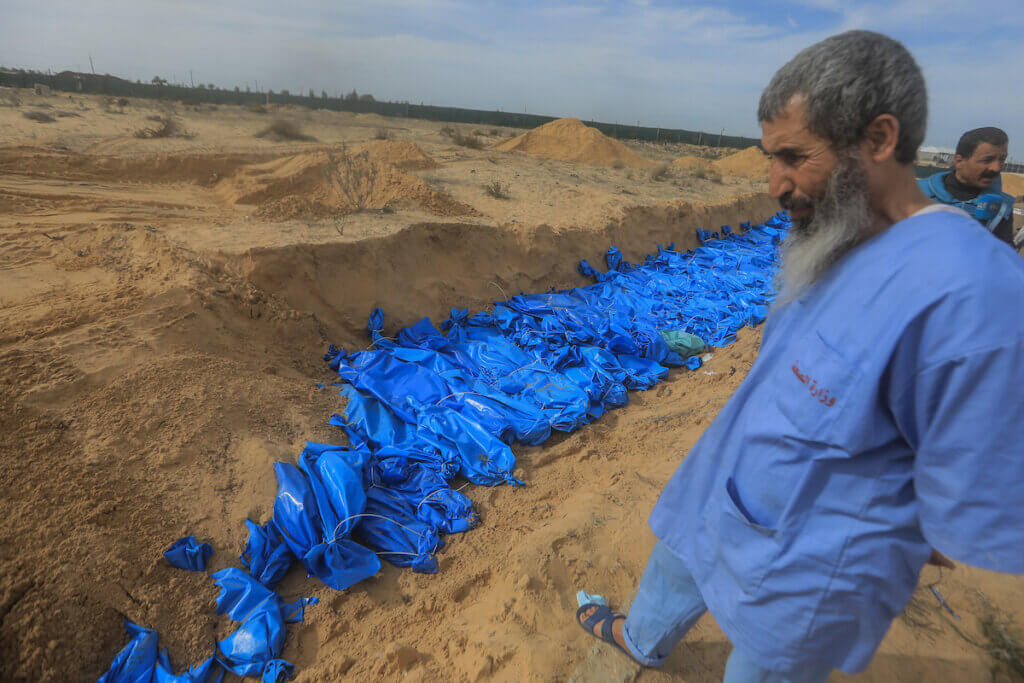
For over two years, Palestinians in Gaza have been declaring: “We are being exterminated.” These declarations did not emerge from official Israeli statements alone, but from lived experience, where Israeli military operations have turned Palestinian bodies into sites of extreme colonial violence. Yet, despite the visibility of mass displacement, bombardment, and starvation, much of the international community remains reluctant to categorize these actions as genocide.
In practice, Palestinian reality becomes “legitimate” only once it passes through the moral frameworks of international institutions—frameworks that often understate the scale of the violence. Recognition usually follows a lengthy process: assessment, verification, data collection, and the involvement of a “credible,” “neutral” authority to study and label the event. Only then can Palestinian suffering acquire a certain degree of legitimacy. In effect, Palestinians may die without restriction, but they are not permitted to name their own deaths without external approval.
In an effort to combat this, we have seen how Palestinian resistance figures, including Hamas itself, have attempted to contextualize the genocide in Gaza by using one of the most potent historical analogies in the Western lexicon: the Nazi holocaust.
In the context of colonial struggle, this is not simply a matter of terminology—it is a strategic challenge.
At first glance, Hamas’s media strategy to use the Nazi holocaust appears logical, intended to evoke the Western moral memory in an effort to mobilize public opinion. Yet after nearly two years, little has come of it. Why?
In the Western political imagination, the Second World War is a central moral reference point, and the Holocaust lies at its core. Western epistemic dominance has enabled these states to impose their ethical standards and define what behaviors are unacceptable, shaping the very foundations of the concept of “humanity.” The Holocaust was not a historical anomaly — the colonial histories of the same states that decry Nazi atrocities are replete with genocides and famines perpetrated against colonized peoples. What rendered the Holocaust a moral absolute was not the act of mass killing itself, but the identity of the targeted (European) body. In this sense, global moral frameworks have been built on a Eurocentric foundation.
By choosing to frame the events in Gaza through the Holocaust, Hamas reveals two dynamics. First, that the Palestinian tragedy is not being presented as a self-standing experience, but rather through the lens of another catastrophe — one that Western powers have designated as the archetype of atrocity. This reinforces the authority of a moral system that is selectively deaf to Palestinian suffering and inevitably grants primacy to Western trauma. Second, the use of this analogy sends a message to Western audiences: “Believe us, because what is happening to us resembles your own history.” This reinforces the idea that Western pain is the benchmark for all other suffering, against which all other strategies must be compared to be deemed credible. This dynamic risks undermining the Palestinian historical experience by situating it within the moral order from which it seeks to break free.
There is also a structural problem in the comparison itself. By invoking the Holocaust and Nazism, the Gaza war is placed in an unwinnable position — the comparison is judged against a metric designed to keep the Holocaust at the top of the hierarchy of atrocities. This overlooks the fact that the Holocaust occupies a protected space in Western collective memory, one maintained through decades of investment in museums, films, literature, and education. The enormity of Nazi crimes is thus pictured as unmatched, meaning that if the violence in Gaza is perceived as falling short of that standard — for example, lacking the iconic imagery of gas chambers — it becomes easier for skeptics to reject the genocide label.
Furthermore, the term “Zio-Nazism” frequently used by Hamas is imprecise. While similarities exist, including advancing an ideology of racial supremacy, Zionism is a settler colonial project, and Nazism was not. While both have committed grave crimes, these crimes differ in substance and purpose. Israeli policies in Gaza are best understood as part of the longer historical continuum of settler-colonial violence, not as a direct iteration of Nazi methods. Technically and politically, the analogy risks obscuring the structural logics of Israeli violence and allows Israel to dismiss the charge by discrediting the comparison.
When Hamas chose to employ the Holocaust and Nazi comparisons, its intended audience was clearly the Western international community. This reveals two related problems. The first is a misreading of the structural nature of Western support for Israel — seemingly assuming that the West’s position is driven by ignorance or moral blindness, rather than by longstanding strategic and colonial interests that position Israel as a functional ally in the region. In this view, Western securitization of Palestinians and of the resistance could be reversed if the public were persuaded to see Israel through a different moral frame, such as that of the Holocaust.
It also overestimates the likely impact of Western public pressure on state policy, misjudges which alliances are viable, and constrains its diplomatic maneuvering to frameworks set by others. In such a context, the Holocaust analogy does not merely fail to persuade — it signals an underlying strategic posture that risks hindering the movement’s ability to convert battlefield gains into long-term political advantage.
Resistance and liberation are not solely about reclaiming land; they are equally about reclaiming imagination, consciousness, and language. At first glance, speaking of decolonizing knowledge frameworks during a war of extermination may seem secondary — yet it remains essential. What is happening in Gaza today is not an exceptional event, nor does it resemble the Holocaust as the West has constructed it in its moral imagination. Rather, it is the continuation of a long colonial legacy — one that has shaped not only the fate of Palestinians but that of other peoples across the Global South.
Seeing Gaza’s present as part of this broader colonial continuum is essential for building new alliances in a shifting geopolitical order. The region’s own colonial history offers ample comparative frames to expose atrocity, without reinforcing moral regimes that — after more than two years — have yielded very limited diplomatic and political returns for the Palestinian struggle.
The way we name what is happening is not a symbolic act; it fundamentally shapes the trajectory of strategic thinking and is an indicator of how we perceive things and how we think we are perceived by others. Decolonizing the frameworks through which we speak is therefore not merely a symbolic goal, but a strategic pathway toward a political and diplomatic practice capable of translating tactical gains on the ground into long-term strategic victories — using terms we define ourselves, rather than those imposed from outside.


This article is wrong about the colonialism frame. Israel is first and foremost a racist project. The West tries to atone for the Holocaust by giving Jews a Jewish state at the expense of Palestinians.
What Hamas should say is not.”this is a new Holocaust”, but “does the Holocaust (a result of EUROPEAN antisemitism) justify a genocide on Palestinians?”
from
Silence for Gaza // Mahmoud Darwish
Gaza is far from its relatives and close to its enemies, because whenever Gaza explodes, it becomes an island and it never stops exploding. It scratched the enemy’s face, broke his dreams and stopped his satisfaction with time.
Because in Gaza time is something different.
Because in Gaza time is not a neutral element.
It does not compel people to cool contemplation, but rather to explosion and a collision with reality.
Time there does not take children from childhood to old age, but rather makes them men in their first confrontation with the enemy.
Time in Gaza is not relaxation, but storming the burning noon. Because in Gaza values are different, different, different.
The only value for the occupied is the extent of his resistance to occupation. That is the only competition there. Gaza has been addicted to knowing this cruel, noble value. It did not learn it from books, hasty school seminars, loud propaganda megaphones, or songs. It learned it through experience alone and through work that is not done for advertisement and image.
Gaza has no throat. Its pores are the ones that speak in sweat, blood, and fires. Hence the enemy hates it to death and fears it to criminality, and tries to sink it into the sea, the desert, or blood. And hence its relatives and friends love it with a coyness that amounts to jealousy and fear at times, because Gaza is the brutal lesson and the shining example for enemies and friends alike.
Gaza is not the most beautiful city.
Its shore is not bluer than the shores of Arab cities.
Its oranges are not the most beautiful in the Mediterranean basin.
Gaza is not the richest city.
It is not the most elegant or the biggest, but it equals the history of an entire homeland, because it is more ugly, impoverished, miserable, and vicious in the eyes of enemies. Because it is the most capable, among us, of disturbing the enemy’s mood and his comfort. Because it is his nightmare. Because it is mined oranges, children without a childhood, old men without old age and women without desires. Because of all this it is the most beautiful, the purest and richest among us and the one most worthy of love.
We do injustice to Gaza when we look for its poems, so let us not disfigure Gaza’s beauty.