

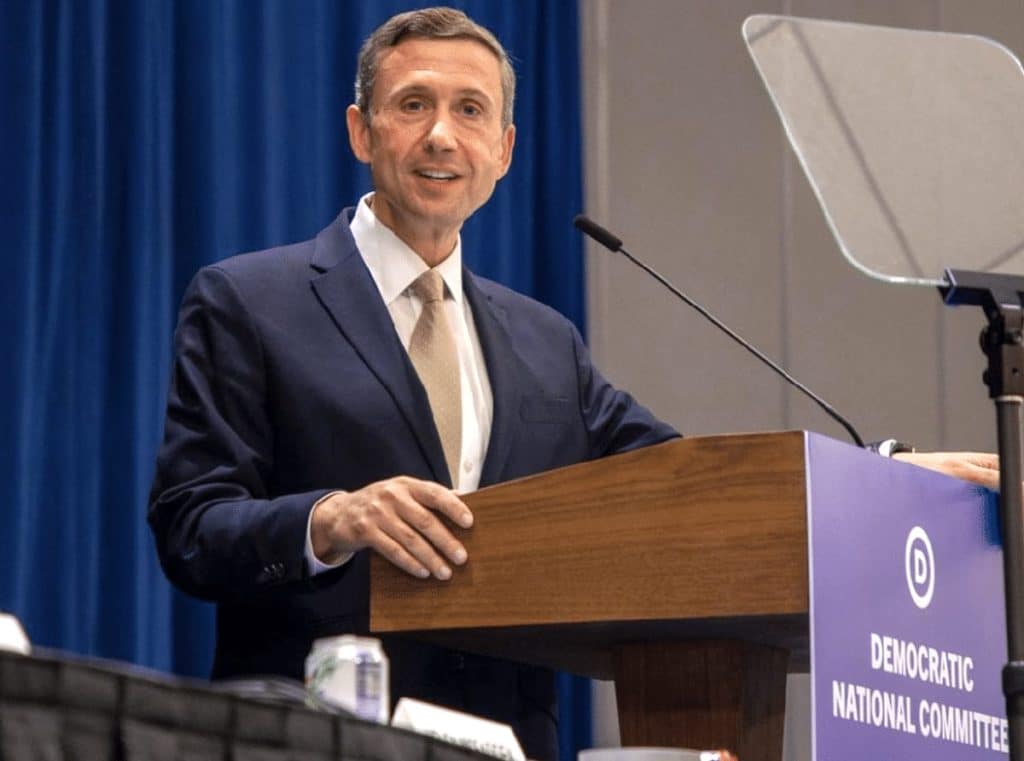
The Democratic National Committee’s summer meeting in Minneapolis last month ended not in dysfunction, but in deliberate avoidance. At the very moment when grassroots Democrats demanded a clear stand on Gaza, party leaders chose to bury the debate entirely rather than let members vote their conscience.
DNC Resolution 18, which called for a ceasefire and suspension of military aid to Israel, was first defeated, then a watered-down substitute was quietly withdrawn, and finally the entire meeting was abruptly adjourned. With that, party leadership extinguished debate while families in Gaza faced more famine and bombardment, and while three-quarters of Democrats oppose sending more military aid to Israel.
DNC Resolution 18, introduced by 26-year-old DNC member Allison Minnerly of Florida, called for a ceasefire, suspension of U.S. military aid to Israel, and recognition of Palestinian statehood. A Quinnipiac poll released before the meeting found that 35% of Democrats support more military aid to Israel, the lowest level on record. Gallup polling likewise shows Democratic support for Israel’s Gaza operations has collapsed.
In other words, Resolution 18 simply put on paper what the party base already believes. But party leaders, aided by lobbyists and sheep-like DNC members, ensured it never stood a chance. Resolution 18 was defeated, but the vote revealed just how far support for Israel has fallen in the party.
The fight over Resolution 18 was more than a simple vote over a symbolic resolution. The story shows how the Israel lobby is doing all it can to prevent Democratic Party leadership from honoring the overwhelming will of party members. It also is a harbinger of fights to come, as support for Palestine only continues to grow in the party in reaction to Israel’s genocide in Gaza.
Israel lobby interference
Democratic Majority for Israel (DMFI) mobilized aggressively against Resolution 18, calling it “flawed, irresponsible,” and arguing:
“The resolution’s failure to even mention Hamas’ October 7th attack on Israel, which killed more than 1,200 people and saw more than 250 others kidnapped, is irresponsible and dangerous. Rewarding Hamas’ terrorism would not end this war. It would prolong it, embolden terrorists everywhere, and jeopardize America’s national security.”
DMFI insisted the measure would “deepen divisions in our party” and pledged to fight its advancement. DMFI was involved in providing input for the drafting of Resolution 3, the DNC chair’s watered-down substitute. Given DMFI’s history of dumping millions into Democratic primary elections and given that Ken Martin, the Democratic Party chair, has emphasized the DNC officers must not put their thumb on the scales in Democratic primaries, it raises the question as to why DMFI was involved in drafting Resolution 3. The last time the DNC had a debate at the Resolutions Committee on the issue of Palestine was in 1988.
The DMFI rhetoric was not confined to press releases. On the day of the vote, handouts of these identical talking points were distributed directly inside the Resolutions Committee; and it was clear that pro-Israel lobbying groups had activated its members to present opposition within the meeting. DMFI later applauded the Resolutions Committee’s move to crush Resolution 18. DNC member Millie Herrera, who served on the Resolutions Committee for the Hispanic Caucus, initially co-sponsored the resolution, but withdrew her support and instead backed Resolution 3.
Before the Resolutions Committee vote, a letter was placed at the desks of Resolutions Committee members that had been organized by the Jewish Democratic Council of America (JDCA), an Israel lobby group. signaling the campaign underway. The letter implied that Resolution 18’s call for an arms embargo,, which Democratic votes overwhelmingly support and is every state’s obligation in cases of genocide , would be “emboldening Israel’s adversaries.”

A photo of the letter organized by the Jewish Democratic Council of America that was circulated to the Resolution Committee in opposition to Resolution 18. 
A photo of the letter organized by the Jewish Democratic Council of America that was circulated to the Resolution Committee in opposition to Resolution 18.
What the vote tells us
When the committee finally voted, in a voice vote, Resolution 18 was defeated. But the story was not just who voted no, it was also who refused to take a stand. Five members abstained: Deborah Cunningham Skurnik (California), a longtime fundraiser with ties to pro-Israel donors; Samuel Vilchez Santiago (Florida), an ambitious young politician guarding his career prospects; Harini Krishnan (California), who brands herself progressive while avoiding hard conflicts; Ada Briceño (California), a prominent labor leader; and Otto Lee (California), a Silicon Valley official.
Their abstentions were calculated acts of self-preservation made at the expense of Palestinian lives and grassroots voices. Yet they were also telling. Just a few years ago, a measure calling for an end to U.S. military aid to Israel would likely have been buried by a solid bloc of “no” votes. The fact that these members could not bring themselves to oppose Resolution 18 outright shows how much the ground has shifted.
Even among cautious politicians and careerists, there is recognition that the base of the party has moved and that standing against Palestinian rights outright now carries risks. Abstention, in this sense, became the escape hatch: a way to avoid angering lobbyists, but also to avoid going against the majority of Democratic voters who support an arms embargo.
The DNC’s answer: avoid Palestine at all costs
Once Resolution 18 was shared, DNC Chair Ken Martin introduced his own “compromise,” calling for a ceasefire, hostage releases, humanitarian aid, and reaffirming a two-state solution while carefully avoiding weapons transfers. According to DMFI and JDCA, this alternative was crafted with the help of Israel lobby organizations but even this minimal measure didn’t survive. Martin withdrew it himself after approval, reportedly to avoid a fraught vote over the measure which would surface the deep divisions over Israel in the party. Instead, Martin promised to establish a task force with no membership list, no scope, and no deadline.
The next day Martin abruptly ended the full DNC meeting following a motion en bloc to accept all recommendations from the Rules and Bylaws Committee and Resolutions Committee
The party left Minneapolis without a single policy statement on Gaza.
Much of the mainstream media framed this as dysfunction: Democrats “passed, then pulled” their own resolution. But grassroots activists understood it differently, not dysfunction, but deliberate avoidance. Rather than let members vote their conscience, party leadership chose to bury the debate entirely. The consequences are serious. While famine ravages Gaza and U.S. weapons fuel the destruction, three-quarters of Democrats oppose sending more military aid to Israel. Yet the party machinery denied DNC members even the chance to vote on the question.
By privileging outside lobbyists over grassroots voices, the DNC risks alienating young people, Arab and Muslim Americans, progressive Jews, and the activists who form the heart of Democratic turnout in swing states. This whole fiasco showed whose voices are heard and heeded when decisions get made.
The next fight
Minneapolis will not be the last word. If the DNC wants to rebuild credibility with its base, several changes are urgent before the next meeting in Los Angeles on December 11–13, 2025.
I write these recommendations not as an outsider, but as someone who has been engaged in this work for decades. I began supporting the Democratic Party in 2004 when I was in law school as John Kerry ran for president, and have volunteered for local, state and federal campaigns ever since, because I believe in the power of voting. In 2020, I helped flip three Florida counties blue in the presidential election and supported out-of-state voter mobilization for the Georgia Senate runoff in 2021 for now Senator Jon Ossoff. That organizing landed me a seat on the Florida delegation to the Democratic National Committee, where I later served as co-chair of the DNC Interfaith Council and as a member of the Executive Committee of the DNC’s Women’s Caucus.
I was also the first DNC member to publicly call for Joe Biden to step aside following his disastrous debate performance last summer. At the time, I warned that Gaza would cost Democrats not only the White House, but also control of the Senate and House. My warnings were summarily ignored, and here we are. My political activism grows out of that experience, and from conversations with other grassroots Democrats who have long fought to align party policy with the values of its voters.
If we want to move forward as a party, these actions must be taken:
End lobbyist capture. Outside groups should not have access to distribute handouts in committee rooms or dictate internal debates through pressure and emotional blackmail campaigns.
Guarantee democratic process. Any Gaza resolution meeting the threshold must receive a recorded floor vote with names published immediately.
Demand accountability. Grassroots activists should press abstainers to explain their silence and commit to supporting future Gaza resolutions.
Build pressure from below. State parties must continue filing Gaza resolutions until national leadership can no longer deflect grassroots demands.
Force transparency. If the promised task force moves forward, it must publish its membership, include youth and Palestinian/Arab/Muslim voices, and deliver recommendations within eight weeks or be exposed as pure deflection.
The DNC’s entrenched leadership thought that procedural maneuvers could defuse the Gaza debate. Instead, they exposed how thoroughly lobbyist pressure has exerted control over the party apparatus. Unless Democrats change course, Minneapolis will be remembered not as a moment of unity, but as a pivotal moment when party leaders chose to ignore their own voters and turn their backs on Gaza.
The base is watching. And the base remembers.


“The DNC’s answer: avoid Palestine at all costs”
I get it: Israel is a hot potato for American politicians. But what’s always puzzled me is that the Jewish community provides plenty of cover for any politician who wants to be critical of Israel, it would be easy for Democrats to claim they have Jewish support for an arms embargo or recognition of a Palestinian state, whatever. Commanders for Israel’s Security ( About Us | Commanders for Israel’s Security ) wants Palestinian state, and these folks are not lightweights. 9,000 Israelis sign a petition to recognize a Palestinian state (9,000 Israelis sign petition to recognize Palestinian state ahead of UN summit | The Times of Israel ) – it’s not a huge number but it’s not chopped liver, either. Various foreign policy experts point out that a Palestinian state would be good for Israel ( A Palestinian State Would Be Good for Israel: The Chance for a Two-State Solution Still Exists—but Won’t for Long ). Avrum Burg, a former speaker of the Knesset, speaks out on Israel’s crimes ( “A Kingdom of Wickedness” – by Peter Beinart ).
So why don’t the Dems avail themselves of this cover?
This is an example of how the US Supreme Court’s Citizen’s United Decision has made moneyed interests such as AIPAC much too powerful. Our Democracy is being destroyed from within by the power of these rich lobbying groups (hello, AIPAC) and the billionaire class (example: doxing tycoon, Bill Ackman).
The elected Democratic Party politicians who are being bought by special interests need grow a spine, resign or face a primary challenge.
Jim Zogby has been talking about this for some time. He points out that the DNC doesn’t make policy. Candidates do. There are going to be more Zohran Mamdanis, more AOCs.
Maybe Cori Bush will be re-elected. If she is, that will shake up the DNC.
I’ve commented in the past that like Spinoza, the American Founders employed the circumlocution “Nature’s God” in the Declaration of Independence, because they did not accept standard Jewish or Christian beliefs. Benjamin Franklin wrote about his religion and non-Christian beliefs in his autobiography from 1777-1790. He believed in a Supreme God who was the father of many other Gods, each with their own Sun, and planets. He was a Grandmaster of the Pennsylvania Scottish Rite. See NMJ | Brother Benjamin Franklin.
Many of the founders of the American Scottish Rite Masonry were Jewish: On August 5, 1813, the Jurisdiction’s first Northern Supreme Council was formed by Emanuel De La Motta (1760–1821), in his capacity as the Southern Jurisdiction’s Grand Treasurer General. The Council consisted of six members – Daniel D. Tompkins (1774–1825), Sampson Simson (1780–1857), John James Joseph Gourgas (1777–1865), Richard Riker (1773–1842), John Gabriel Tardy (1761-1831), and Moses Levi Maduro Peixotto (1767–1828). Of these seven men, three were Jewish – De La Motta, Simson, and Peixotto. Other prominent Jews involved with the establishment and founding of the Scottish Rite include Massachusetts Lodge Grandmaster Michael Hays (1739–1805). He was Judah Tuoro’s uncle and the official who first refused to recognize Prince Hall Masons. There were three of the Southern Jurisdiction’s founding members – Abraham Alexander (1743-1816), Israel Delieben (1740-1807), and Moses Clava Levy (1749-1839). Dr. David Peixotto was the Grandmaster of the Washington D.C. Lodge.
Today independent scholars and large teams of Israeli and US archeologists, geneticists, historians, and philologists working together have confirmed that Palestinian Christians and Muslims are descended from 1st Century Judeans, Samaritans, and Galileans. Many of them inherited more than 60-70 percent of their Y-Chromosome DNA from the ancient Canaanites buried throughout the Levant and Near East. Freemason Winston Churchill described the Arabs as a “lower manifestation” than the Jews, whom he viewed as a “higher grade race” compared to the “great hordes of Islam”. He referred to Palestinians as “barbaric hordes who ate little but camel dung”.
“We insisted on reserving the right to bomb niggers.” So David Lloyd George explained the British government’s demand at the 1932 World Disarmament Conference to keep the right to bomb for “police purposes in outlying places”.
The Forward observes that the Balfour Declaration was an antisemitic, racist undertaking. It was said to be based upon a mistaken British government view of the small group of officials in charge of foreign policy for the Ottoman Empire and its Young Turks Movement. The notion that new Freemason Leaders and B’nai B’rith Lodges established in Manchester and London by Atheists and Zionists appointed as Presidents (Chaim Weizmann and Herbert Bentwich) in 1915 took control of the Paris Peace Conference over the objections of American B’nai B’rith, Reform, and Scottish Rite mainstream majority became the elements of the modern narrative, e.g. See The Balfour Declaration and B’nai B’rith: An Important Backstage Role and Annals of the Academy of Romanian Scientists
Series on History: FREEMASONRY AND THE PARIS PEACE CONFERENCE
(JANUARY 1919 – JUNE 1920)
I don’t believe there ever was, or is, “a worldwide Zionist or Jewish conspiracy”. But during the 17th through early 20th centuries in the United States there were British and US Imperialist-Colonial governments that suppressed the rights of dissidents, religious and racial minorities, and slaves. One precaution taken by Jews was to establish and join secret societies with regalia, passwords, oaths, and secret signs that they hoped would be useful to promote the interests of the wealthy members and help improve the social standing of the their insiders. The notion that Freemasonry was Jewish or had a common monotheistic belief in God and the universal brotherhood of mankind had no basis in reality. Grandmasters, like Ben Franklin were free to espouse polytheistic views and thought most Europeans were unsuitable immigrants to the New World. He wrote that all except Anglo-Saxons were dusky or non-white – could never be assimilated, and were racially undesirable.
Likewise, the American Jews adopted the genocidal and supremacist racial views of their “White” counterparts, like the Young Americans, Manifest Destiny, American Imperialism, and a European-American “Jewish race” of non-religious political leaders like Benjamin Disraeli, August Belmont, and Judah P. Benjamin who were not practicing Jews as adults and did not affiliate with the Jewish community or converted.