In early March 2024, Raunaq Alam, 32, Afsheen Khan, 23, and Julia Venzor, 26, vandalized Uncommon Church in Hurst, Texas, a nondenominational Christian place of worship. The associated graffiti, reading “Fuck Israel” with three down turned red triangles, was left along with stickers with a secure layer of spray adhesive on the church’s flagpole. An Israeli flag waved from the top of the flagpole and was visible from the main road.
The vandalism was done in protest, as the church is an outspoken supporter of both Israel and the Israeli military. Now referred to as the “Tarrant Three” by fellow organizers, Khan’s court case is due to start soon, where she is facing hate crime and criminal mischief charges with a possible sentence of 10 years in prison.
Alam has already seen his day in court and was recently re-arrested and released on bail for charges related to his trial for the fifth time. Alam, who beat his own hate crime charge with the help of 12 Tarrant County jurors, has not seen more than a few days of freedom. His guilty verdict on the criminal mischief charge came with a jury recommendation for five years probation, however, this did not keep the judge from handing down a sentence of a conditional 180 days in jail. After entering the appeals process and being arrested once more, he is currently on an ankle monitor with a curfew.
Venzor variably accepted a deal offered by the state in exchange for a guilty plea and “truthful” testimony against her codefendants. Throwing herself on the mercy of the court, Venzor was also one of the Garland 23, along with Khan, a group of protesters who blocked entrances to local arms manufacturer General Dynamics in 2024. Venzor has publicly admitted that she would not have taken the deal from prosecutors if not for her concern for her two young children. Despite her guilty plea to a hate crime enhancement to her charges, she testified during Alam’s trial that she didn’t think what they did was a hate crime.
Khan commented on the state’s aggression toward the Three.
“Raunaq has always been outspoken about injustice. He deeply cares about the Palestinian people. It’s so hard to see someone like Raunaq who is filled with so much love be painted out as a hateful person,” Khan said to Mondoweiss. “And the state is well aware of the terror and intimidation they’re wielding […] For Julia, the pressure got so intense, she had to face the very real possibility of her children growing up without their mother. She did the only thing she could and accepted a plea for probation to testify against us.”
Aggressive prosecution includes treating Israel criticism as a hate crime
None of the Tarrant Three has ever contested whether they vandalized Uncommon Church. After all, the church had been comparably flagrant in its fundraising for the Israeli military.

Khan and Alam’s legal representatives only argue against the hate crime enhancement and seek probation for the criminal mischief charge. A hate crime is considered a third-degree felony and is punishable by a prison sentence of up to 10 years.
The prosecution’s allegation that the three’s actions constituted “hate speech” against a protected group: namely, people of Jewish faith is a controversial one. Their graffiti tag only mentioned Israel and one sticker directly stated “Anti-Zionism ≠ antisemitism.” Experts have weighed in on the charges, voicing concerns that the hate crime enhancement could have an adverse effect on the free speech rights of Texans and Americans at large.
Alam’s treatment may be a bad omen for Khan, who will be the next to go to trial.
The state brought on Assistant District Attorney Lloyd Whelchel, who typically handles capital murder cases, to prosecute the defendants. This was done in order to ensure the harshest sentence in the Three’s trials, according to Alam’s lawyer Adwoa Asante. Also, Judge Brian Bolton, despite being a misdemeanor judge, followed the cases in their escalation to felony charges, and is responsible for the added condition of 180 days in jail to Alam’s probation against the jury’s recommendation. This represented the harshest possible supplement he could have added to the sentence. Finally, Alam’s lawyer also alleged Bolton participated in unauthorized communications in a failed recusal motion (denied by Bolton himself), which has led legal professionals in Texas to call the judge’s impartiality into question.
“I’m not sure why Judge Bolton has so much time in his court schedule that he can devote an entire week to a case that is not assigned to his court,” Khan’s lawyer, Alison Grinter Allen said. “And I certainly also wonder why the assistant district attorney, who is a death penalty prosecutor, has so much time in his schedule that he has time to devote this much of his very important time to misdemeanor graffiti, but that is a question that only they can answer.”
Neither Whelchel nor Bolton responded to requests for comment.
A church committed to the Israeli occupation
At Alam’s hearing, Uncommon’s lead pastor, Brad Carignan, testified that the damages cost the church $1,750. Although he admitted during his testimony that one of his employees repainted the wall, the cost, and the fact that the vandalism took place on a church influenced the state’s elevation to felony charges from what had originally been misdemeanor vandalism.
“Attacks on churches can be seen as attacks on communities. And in North Texas, with the fire bombings of Black churches, this has a real history to it, because people attack groups through their church,” Allen told Mondoweiss. “And weaponizing the gains of the Civil Rights Movement has been the Right’s whole vibe this past, like five or six years.”
Beginning its operations almost a decade ago, Uncommon Church is more of a televangelist platform than a contemporary church, hence its name “Uncommon.” Still, their content reach has been somewhat limited, with most videos clocking in at around 500 views, save for one: “The Truth About Palestine,” which has over 400,000 views. The video recounts many common anti-Palestinian Zionist arguments through the gloss of interwoven bible verses interpreted as allusions to Israel.
Carignan has facilitated tours of Israel for churchgoers and emphasizes the importance of Christian support for the occupying state. In fact, Israel has its own section on the Uncommon website’s about page. Likewise, Carignan’s wife Josie has raised funds for the Israeli military through the sale of pro-Israel apparel, and the Carignan family ties to the Israeli occupation run even deeper. Josie’s sister Johanna is married to Doron Keidar, a commanding officer and Israeli social media personality, and she runs the social media account and podcast @dailybreadmoms, where she shares a perspective of Israel from an “IDF wife and homeschool mama living in the mountains of Judah.”
Dangerous precedent
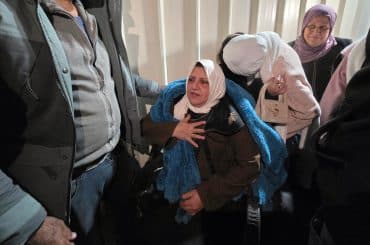
The state’s hostility was noted by Alam’s supporters during Whelchel’s closing arguments, as he accused the gallery, like Alam, of “[clothing] themselves in righteousness.” The gallery was predominantly made up of fellow organizers in keffiyehs and family friends in hijabs.
“[The prosecutor] gestured to us – I don’t know what we’re called, visitors, guests – when we don’t have the right to speak,” one gallery member told Mondoweiss between court sessions. “He was clearly accusing us. Do we have the right to defend ourselves? We’re not on trial!”
Both the state and the judge’s harsh legal response to the actions of the Three signal a disturbing trend to both Asante and Allen, which could have repercussions in similar cases pertaining to Palestine activism around the country. Asante has compared the concept of a state, in this case Israel, being a victim of a hate crime, a protection meant to be offered to marginalized people, to the new ‘personhood’ of corporations as exemplified in the Citizens United case, with similarly dangerous consequences.
“I don’t think that [the DA] has decided that this is going to be handled under normal circumstances, and that’s his office’s decision… [the Three] have been singled out,” Allen said. “That is a political decision. That’s why we elect prosecutors, and the voters need to hold Phil Sorrels accountable for his choices, just like every other elected official is held accountable for their choices.”
Khan’s trial date was recently rescheduled to December 2.