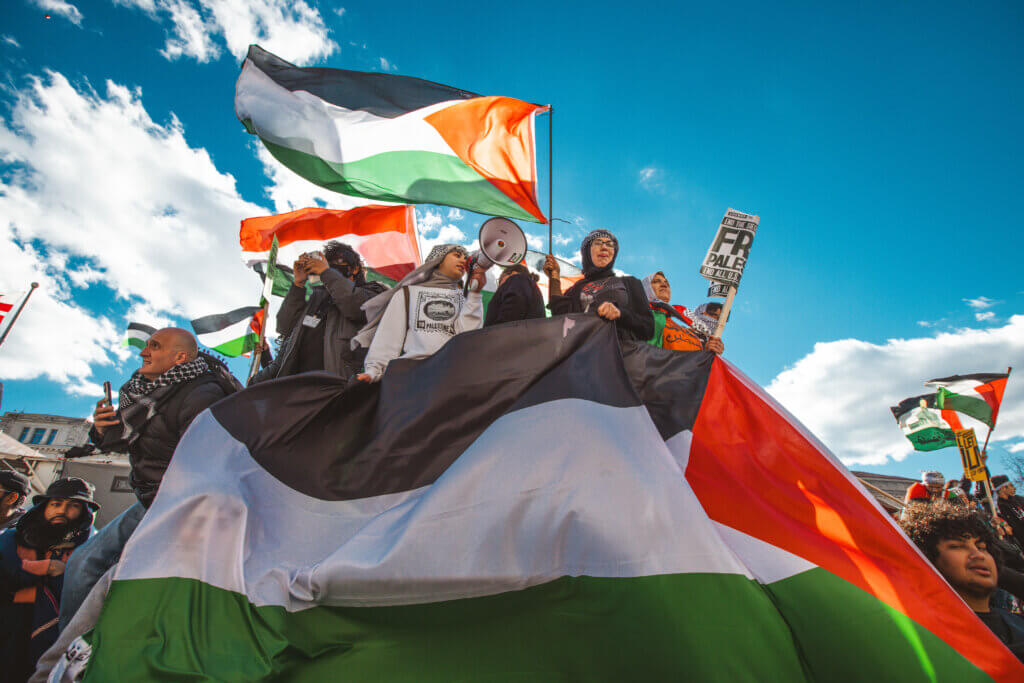
As recent reports have shown, the Global Sumud Flotilla was illegally intercepted by Israeli occupation forces in international waters, sparking outrage across the world. In response, dockworkers’ unions have called for a national strike on Friday, October 3. Against this backdrop, the slogan “Globalize the Intifada” has echoed across protests and demonstrations worldwide, becoming a rallying cry for those who see in the Palestinian struggle a universal fight against oppression.
Everybody has been repeating the slogan, but what does it actually mean, and why is it significant?
At its core, it captures the idea that the Palestinian Intifada — the term Palestinians popularized during their grassroots uprising against the occupation back in 1987, and which means to “shake off” and “rise up” — was never just a local uprising confined to the streets of Gaza or the alleyways of the West Bank. It was, instead, a model of struggle that revealed how ordinary people could resist a system of domination with nothing but their own bodies, voices, and determination. To globalize the Intifada means to recognize that this form of resistance — decentralized, popular, and rooted in everyday life — carries lessons for oppressed peoples everywhere.
The Palestinians showed that an uprising can outlast tanks and warplanes if it draws strength from the daily persistence of ordinary people.
The essence of the Intifada, as the late Egyptian scholar Dr. Abdel-Wahab El-Messiri explained,1 is that it was not a conventional revolt led by an army or a single charismatic leader. Its very power lay in the absence of formal leadership. There was no one person to assassinate, no headquarters to bomb, no command structure to dismantle. The uprising was carried on the shoulders of civilians, workers, farmers, mothers, children, and teachers. All of them transformed resistance into a daily practice.
In this way, the Intifada was immune to the tactics normally used by occupiers to crush revolts. What made it endure was precisely that resistance was normalized into the daily rhythm of life. Palestinians went to work, to school, to the market, and in the same breath, participated in protests, strikes, or acts of defiance.
The uprising did not require people to suspend their lives; instead, it was woven into their daily existence. For El-Messiri, this was what gave the Intifada its unique character: not a momentary eruption of rage, but a way of life.
Because of this, the Intifada could continue for years without burning out. It was not sustained by a single dramatic act of violence, but by countless small, persistent actions carried out by an entire society. Each person, each neighborhood, carried their share of the struggle. This made the uprising not only durable, but also deeply democratic — rooted in the collective will of the people rather than the orders of a few leaders.
To call for the Intifada to be globalized is, therefore, to call for this lesson to be understood and embraced: that resistance is strongest when it is decentralized, when it belongs to everyone, and when it becomes inseparable from the very act of living under oppression.
The message of the intifada is not confined to Palestine. To make resistance inseparable from daily life means recognizing that solidarity is not only expressed in moments of crisis or mass protest, but in the choices people make every day. People of the world need to carry the Palestinian cause in their hearts because it is a cause that represents injustices everywhere. The intifada is a culture of resistance that can be adopted, as we have seen in the last two years, with weekly protests and marches for Palestine. But a lot more can be done to put an end to the 77 years of occupation in Palestine.
Injustices cannot and should not be normalized. People around the world bear a responsibility to amplify marginalized voices, support strikes and boycotts when they arise, and link their personal routines, whether at work or in classrooms, to the wider struggle for justice. To globalize the Intifada is not just about chanting a slogan, but about practicing a form of steadfastness (sumud) that transforms ordinary life into a site of dignity and defiance.
It has become more than a chant at rallies; it is a statement about how liberation movements must adapt in an age of asymmetrical power.
The Palestinians showed that an uprising can outlast tanks and warplanes if it draws strength from the daily persistence of ordinary people. As strikes spread and voices echo across continents, the cry to globalize the Intifada reminds us that the struggle for freedom in Palestine is inseparable from the wider human struggle for dignity and justice.
Notes
- Al-Messiri, Abdel Wahab. The Palestinian Intifada and the Zionist Crisis: A Study in Perception and Dignity. Cairo: Alfaneya Print, 1988. ↩︎