

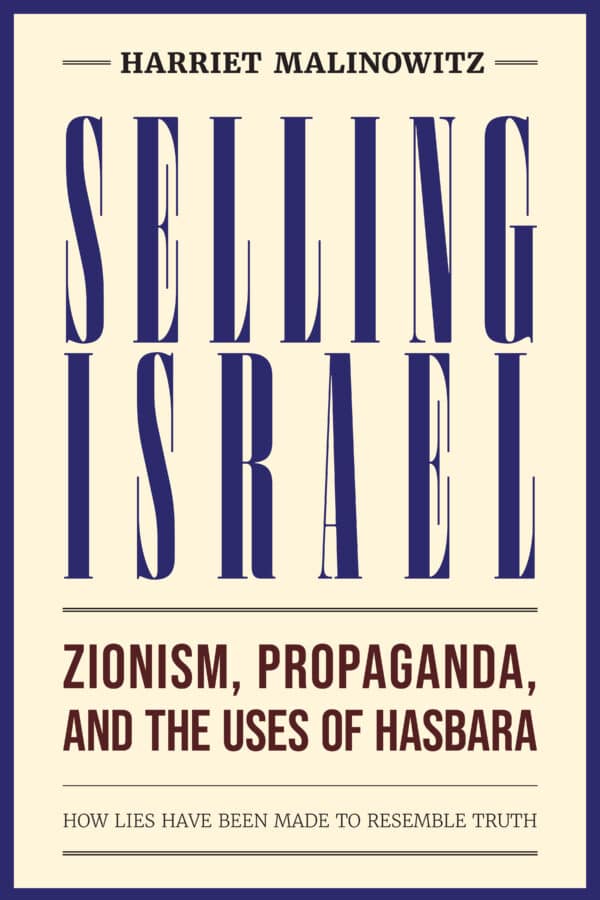
There are a number of pressing questions at the heart of Harriet Malinowitz’s newly released book, Selling Israel: Zionism, Propaganda, and the Uses of Hasbara. “How could what was initially a small group of Eastern European Jewish thinkers and activists convince the Jews of the world to agree that they were all one ‘people’ undergoing one shared threat with one shared path to salvation – as well as a shared imperative to seek it?” she asks. “How could they convince the rest of the world to include them in the family of nations? And how could they convince all involved – including themselves – that their project of liberation was a benign and noble one to which they were entitled, producing no casualties or collateral damage?”
The answers to these queries are at the crux of Selling Israel, and the book not only systematically examines them, but dives into how hasbara – globally enacted but Israeli government-instigated propaganda and public relations efforts– has been used to boost Zionism, diminish the perception of Palestinian oppression, and promote the fallacy that the 78-year-old country began as a land without people.
The exhaustively researched work was touted by Publisher’s Weekly as “an impressive and meticulous challenge to established narratives.”
Malinowitz spoke to reporter Eleanor J. Bader about herself, her research, and her findings shortly after the book’s publication.
Eleanor J. Bader: Did you grow up believing that Israel was necessary for Jewish survival?
Harriet Malinowitz: Actually, I was not initially given the usual sales pitch about Israel – that the country was established as a safe place for Jews. What I heard instead was that Israel was wonderful because everyone was Jewish – the bus drivers, the garbage collectors, the teachers, the bankers, the policemen. Everyone!
Bader: When did you begin to question this?
Malinowitz: It was a gradual process. I went to Israel for the first time in 1976 with my mother and brother, then returned in 1977 and spent several months on a kibbutz. I visited again in 1982 and 1984.
When I was eight, my aunt moved there. She was in Israel from 1962 until 1969, and we sent letters back and forth. Her letters included a lot of local color about the kibbutz where she lived.
My Hebrew school teacher had me read them aloud in class and beamed until one letter concluded that Israel was a great place to visit, but not to live. The letter was suddenly snatched from my hand.
When my aunt returned to the US, she brought her Iraqi-born husband, who was justly resentful about how Mizrahi Jews were treated by the Ashkenazi elite in Israel. He was an economist and faced a glass ceiling in his work there. He was glad to get out.
During my own time on a kibbutz, there were Palestinian men working in the fields not far from the kibbutz members and international volunteers, but when we were all called in for a break in the “breakfast hut,” I saw that they simply kept working. I also met and drank tea with Palestinian merchants in the “shuk,” or Arab market, in Old Jerusalem, so I realized that what I’d been told about everyone in Israel being Jewish was untrue. I was told they were “Israeli Arabs” – without any coherent explanation. This left me completely baffled. Still, I was sure that I must be the one who wasn’t getting something.
When I returned to the U.S. in 1984, I became involved with Central American solidarity work, which gave me a dawning awareness of international military support structures and the propaganda we received about them as Americans. Meanwhile, I read Lenni Brenner’s 1983 book, Zionism in the Age of Dictators, which talked about Zionist complicity with Nazis. That provided another jolt.
I knew just enough to be excited by the first Intifada in 1987. But by the time of the second Intifada in 2002, people had cell phones and I could hear gunfire in Jenin via Democracy Now! on the radio. There were now blogs and listservs which carried information in new ways. But I was still naïve enough to be astounded that Israel refused to let a UN fact-finding team into the area.
This was a real turning point for me.
While I was in Australia in 2004, I read Ilan Pappe’s The History of Modern Palestine, in preparation for attending a small gathering of Sydney journalists, academics, and activists at which Pappe was the guest of honor. One of the main takeaways of that evening for me was that it was actually 1948, not 1967, that was the key year for understanding the situation. Another lesson was that change was not going to come from inside Israel but was up to Palestinians and allies in the rest of the world. The discussion at that gathering had a huge impact on me, and when I returned to the U.S., I plunged into research on the history of Palestine and of Zionism and eventually merged those interests with my research on propaganda, already well underway. I soon knew that I wanted to write a book on Zionism and propaganda, but it took me twenty years to complete the project!
Bader: The idea that God promised Israel to the Jews is largely unchallenged. Why is this?
Malinowitz: I think people are afraid to mess with other people’s religious beliefs, particularly where God is concerned. Plus, a lot of people believe the claim!
Bader: You write that Israelis rarely invoked the Nazi Holocaust before the 1960s because it was felt that the loss of six million Jews seemed like a sign of weakness, as if they’d gone to their deaths “like sheep to the slaughter.” Yet you also note that the genocide was seen by David Ben-Gurion to be a ‘beneficial disaster.’ Can you elaborate?
Malinowitz: I was shocked by how disparaged survivors of the Holocaust were in the country’s early years, as if they were a stain on Israeli masculinity that had to be expunged. Later, though, there was an ideological shift; the Israeli military reassured the world that they were strong, determined, and capable of fighting back if attacked, but at the same time the Holocaust could be invoked as a reminder of their perpetual victimhood, justifying all their exploits in the name of averting another genocide against the Jewish people. Similarly, the Holocaust has been used strategically when it serves international fundraising or is needed to garner empathy for Israel as an allegedly beleaguered nation.
Bader: Zionism was mostly promoted by Ashkenazi Jews who put forward the idea that there is one unified Jewish people. How did that idea spread?
Malinowitz: Zionism started out as an idea hatched by Eastern and Central European Jews, emerging in response to their own dire situation in the late nineteenth century. There was a lot of talk about “the Jewish people,” but Jews outside of Europe didn’t really appear on their radar until much later when they were needed to build up the population. For me, the claim that Israel represents all Jewish people is a fallacy. I, for one, was never consulted about this!
Some people are being spoken for, and ultimately used, by others. The claim by one faction that everyone is united and that there is one Jewish people is propaganda. It reminds me of white feminism in the 1970s where a few claimed to speak for “all women.” Who elected them?
Bader: What happened to the socialist impulse that galvanized so many late 19th and early 20th-century Zionists?
Malinowitz: Until 1977, when Menachem Begin was elected and the Likud became a political force, the kibbutzim were Ashkenazi-dominated and received big government subsidies from the then-ruling Labor Party. They were not in reality self-sustaining. In some ways the “socialism” was ideological and lifestyle-oriented rather than genuinely economic, more Zionist than Marxist. By the 1980s, kibbutzim had to shift gears in order to survive, turning from agriculture to industry – tourism, manufacturing, real estate development, technology. The utopian collectivist mood was gone.
Bader: How has manufactured doubt about things like the 1948 Nakba served Israel’s propaganda machine?
Malinowitz: Doubt can be a powerful weapon. There is a template that was developed by the tobacco industry that Zionists, climate and Holocaust deniers, Armenian genocide deniers, and others have used. The idea is there are competing narratives and both should be equally considered – rather than examining their credibility. This was why it took so long to convince the public that smoking caused cancer – because industry operatives challenged scientific expertise with their own “research,” leaving people thinking that the jury was still out and they might as well go on smoking until there was a clear and present danger. It’s been the same with Nakba denial. If the Zionists didn’t really force the Palestinians out in 1948, then they bear no responsibility for the refugees, right?
Bader: The idea that Israel is essential to Jewish survival has long been accepted as true. Why did alternatives to Zionism fail to gain traction?
Malinowitz: Assimilation is one alternative that many have chosen, but it undermines the Zionist project and vilifying it was thus a huge task of the Zionist movement. The European Bund argued that it was important to fight against all forms of discrimination and support workers’ struggles along with fighting antisemitism. They opposed the formation of a separate Jewish state. This has always made sense to me. Migration to North America and elsewhere was also seen as a desirable alternative. There were cultural Zionists who felt that Palestine could be a safe haven without civic nationhood.
The Bund never became well-known in the United States, and the group’s platform never took hold the way Zionism did. Instead, Zionists pushed the idea of Israel as the only solution t0 antisemitism, the only way Jews could be safe.
Bader: There are a lot of myths about Israel, from the idea that the land was vacant to the idea that Israelis made the desert bloom. How were these ideas popularized?
Malinowitz: Both ‘a land without people for a people without a land,’ and ‘they made the desert bloom’ are marketing jingles, to appropriate a term from Israeli expat and anti-Zionist Moshe Machover. But despite these being preposterous lies, the phrases stuck. It’s like the idea that Columbus ‘discovered’ America, which you believe until you encounter evidence and become aware that it is absurd.
I also think that phrases like “making deserts bloom” are appealing because they give Israelis almost supernatural abilities. It makes them sound like they’re capable of doing miraculous things, and it elevates them in the popular imagination. As long as Zionist adherents remain snug in the logical bubble of organizations like the Jewish National Fund, the World Jewish Congress, Hillel, and Birthright, they receive a hefty payoff: a sense of fellowship and belonging.


“If the Zionists didn’t really force the Palestinians out in 1948, then they bear no responsibility for the refugees, right?”
What solidifies the expulsion of responsibility is their use of force to prevent Palestinian refugees from returning, in order to maintain a significant Jewish voter majority. This alone constitutes a human rights violation that amounts to the Crime of Apartheid.
“News clip from the 90’s surfaces detailing how the ADL was caught red handed creating fake Nazi groups to justify their existence & raise money.”
Nov 28, 2025
·
https://x.com/conspiracyb0t/status/1994369685979320797
Another book to read! Seriously, you do have to know the subject of Israel-Palestine pretty thoroughly to make any sort of argument when discussing it, as everything you say will be challenged by someone.
Zionism is arguably the greatest con job of the 20th century.
Sounds like this book is very similar to retired Prof Norman Finkelstein’s cutting edge truth telling in “The Holocaust Industry.” Just several decades later. We know Finkelstein came to grips with the facts on the ground in the P/I conflict in mid 80’s. He choose to be out on the front lines pushing back against the endlessly repeated lies back in the mid 80’s.
Sounds like Bader comes to terms with some of the facts having to do with the conflict around same time as Phil Weiss, Medea Benjaman, early 2000’s. Around run up to invasion of Iraq.
“Malinowitz: I think people are afraid to mess with other people’s religious beliefs, particularly where God is concerned. Plus, a lot of people believe the claim! “
Part of standard “hasbara.” People know they can shut down a conversation, debate, rational, fact based thinking by stating “God said it” Aye yi yi! Used to work all of the time.
U