When the ceasefire was declared in mid-October 2025, many in Gaza believed it might finally signal a return to peace—an end to the explosions, the airstrikes, and the constant buzzing of the Zannana (unmanned reconnaissance aircraft) overhead.
But the reality on the ground has been very different.
Almost every morning, the sounds of Israeli bombing can still be heard. Breaking news headlines continue to report rising numbers of martyrs and injured civilians. According to Gaza’s Ministry of Health, since the so-called end of the war, over 236 civilians have been killed and nearly 600 have been wounded. Israeli tanks continue to block access to large parts of the territory, restricting civilian movement through what is referred to as “the yellow line,” preventing thousands from returning to their homes. Surveillance drones still hover above. Bombs still fall—only now under the label of a “ceasefire.”
According to the Government Media office, Israel shot at civilians 88 times, raided residential areas beyond the “yellow line” 12 times, bombed Gaza 124 times, and demolished people’s properties on 52 occasions. It added that Israel also detained 23 Palestinians from Gaza over the past month.
Meanwhile, Israeli authorities continue to issue public threats about resuming full-scale military operations in Gaza. These threats, combined with ongoing violence, have raised a serious question among Palestinians: Is there really a ceasefire? And if there is, why are we still suffering? Why are we still deprived of food, medicine, and safety? Why are we still hungry?
A life of displacement and debt
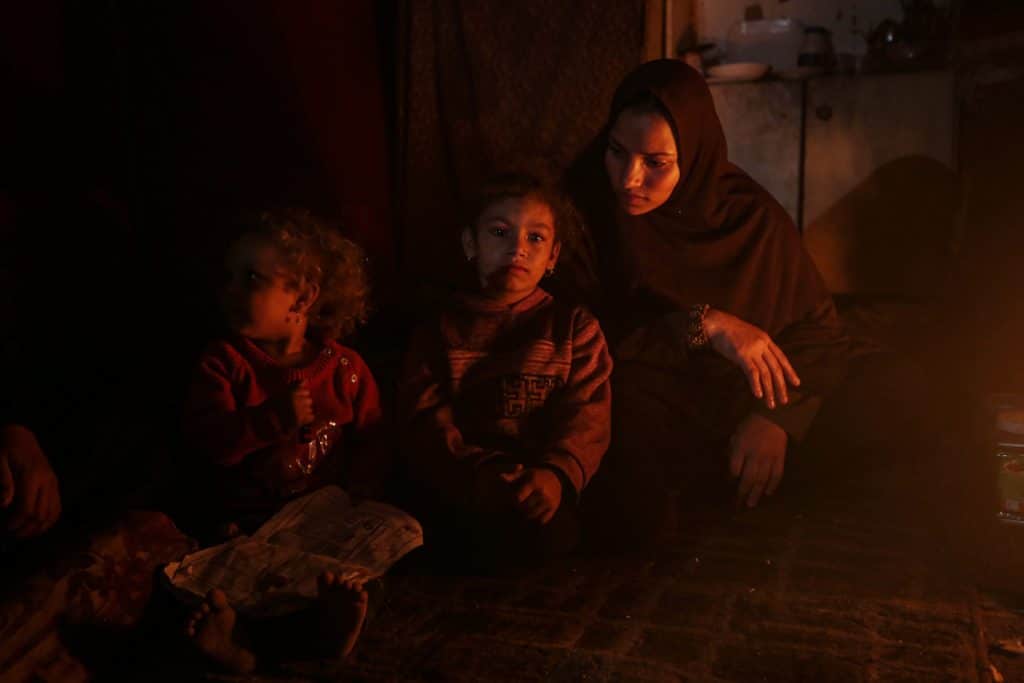
For the past 24 months, 29-year-old Raheel has lived in constant displacement—evacuating, relocating, and returning again and again, crossing Gaza from north to south and back. Her most recent displacement brought her to Al-Nusairat Camp in central Gaza, designated by Israeli authorities as a “safe zone.” There, she, her husband, and her in-laws lived in a single tent. For nearly 20 days, that fragile patch of fabric was their only shelter.
Their departure from Gaza City was not voluntary—it was a desperate decision taken under fire. As Israeli ground forces advanced and bombing intensified across the city in a systematic campaign to seize control, Raheel and her husband were forced to flee.
“We didn’t have the money to leave,” she recalled. “But we couldn’t afford to stay either.”
With no stable income, they borrowed what little they could—from some dear friends—and joined the hundreds of thousands of displaced people heading south in search of safety.
But safety was temporary.
“When the ceasefire was declared, I didn’t feel relief,” Raheel said. “I felt panic. I couldn’t think of anything but the debts we were carrying. We could barely afford the going, how would we afford now the coming back?”
Like many others, she and her family had to borrow again—this time to return to what remained of Gaza City. The pressure of surviving displacement was replaced by the pressure of returning to ruin.
Just before they made it back, Raheel received the news that their home in eastern Gaza had been destroyed.
“Since the beginning of the war, I didn’t get to live a single day in peace inside my own home,” she said. Her house, located in eastern Gaza, had been under a declared red zone for most of the days of the war.
She added, “Throughout the genocide, I kept imagining that moment of return—just to have some privacy, some space. But even that was taken from me.”
Although they had no home left, they returned anyway. “We didn’t go back because life was better there,” she said. “We went back to stay close to the rubble of our house—close to our people—rather than keep moving endlessly. Displacement breaks you, little by little.”
Today, Raheel’s family survives on a day-by-day basis. Her husband remains unemployed and has no stable income. They rely on small cash vouchers, humanitarian food parcels, and support from friends and relatives—many of whom are struggling themselves. Every meal, every trip, and every illness adds to their mounting debts.

Markets overflow with unhealthy, expensive food
“Though markets might look full now with products that had been absent for the past two years, our daily meals haven’t changed much,” Raheel said. “It’s still mostly canned foods, legumes, and a few types of vegetables.”
She added, “Some prices have dropped a little, yes—but most of the new products allowed in are either scarce or too expensive.”
Following the ceasefire, the Kerem Shalom Crossing reopened for the first time since March 2025. In the weeks that followed, Gaza’s commercial centers began to restock. Supermarkets, minimarkets, street stalls, and even shopping malls resumed operation.
Shelves now appear filled again. Alongside basic food items like legumes and canned goods, there’s an abundance of sugar-laden products: chocolate bars, biscuits, candy, jam, and sweetened drinks. Fats such as butter, processed cheese, and canned cream have also returned in limited supply. Other non-essentials, such as cigarettes and soft drinks, are also widely available.
“I long for chocolates and sweets like anyone else,” Raheel said. “But how can I even think about those when I can’t afford basics? There are more urgent needs.”
A bar of chocolate sells for 7 shekels (around $2), and a pack of biscuits is about 10 shekels ($3). These items now dominate shop displays, while essential foods remain scarce and unaffordable.
Eggs are nearly impossible to find. Milk and other dairy products are rarely available. Frozen chicken and beef arrive in limited shipments and disappear quickly. For most families, they are simply unaffordable.
“If you’re lucky, one kilogram of frozen chicken costs about 50 shekels ($15), and a kilo of meat is around 70 shekels ($22),” Raheel said. “Even the smallest family needs more than a kilo to feel full. For us, even one kilo is out of the question.”
“It’s been a month since the ceasefire began,” she added, “and I still haven’t eaten chicken or meat. I haven’t even been able to buy a single egg.”
Even though Raheel eats the same portions of food as before, she has noticed that she is gaining weight, as her diet lacks diversity, consisting mainly of carbohydrates and sugar.
The White House reports that nearly 15,000 trucks carrying commercial goods and humanitarian aid have entered Gaza since October 10. But according to Gaza’s Government Media Office, only 171 trucks—out of the 600 expected daily—are actually being allowed in.
The majority of these trucks carry wheat flour, carbohydrates, starches, sugar, and processed foods such as cheese spreads and canned cream. With these products commonly available in Gaza, with few alternatives, people are forced to rely on them as their main source of nutrition, pushing people to gain weight—quickly but unhealthily—concealing the physical signs of hunger and long-term malnutrition.
“We don’t want chicken and meat just because we miss the taste,” she said. “We want them because our bodies—fragile and worn down by war, famine, and displacement—need real food. We want to repair what’s been broken. We want to regain our strength.”
She paused.
“We want to feed ourselves not for pleasure—but for survival. For health. For dignity. For life.”
Noor Alyacoubi
Noor Alyacoubi is a translator and writer based in Gaza.