
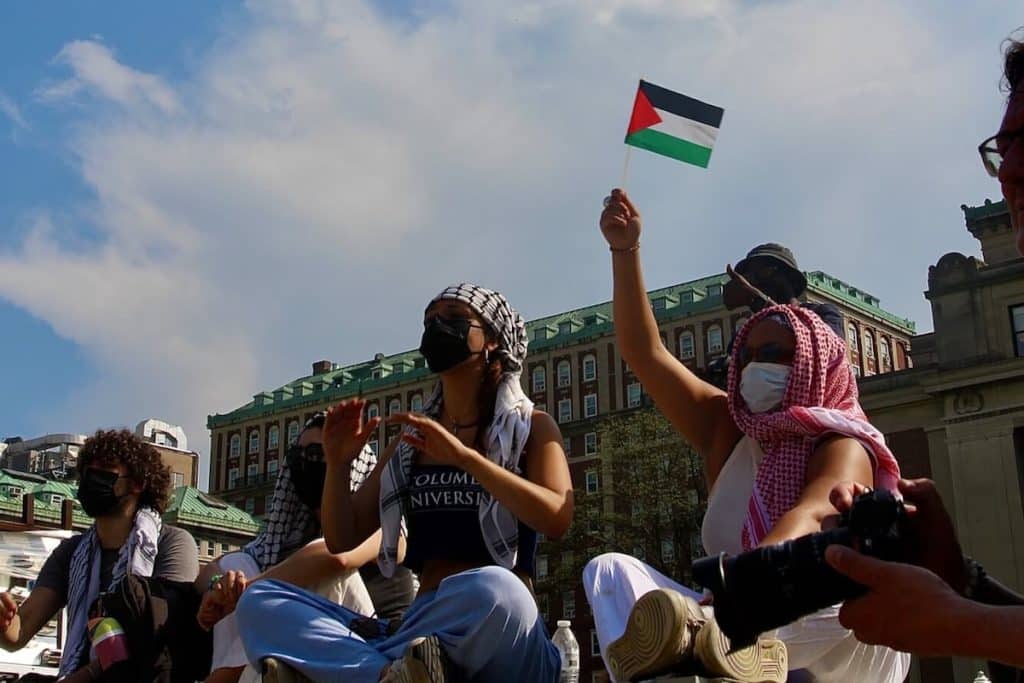
Last week, the American Association of University Professors (AAUP) and the Middle East Studies Association published a joint report on the weaponization of antisemitism claims across U.S. college campuses.
It’s the first in-depth study of such investigations and reveals how civil rights legislation is being used as a cudgel to quash student activism.
“The findings in this report underscore how the Civil Rights Act of 1964—which passed in response to years of nonviolent civil disobedience against racial injustice—is being cynically misused to squash political dissent and speech that advocates for the human rights of Palestinians,” said AAUP General Counsel Veena Dubal in a statement. “This is a perverse outcome.”
The report documents a surge in government probes and private lawsuits since October 7. It notes that more investigations (25) were launched in the two months after the attack than in all the previous years combined (24). There were 39 of them in 2024, and that record is set to be broken again, as there were 38 in 2025, with 3 months left in the year.
Additionally, the study demonstrates how the Biden administration laid the framework for the Trump administration’s vast crackdown on the Palestine movement.
Between October 7, 2023, and the end of 2024, Biden opened more antisemitism investigations (65) than for all racial harassment investigations combined (38). In 2024, the Biden administration pushed antisemitism investigations that led to more than twenty schools adopting new policies.
Finally, the report delves into Trump’s Task Force to Combat Antisemitism, which has ramped up investigations despite the White House’s vast cuts to the Department of Education.
The authors note that the education cuts have informed the structure of the task force and streamlined the probes:
In recent months and possibly in response to the dismantling of ED, the Department of Justice’s Civil Rights Division appears to have taken a more direct role in campus antisemitism investigations, issuing findings of violations against George Washington University and UCLA during the summer of 2025.
The Department of Justice also announced an antisemitism investigation against the University of California system under Title VII of the 1964 Civil Rights Act, which forbids discrimination by employers The Equal Employment Opportunity Commission, also acting under Title VII, has pursued antisemitism cases against Columbia University and opened a probe of the California State University system.
Although these are all framed as antisemitism investigations, virtually all of them are predictably connected to Israel. Out of 102 antisemitism complaint letters, only one has not involved speech critical of Israel.
Most complaints originate from a small group of pro-Israel organizations and figures, such as Zachary Marshall, editor-in-chief at Campus Reform, a college news site, who filed 33 complaints, leading to 16 investigations.
Israeli business leaders in NYC concerned about Mamdani
This week, the Times of Israel ran a story claiming that NYC’s business community is “rattled” over Zohran Mamdani’s mayoral victory.
Mamdani recently reiterated his support for BDS in an MSNBC appearance.
“I think critiques of the state of Israel are critiques of a government, as opposed to critiques of a people and of a faith,” he explained. “And my job is to represent every single New Yorker, and I will do so no matter their thoughts and opinions on Israel and Palestine, of which millions of New Yorkers have very strong views — and I’m one of them.”
The Times says there is “concern that the rise of the democratic socialist with a history of outspoken anti-Israel rhetoric, including support for a boycott of the Jewish state, will chill what has been a thriving business environment for Israeli entrepreneurs and companies.”
“The mood is not great – we are unhappy with a new mayor that we understand does not like Israel, and has an inclination, which is anti-Israel,” says Erel Margalit, founder of a venture capital fund called Jerusalem Venture Partners. “We are worried about the rhetoric and maybe some of the actions that a new mayor can take.”
“We worry about some policies that could be stopped,” he added. “We have public-private partnerships together with universities and cohorts of startups, and also run events together with the city — this is like a calling card of the city.”
“The way some of the campaign policies or the campaign priorities Mamdani expressed definitely raises eyebrows for how Israelis will feel about doing business in New York,” said Aaron Kaplowitz, president of the United States-Israel Business Alliance. “I think Israelis, like any people, want to feel embraced and welcomed.”
Further reading
- Why writers must boycott the New York Times
- Pro-Israel groups melt down over Mamdani win
- Zohran Mamdani’s victory is a loss for Zionism
- Exposing the Tata Group, a major sponsor of the New York Marathon and a leading supporter of the Gaza genocide
- Trump’s widening war on the left started with Palestine
- Palestine Legal: New Report Exposes UC Berkeley’s Repression of Pro-Palestinian Speech Likely Violate Civil Rights Laws
- Kentucky Lantern: UofL student group supporting Palestine suspended amid protests at Kentucky campus


Did Mamdani decline to use the term “Globalize the intifada” because it was being taken as anti-Semitic?