

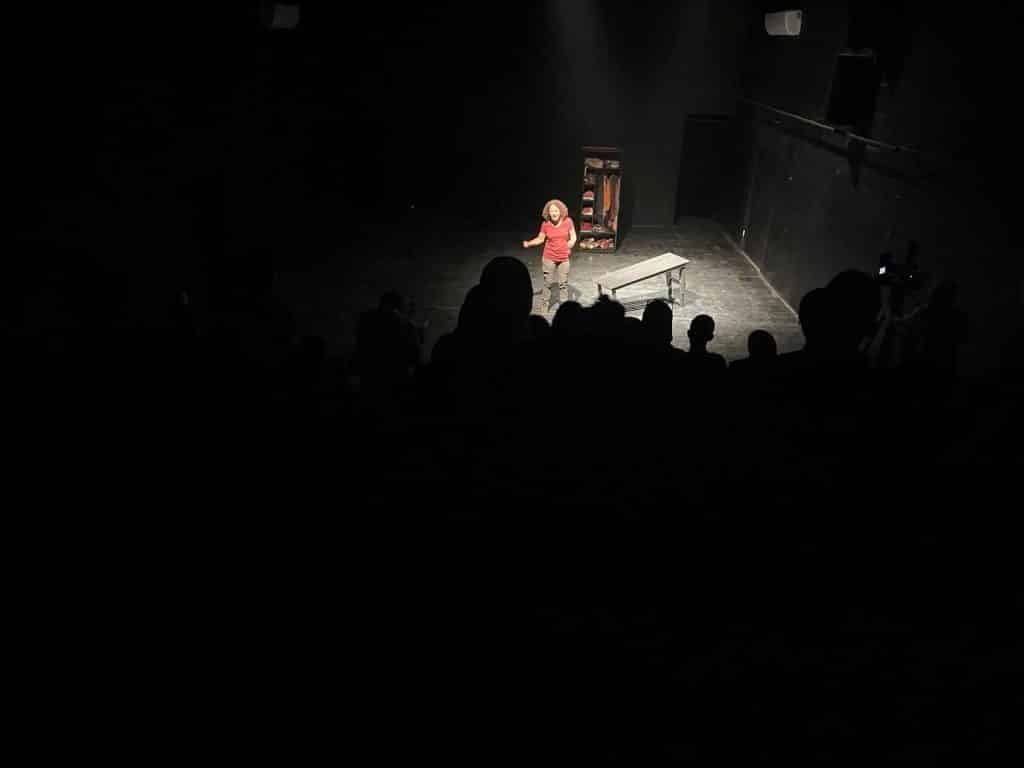
On September 19, 2023, during a performance of the “Danteel” Palestinian monodrama at the Freedom Theater in Jenin refugee camp, the electricity suddenly cut out. On stage, the actress and playwright playing the main character, Salwa Naqqara, broke the silence and asked, “What happened?”
“It’s the army,” someone from the audience responded. In that instant, the play transformed, its music and theatrical scenes drowned out by the thunder of gunfire and explosions. The theater was plunged into fear, with the audience trapped inside as shooting continued for over two hours.
“We completed the performance by candlelight, with the sound of gunfire filling the background,” said Mustafa Sheta, the manager of the theater. “It felt like the scene was an extension of the play itself, which explored the suffocation of space and the search for identity.”
The Freedom theater itself came under attack again. The military raid included attempts to seize control of the building, burning cars outside the theater, detonating stun grenades, and smashing doors and windows. The assault came two months after Israel had launched a major invasion of the camp in July called Operation Home and Garden, which aimed to eliminate armed resistance fighters in the city and refugee camp. The operation resulted in the deaths of 12 Palestinians, all young men, while hundreds more were injured in airstrikes and drone attacks, and some 300 were arrested.
Two years later, in August 2025, the New York Times ran an interview with former Palestinian prisoner Zakaria Zubeidi, a former leader of the Fatah armed wing during the Second Intifada. He gained iconic statu in the history of the Palestinian struggle when he became one of six escapees to break out of Israel’s maximum security Gilboa prison.
Zubeidi was also an early member of the Freedom Theater. It started as an initiative founded by Israeli-Palestinian actor Juliano Mer Khamis and his Jewish-Israeli mother, Arna, when Zubeidi was still a child.
In the interview, Zubeidi reflected on armed struggle and the Palestinian Authority’s project, acknowledging that Palestinians have tried every form of resistance — armed struggle, diplomacy, and even theater and the arts, or what he called “cultural resistance.”
“We founded a theater,” he told the Times. “What did that do? We tried the rifle, we tried shooting. There’s no solution.”
Zubeidi said that Palestinians needed to reconsider their tools in their struggle for freedom. He said he continues his search for answers and has recently returned to higher education.
Two years since October 7, 2023, Jenin refugee camp is now empty. The Israel army had launched its most recent large-scale assault on the camp, alongside two other refugee camps in Tulkarem, at the start of 2025, displacing an estimated 42,000 refugees in the northern West Bank. The people of the camps are still living in squalid living quarters in public gymnasiums and halls in the cities of Jenin and Tulkarem, while institutions that had been built over the course of decades were also uprooted.
Among these institutions are the Jenin Freedom Theater. An embodiment of the “cultural resistance” genre of committed art, the attack on the camp was also an attack on the theater. Mondoweiss spoke to several members of the theater and listened to their stories.
Over the course of two years, its community of actors, artists, and culture workers have scattered. Some are conducting traveling performances and continue to work on their careers. Others have since been killed during Israel’s assault on Jenin refugee camp. And some are now in prison after having been arrested by the Israeli army, where the Israeli practice of deliberate starvation, regular beatings, systematic torture, and humiliating and degrading treatment have been thoroughly documented over the past two years.
Theater veterans Mondoweiss spoke to are haunted by the thought of what happened to the place where they had learned their craft, and where they learned that art did not have to be disconnected from their community.
Rising arrests and mass killings
“I went outside, the weather was pleasant. It was a normal April morning in the twilight. It was a Friday, the 13th, and the streets were crowded with people. The air felt heavy. I stepped out, searching for a breath of space. From behind the fence, I saw the tanks. I walked a few steps closer, just to look, just to breathe. Suddenly, I felt pain in my leg. I fell—slowly, like in the movies. The sound turned into an echo, then silence. Everything collapsed, even my own presence.”
That was part of a theatrical piece performed by Ahmad al-Toubasi, the former theater’s Artistic Director, just days before his arrest in November.
In the same period, the theater paid a heavy price in blood; the lives of several of its closest friends and trainees were cut short. Sadil Naghneghieh was killed in June, followed in November by Yamen Jarrar, killed in a drone strike; Jihad Naghneghieh, also killed in a drone strike; Muhammad Matahin, who was shot dead by Israeli forces with live ammunition; and Mahmoud al-Saadi, a member of the theater who participated in training workshops and participated in the preparation of several artistic productions.
Not long after, the crackdown — part of a widespread and seemingly indiscriminate campaign of arrests in the camp — reached the rest of the theater’s leadership. Mustafa Sheta was also arrested, leaving the institution stripped of its core figures and community.
After the arrests and the Israeli attack on the theater, followed by the army’s looting of its lighting and sound equipment, its productions were brought to a complete halt. The displacement crisis in Jenin refugee camp further compounded the effects of siege and suffocation—on both the theater and its audience.
The theater had entered its final days after the Palestinian Authority’s military campaign in late 2024 in the camp to root out resistance fighters, dubbed Operation Protect the Homeland. The campaign transformed the theater from a safe space for expression into a place overshadowed by suspicion and fear. But no one expected that what awaited the theater would be far worse
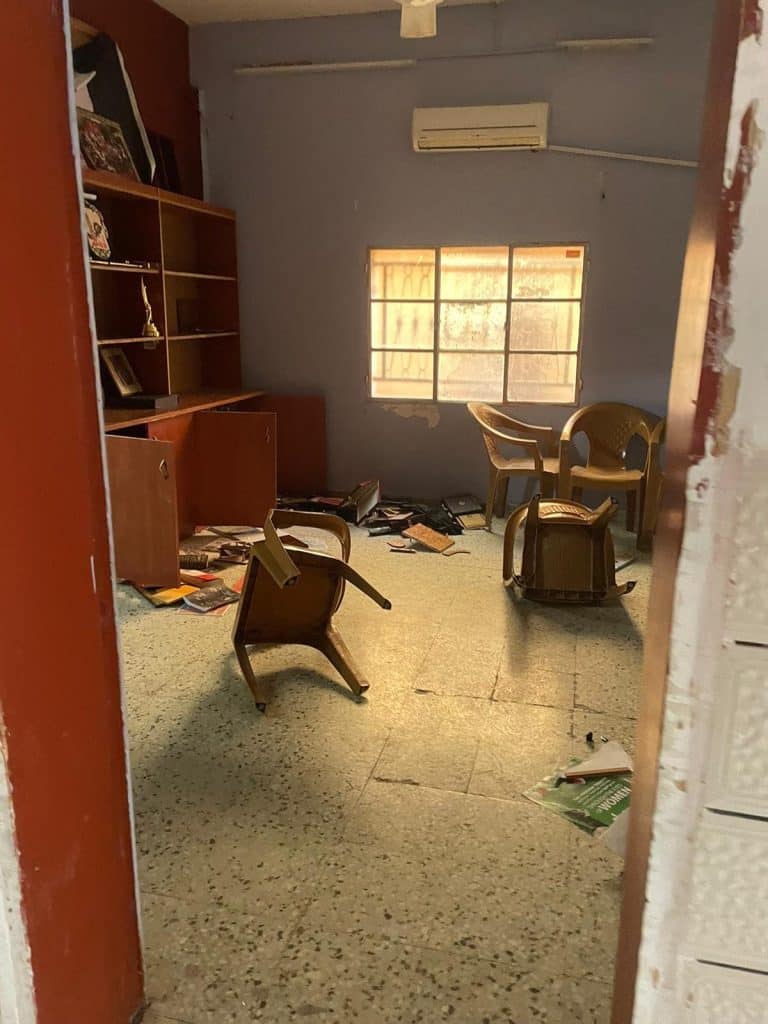
The last performance to be staged at the theater was “A Corpse Amid the Rubble,” which told the story of two men trapped in a basement, exploring the fragile boundaries between friendship and enmity. The performance took place just before the theater was forced to close its doors entirely following the forcible displacement of the camp’s entire population in Israel’s Operation Iron Wall in early 2025.
The play felt like a prophecy. Today, no one knows what has become of the theater—except for a short video capturing one of the darkest scenes in its history. “We saw the theater’s large screens projecting, while Israeli soldiers sat in the audience as if watching the events of the October 7 film. At the entrance, the bloated carcass of a donkey lay on the ground,” Sheta told Mondoweiss.
Despite working under nearly impossible conditions, the theater continues to carry out what Shehta calls “survival activities.” These efforts persist even as the main headquarters remains shuttered and as funding has dried up. Travel restrictions and visa denials to some of the theater’s leading actors have made the suffocation even worse.
The Horse of Jenin and Hind’s voice
Alaa Shehadeh, a graduate of the Freedom Theater, has toured Europe with his new play, “The Horse of Jenin,” a retelling of the story of the horse built out of the metal wreckage from civilian and ambulance cars that were destroyed during the 2002 Israeli invasion of Jenin. In October 2023, it was dismantled by the Israeli army. The play has been performed over 90 times and was awarded the Fringe First prize at the Edinburgh Festival.
“It is a storytelling performance about the remains of the horse, narrating a universal story of imagination and resistance,” Shehadeh told Mondowiss. “It tells it through the daily life of a child growing up in Jenin under occupation, whose simple dreams are no different from those of any child in the world: to play and enjoy life.”

The play continues to be performed, despite threats issued by Zionist organizations and institutions against theaters hosting the play. “Before every performance, the theaters would receive threatening emails accusing the play of being antisemitic,” Shehadeh said. “This created disruption for the venues, which often posted warnings that the performance might be accompanied by a security incident and increased police presence inside the theater. For me personally, I carried the constant tension and fear into every show.”
That same year, a film featuring Freedom Theater graduate Moataz Malhis won the Silver Lion at the Venice Film Festival. The film’s name is “The Voice of Hind Rajab,” a dramatization of the deliberate Israeli massacre of five-year-old Hind Rajab and her family in Gaza, whose car was riddled with over 300 bullets.
Today, The Freedom Theatre operates from a temporary location in central Jenin, just a few kilometers away from its original home in the refugee camp. The space lacks even the basic equipment of a theater, yet it serves as a modest space where actors continue their rehearsals. About a third of the staff who were employed at the theater before October 7 still come to work.
The way the staff members have chosen to continue their work is to gather the stories of displacement. Their assignments involve traveling between the different places where camp residents are now staying, collecting their stories as part of a living collective memory. Staff members say they’re doing it to rebuild the camp’s image and keep its spirit alive.
“One of our most important projects now is the Living Memory Project,” Shita told Mondoweiss. “It seeks to revive stories and narratives so we can rebuild our own story — not only to share it with the world, but to make sure it doesn’t vanish or fade away.”
“This current space was never meant to be our permanent home,” Sheta added. “Our original theater inside the camp was not chosen by chance; it carries deep symbolic meaning as part of the cultural resistance rooted in the camp’s struggle. It represents a real and tangible act of defiance: our physical presence in a place marked by injustice is itself a light that we refuse to extinguish.”
Majd Jawad
Majd Jawad is a Journalist and researcher from Jenin, Palestine, holding a Master’s degree in Democracy and Human Rights from Birzeit University and a Bachelor’s degree in Journalism.

“It represents a real and tangible act of defiance”.
_____________________________________________
Is defiance or public opinion more likely to achieve liberation?