Editor’s Note: This report first appeared in its original form as a podcast on the Mondoweiss Youtube channel. For more podcasts and video reporting like this, subscribe to our Youtube channel.
Friday, October 10, 2025
It’s a bit after eight in the morning. We’ve just arrived in Beita, a village in the north of the West Bank. The light is still soft, catching in the dust hanging on the road as people park their cars. Everyone is gathering here for the annual season of the olive harvest. Except this isn’t your typical olive harvest. Here, in occupied Palestine, picking olives comes with risks: injury, arrest, or even death.
“There are settlers trying to stop the farmers from harvesting their olives so we are coming to help them,” Munther Amira tells us. Munther is a Palestinian community organizer from Deir Aban, a Palestinian village ethnically cleansed in 1948. He grew up in the Aida refugee camp, in Bethlehem, where he still lives.
Today marks the first day of Zaytoun 2025, a campaign for the olive-harvest season organized by a number of Palestinian collectives to support farmers at the edges of Israeli settlements. Munther Amira has spent months helping coordinate this campaign: bringing in activists and journalists, planning the routes, handling the logistics, and trainings. Now that the season has begun, everything is suddenly becoming real.
“It’s a big happiness to have all these people here,” he says, looking around. There are dozens of us – mostly Palestinians, but also international solidarity activists from all over the world. “We don’t do it because we think the farmers are poor and weak,” Munther told us. “We do it as a way to say ‘thank you for being in the frontlines’.”
Olive groves aren’t what most people imagine when they hear the word “frontlines”, but in recent years, as settlements and outposts continue to multiply, the frontlines of Palestinian resistance to Israeli colonialism have shifted and expanded across the West Bank. And plots of land farmers could once reach are being progressively cut off by the encroaching occupation and the threat of violence. Munther Amira speaks of a different kind of genocide, of ethnic cleansing. “The people have to see what’s going on here,” he adds.
It’s not our first time in Palestine. We have been reporting on the subject, mostly in Portuguese, since 2017. But although we’ve been spending time here, every year, for the last few years, we’ve never actually been to the olive harvest before – and so, we don’t quite know what to expect. The weight of the occasion hasn’t fully set on us yet. For now, we’re in high spirits, slightly buzzing with caffeine, in awe of this large group of people steadily making their way up the rugged slopes.
Munther points to a new outpost on the top of the hill, Mevaser Shalom – Hebrew for “the peace bringer.” This morning, before we got here, settlers had already attacked a Palestinian family of three, who were taken to the hospital. As we walk, we see their blood on the ground, next to a couple of emptied tear gas canisters. The tear gas was shot by Israeli army soldiers, who offer 24/7 protection to the settlers.
People gather to start the harvest – tarps under the olive trees, their branches struck in a rhythm that has passed from generation to generation. Less than five minutes later, six Israeli soldiers arrive in a jeep. There are a few moments of quiet as the soldiers observe the group. But suddenly, the harvest starts to unravel.
It’s not even 10 a.m. when the first stun grenades and tear gas canisters start landing around us. A group of fifteen settlers runs across the olive groves, and a group moves to stop their advance, but the soldiers are quick to shield them. Wahaj Bani Moufleh, a Palestinian photojournalist and resident of Beita, is shot point-blank in his foot with a tear-gas canister, in what seems like a deliberate targeted attack. He’s wearing a blue vest with the word “press” on it. As people carry him toward an ambulance, soldiers fire more tear gas in their direction. The air becomes thick with acrid smoke.
Most of the settlers are kids, it seems. Unarmed teenagers shielded by heavily armed soldiers, and now by the Israeli border police as well. The border police arrive and immediately direct the farmers and the activists towards a specific patch of land. “On this side, you can do it,” they say. (picking olives, they mean). “That side is off limits”.
The harvest goes on in the background while Palestinian farmers and landowners argue with the Israeli authorities, insisting they should be able to pick olives everywhere – it is, after all, their land. Munther Amira, again: “They want to control everything to show that they have the power here. And we are trying to show that we have the power here.”
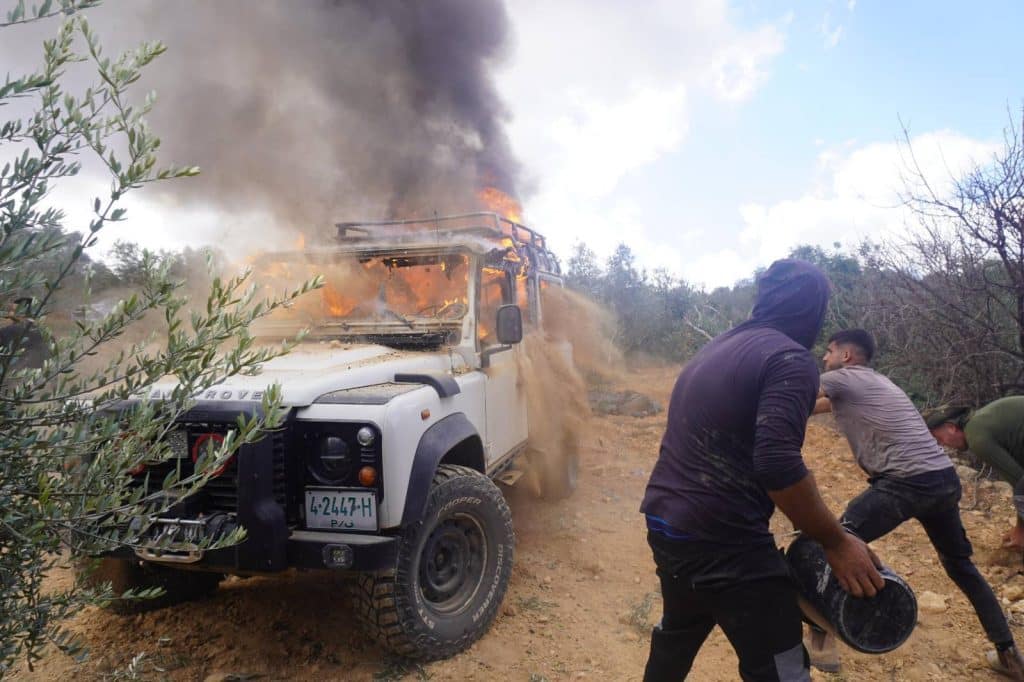
This standoff lasts for a few minutes. But, as it would turn out, the earlier display of violence was just a prelude to what was to come. A group of masked settlers descends from the hill, throwing rocks at a Palestinian family in a nearby slope and setting a car on fire. People rush over, shoving handfuls of dirt into the flames, hoping to put the fire down. Their efforts are met with a hail of rocks from the settlers and clouds of tear gas from the military.
Then, the settlers attack again from the slope we had just left. Everywhere we look, absolute chaos. The soldiers keep on sending stun grenades and tear gas in our direction. There’s people screaming, shouting, dodging the rocks that settlers keep hurling.
Most people sprint back to the cars. A few stay behind, on the other side of the hill, with little more than rocks. We’re unsure what to do. Do we keep documenting what we see? Try to interview people? Run? Stay put? In the end, we fall in with the group going back.
With tear gas clouds still hanging at a distance, we begin to take stock of what just happened. We wouldn’t have the full picture, however, until the following day. At least 10 people were injured, 8 cars were burned, including an ambulance.
Back at the cars, we join Munther Amira. He’s still catching his breath from the escape, but somehow, he’s laughing anyway. He lays out what we should expect from this year’s harvest: “A bloody season. It seems, from the first day.” And time would prove him right. What we saw on that first day, in Beita, would end up being a sort of microcosm of everything we could expect for the days ahead: clouds of tear gas, violent settlers, an army seemingly dedicated to protecting them while harassing and attacking both Palestinians and solidarity activists, in a land under siege.
By the end of the season, in mid-November, there would be more than 160 settler attacks, resulting in more than 150 injured Palestinians, almost 6000 trees destroyed, countless damaged vehicles, and one martyr, a 13-year-old kid we met during the harvest named Ayssam Jihad Ma’ala. We didn’t know his name then, but we would learn it soon enough.
We joined this year’s olive harvest campaign for 10 days. This is the story of what we witnessed – a story of incredible violence and oppression, but, most importantly, of community and resistance.
Saturday,October 11
It’s a little over eight in the morning. We’re back in Beita – this time, a much smaller group. One of the farmers invites us for tea, coffee, and some non-optional biscuits in the shelter he built as part of his effort to defend his land. This land belonged to his grandfather before him. Now it belongs to him.
We’ve gathered here because the olive groves we were planning to go to – the same ones from yesterday – are apparently off limits. We learned that from the four soldiers blocking our path with their military jeeps upon our arrival. Even though the family had gotten permission from the military before to harvest their land today, the army has now declared the area a closed military zone. They don’t bother showing us any proof.
About these so-called “agreements”. The previous day unfolded with plenty of back-and-forth negotiations between the Palestinians and the army over where people could or could not harvest olives. One grove was okay, the other was not. One side of the road was okay, the other was not. They call it security coordination.
Mind you, these are all Palestinian lands. Even within the framework of international law, all of these belong to Palestinians. We’re in Area B of the West Bank, according to the 1993 Oslo Accords. But even here, in recent years, the Israeli military has been increasingly blocking Palestinians from working their land unless they first coordinate with the army. This means the occupation forces get a say in when and how Palestinians can harvest. All of this for so-called “security reasons”. Of course, the real source of that insecurity seems clear enough: the ever-growing settler colony, with its settlers and outposts.
Since the reconstruction of the settler outpost Evyatar in 2021, Beita has become one of the West Bank’s frontlines. Ever since, Beita’s residents and solidarity activists have been staging recurrent protests against the outpost. And for that, the village paid a heavy price: tear gas canisters, sound bombs, live ammunition, movement restrictions and closures, as well as house raids and arbitrary arrests.
All across the hills of the West Bank, settlers keep building new outposts. Once fringe radicals, settler leaders like Finance Minister Bezalel Smotrich and National Security Minister Itamar Ben-Gvir are in the highest levels of the Israeli government, and they’ve used their power to further the violent settler-colonial expansion in the West Bank.
The harvest season is no longer the communal ritual it once was, as one Palestinian farmer later explains. The whole family used to gather around the fire to cook traditional Palestinian meals, he says. “Every year, we would have activities. We would have fun.” But not this year. This year, the fire is gone, replaced by provisions cooked and packed in advance, the kind of lunch meant to be eaten on the move, should the moment come when there’s an attack, and everyone has to flee. As if “they are the landowners,” he says, meaning the settlers and soldiers, and “we are the thieves.”
Another farmer steps forward. He tells us his grandmother is 95 years old, and she raised these trees in front of us as if they were her children. She would bring them water in a donkey, before there were any roads, to make sure they all had a sip. “When they attacked us yesterday, my grandmother cried,” he says. It’s as if they were attacking her children.
The group harvests olives for a while. But the peace doesn’t last long. We see a Palestinian farmer walking down the same road we were kicked out of, on the slope in front of us. A few seconds later, soldiers emerge behind him. A minute later, tear gas. A sharp, now-familiar sting fills our eyes with tears. Everyone starts coughing.
They keep shooting as we retreat, and an older man falls down, struggling with the tear gas. Soldiers shout through a megaphone. “You’re assaulting the State security,” one volunteer translates. “You need to leave.” We go up the road, further away from the army, to join some other families gathering at the top. A child lies on the ground and is having seizures. People start shouting at the soldiers to let an ambulance through, but it only comes minutes later. The kid is quickly carried inside and immediately taken to the hospital. He is only thirteen.
We have a few minutes to gather our bearings. The Palestinians around us don’t need a few moments to adjust – this is their reality. And so, as soon as the dust settles, they want to go back and resume the harvest. We’re a lot more jittery – there’s a drone flying overhead, and the soldiers could be back any time now. But the drone, they tell us, is always here. And so, we keep working.
In later retellings, we would often call this one of the quiet days. A good day, even. All in all, by the end of the day, the group picked 400kg of olives (roughly 880 pounds). We had a lovely lunch in the shade – hummus, muttabal, lentils, flatbread, pickles, olives, za’atar. We got to do some interviews, chat with each other, crack some jokes, and have a few coffee breaks to cool down.
Of course, this is not how we remember the day now. Because as we would discover exactly one month later, Ayssam Jihad Ma’ala, the thirteen-year-old kid who collapsed in front of us that day, never recovered. He went into a coma shortly after due to the lack of oxygen in his brain – a consequence of the tear gas – and died on November 11. A thirteen-year-old boy was martyred, all because he wanted to go to the olive harvest with his family.
Sunday, October 12
It’s 10:40 in the morning. Over a hundred people have gathered in Idna, a Palestinian town in the southern West Bank, close to al-Khalil (Hebron). This is technically area A of the West Bank, supposedly under full control of the Palestinian Authority. But it comes as no surprise that we already have unwanted company.
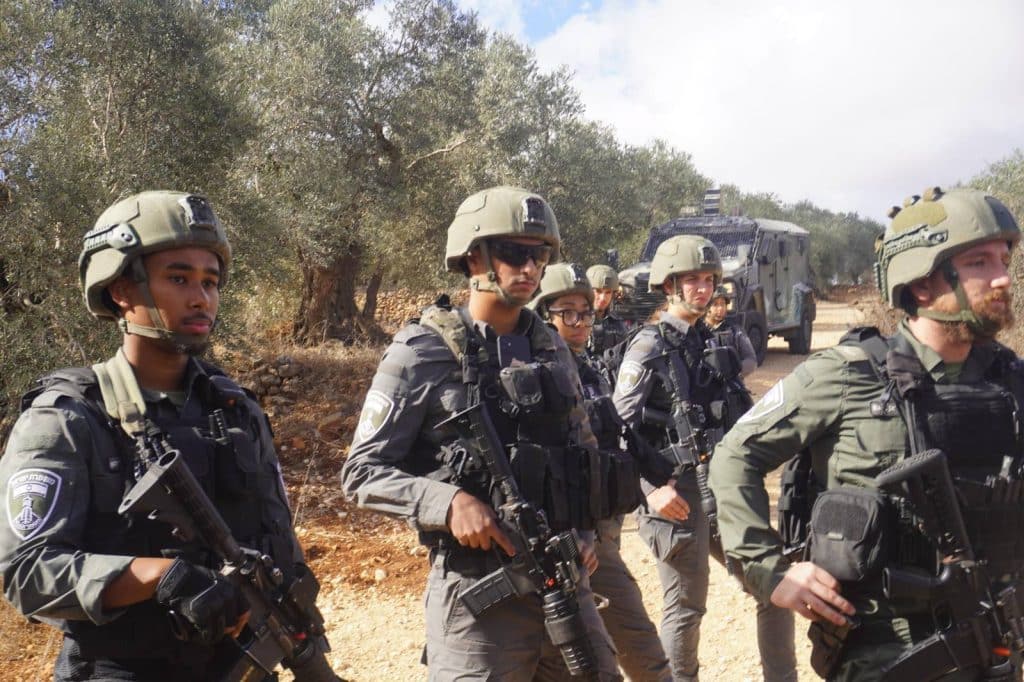
Two armed settlers are hiking up the slope to meet us, and behind them, what looks like soldiers. We had heard many accounts of armed settlers in military uniform, but this is the first time we’re a bit unsure of what we’re looking at – the first of many. The line is becoming blurrier every year, and not by accident. The state arms them, outfits them, and backs them at every level.
Over the next few days, we find ourselves asking, “soldier or settler?”, as if we’re playing a grim game of spot the difference. Do they wear helmets? Do they have insignias? Are their trousers the right color? But after a while, the exercise starts to feel like a technicality, a semantic issue rather than a practical one. At what point do we stop calling these paramilitary settlers civilians? And when the real soldiers collude with the settlers during their attacks, what’s the difference anyway?
The settlers and soldiers begin sending us back. We ask Munther what they are saying: “They… it’s forbidden to do anything,” he tells us. More settlers arrive, moving around us in a swarm. They dictate what people can or can’t do. They film the volunteers and the journalists, try to steal tarps and phones, and walk around like they own the place. But despite the harassment, people hold their ground. The crowd starts singing popular Palestinian songs. “Settlers, out, out,” they chant. The settlers, themselves, keep repeating “shh, shh, shh” – the sounds used to herd sheep and goats, gesturing for us to leave.
One of the settlers, dressed in military uniform, starts grabbing journalists, trying to pull them aside. We ask him why he’s trying to take people away. “Because it’s my land,” he says. Another settler joins in, speaking Hebrew. We tell him we don’t understand his language. He replies, “I don’t want you to understand me. If I want, I take you.”
Eventually, a group of about 13 soldiers and settlers force us all the way back to the town square where the day began. Some hundred and something – maybe two hundred – Palestinians and solidarity activists refuse to go any further. They sit in white plastic chairs, passing around coffee, cucumbers, and fruit. Three Palestinian kids, entirely unbothered by the soldiers and settlers right behind them, giggle and strike poses for the camera.
Monday, October 13
After nearly two hours on the road, we finally reach Qafr Qadum. “It’s one of the famous places here that run Friday demonstrations,” Munther tells us. “They still do them, sometimes.” For years, Qafr Qaddum has been a target of Israeli settler expansion. Munther Amira says it’s famous because its residents have held weekly protests for more than a decade, resisting the expropriation of hundreds of hectares of their land. The crowd is even bigger today – a fleet of buses and cars has brought hundreds of people all the way from Ramallah and elsewhere across Palestine.
Up the hill, we see what looks like the beginning of a settlement. Beside it, a makeshift structure similar to a military tower surrounded by Israeli flags and around fifteen settlers who never seem to look away. We begin climbing the hill toward the olive trees nearest the first structure of the outpost, roughly 20 meters away. And then, the harvest begins.
One of the settlers shouts to a Palestinian next to us. We ask one of the volunteers what he is saying: “He says that all of you are terrorists,” he replies.
Meanwhile, the military also joins us, summoned by the settlers. A few minutes in, one of the settlers – a teenager, by the look of him – pulls a mask over his face, a knife resting on his trousers. Another settler turns to a Palestinian journalist: “Your vest” – the press vest, he means, – “won’t stop the bullets.”
There are now around 15 soldiers and settlers, half of them wearing military-style outfits. One settler carries both a professional-looking camera and a semi-automatic weapon. It’s as if the outpost has its own photojournalist.
The masked settler starts shoving volunteers, hurling insults in Arabic. “Whore,” he shouts at one woman. Tensions rise, and for a moment, it seems the situation might spiral out of control any second. But fortunately, that’s not the case. Volunteers keep picking a few olive trees as they sing “Bella Ciao.” The trees are sparse, and the group eventually moves downhill. Below, soldiers and settlers start asking for people’s IDs, particularly the internationals. We ask why people are being told to leave. “It’s illegal,” one says. “It’s an army area,” another adds. They claim it’s dangerous for us to be there: “I’m worrying for you. I love you because of that.”
Closing off an area – declaring it a “closed military zone” where only authorized people may be – is routine during the olive harvest and for much of the rest of the year as well. The soldiers do it all the time. They do it to prevent protests, to protect settlers and settlements, and to prevent access not only for Palestinians but also for solidarity activists and journalists trying to reach agricultural land. In 2022 alone, they issued over 800 closed military zones – and the army itself has referred to this data as very incomplete.
Setting up a temporary, 24-hour military closed area is so simple that they used to carry around a printer in their jeeps, one activist tells us. Now, with smartphones, they don’t even need that. It’s so easy to set up that they don’t need to bother to lie about it. And yet, in all the days that followed, we never saw a single document, a single shred of evidence for any of these so-called closed military zones used to push us out. But it’s not that they actually need it. It was clear day after day – with or without a real military order, soldiers and settlers can do whatever they want.
Wednesday, October 15
It’s the fifth day of the olive harvest campaign – or rather, the 6th, if you count yesterday. Only we never made it there. We were supposed to go to Tusmyus Ayya, a Palestinian village north of Ramallah. But from what we were told, the Shabak, the Israeli security agency, threatened the mayor of the village. Something along the lines of “if all these people go there, people will die.” So, yesterday was canceled.
Today, we’re heading elsewhere – al-Nazla al-Sharkyia, near Tulkarem, in the northern West Bank. The day starts like many others – listening to Fairuz, grabbing coffee, catching a ride with Munther Amira. Only, this time, we’re also joined by Abeer Alkhateeb. That’s her singing along with Fairuz on the radio. Abeer is no stranger to any of this. Before we met, we’d already seen videos of her: a woman in oversized sunglasses, shouting at fully equipped soldiers, daring them to drop their weapons and face her. There’s a fierce spark in her. But the past few years have taken their toll. She laughs and tells us she’s very scared: “After my husband died, after the 7th of October, the situation became very dangerous.” Today, she’s scared, but she says, “I’m strong to be here. I will fight to be here.”
On the way to the olive grove, we pass by scattered families already at work and military jeeps stationed on a road ahead. They seem to be waiting for us. And surely, as soon as we reach the trees ourselves, not a single olive picked, we’re met with tear gas. We try to count the canisters being shot, but it’s a futile exercise. From that very first moment, tear gas rained down on us, relentlessly, even as we retreated.
Two hours on the road only to be kicked out in less than ten minutes. As we leave, paramedics tend to a woman who fell while fleeing from the tear gas. They think she might have broken her leg. Small fires flare up where many canisters landed, and people rush to put them out.
Back at the municipality building, people hand out water, coffee, and an assortment of manakeesh, thanking everyone for joining. A Palestinian man moves through the crowd, slipping small cucumbers in people’s pockets.
We’ve been going on and on about violence, but here, Palestinians turn even the ugliest of days into acts of community and solidarity. People have gathered here from all over – there’s paramedics, people handing out food and drink, others carrying tarps and ladders and tools. Munther and Abeer keep calling this way of doing things “fauda”, or chaos. But to us, it looks as if it’s more like a well-worn routine of people stepping in and taking care of one another.
Looking around, the mood is far from sour. There’s laughter and lively conversation, as if we weren’t just being tear-gassed ten minutes ago. No one here seems particularly surprised by the outcome. In fact, this is a common experience. Unlike us, always waiting, wondering – “Will the army appear? Will there be settlers?” – the Palestinians know full well what awaits them. And still, they go. Every single time. We would see as much again the following morning.
Thursday, October 16
It’s early morning in Kofr Rae, a village in the Jenin area, and we’re waiting in the municipal building – coffee in hand – for the rest of the group to join. To pass the time, we chat with Yasser, an engineer who works in the municipality. He, too, is coming to the olive harvest. When we ask him what he thinks will happen today, he laughs. “They will hit us,” he says. We assume the same: we will arrive, they will be waiting, and tear gas will follow. Yasser nods along, still laughing. “Yeah, yeah, yeah. Everything. You know that”.
When we’re ready to move, we climb into the trailer of an old tractor owned by one of the farmers, along with a couple of Palestinians. We start winding up a dirt road, dozens of cars in a huge caravan behind us, slowly moving through huge patches of olive groves on either side. Our travel companions point to the hilltops, naming settlements and outposts in the area. A few minutes later, we arrive. The army is already there, as Yasser predicted.
There’s four soldiers on the road – one of them covered with a black mask. It soon becomes clear he’s a sniper. Much like the day before, they start sending tear gas canisters as soon as we reach the olive grove. Only, this time, canisters are aimed low, at leg level, rather than into the air.
As we move back to another olive grove, we spot Manal Tamimi, a community organizer from the town of Nabi Saleh, another that became quite known for its Friday demonstrations. She tells us it’s the first time since October 7 that they have been able to reach these trees: “I think that’s why they are so intense, and why the settlers became more violent,” she says. But all they want is to harvest their olive trees. “It’s not that we are attacking or doing something illegal,” she adds.
Manal tells us we’re not going to pick any olives today, and she is right. The soldiers keep sending on tear gas, and soon enough, the group decides to retreat back to the cars, eyes and throats burning. Then, an already nasty situation gets worse. A group of settlers charges towards us, hurling rocks. Panic spreads. All around us, rocks are flying, people are shouting, and every driver is leaning on the horn. There’s six, seven, eight people trying to squeeze in cars built for five. Everyone scrambles to get away, but the dirt road is narrow, and the line of cars and buses struggles to move. Some people throw rocks back to slow the settlers’ advance. Further up the road, we finally squeeze onto a bus, its rear seats littered with shards of glass from the windows the settlers broke.
The experience leaves a bitter aftertaste. The next morning, that’s what we find ourselves watching for — the exit strategy. We wouldn’t find much relief.
Friday, October 17
It’s 8:43 in the morning. We’re in Silwad, a village just outside Ramallah, and there’s a 3km walk through the hills that separates us from the olive groves. We’ve been warned it might be a tricky day – “they’re raiding as fuck in the area,” one volunteer tells us.
We descend and climb the steep hills ahead. One of the activists tells us the exit plan is to come back the way we came. We don’t particularly like the sound of it, but what’s the alternative? Scrambling down the ravine until we hit the highway?
Along the road, dozens and dozens of burned olive trees, a burned car upside down, and three others next to some unfinished buildings. Everything feels very ominous. Later, Munther Amira explains that the construction was stopped after 7th of October. It became dangerous to even come here, especially after the settlers built the outpost.
Not long after the group starts picking olives, we see goats approaching. A Palestinian tells us they were stolen from the farmers. Behind them, a lone settler, possibly the goat thief, speaking on his phone, moving with the ease and confidence of a landowner. Except this isn’t his land. He comes and goes and the harvest continues.
Branches lie shattered everywhere. In some trees, only the trunk remains. One of the farmers stares in heartbreak at the destruction: “Why do they do this if they think Abraham told them that this land is for them?” he asks. He says the trees were like his children, much like the 95-year-old grandmother from Beita. It’s as if he lost members of his family, he says.
A while later, more settlers arrive – most of them teenagers. They are insisting – in a mix of English and Arabic – we leave. The group eventually decides it’s not worth the trouble, packs their things, and starts leaving. But the settlers block the Palestinians’ cars from leaving.
Not long after, the army comes, along with more settlers – this time, armed. The soldiers echo what the teenage settlers were saying. We have to leave. “This is a closed military area,” one of the soldiers claims. We ask if the settlers are required to leave as well. “They will leave when…” he begins, but immediately course-corrects: ”It’s their territory.” He tells us he does not wish to use force, but we’re interfering with the army and, he insists, we must leave.
But the settlers keep blocking the Palestinians’ cars. For the next fifteen minutes, they pile rocks on the road to block their path and perch on the cars’ hoods. One even stages a dramatic performance, pretending the car is running him over. All the while, we keep asking why the settlers are allowed to stay. Finally, as the car manages to escape and we finally head back, the soldier shouts an answer: “They’re allowed by law”, he says. He doesn’t bother specifying which law, and, frankly, he doesn’t have to.
Saturday, October 18
We were supposed to return to Beita today. But, we soon find out, that’s not going to happen. The village is completely closed off – no one in, no one out. So, when we finally set out, we head to Madama instead, a village close to Burin, in the north of the West Bank.
The days have started to blur at the edges. Early mornings, late nights, long drives, the constant threat of violence. We’re all pretty tired, and Munther Amira is no exception. We ask why he doesn’t take one day off. “I want to pick olives. This is what I want to do,” he replies. Funnily enough, on the 8th day of the olive harvest, that’s exactly what happens. Dozens of people manage to pick olives from morning until mid-afternoon – with two different families, at that. We have a big meal for lunch – rice with chicken, salad, labneh, and some pickled chilies. Almost – almost – like the good old days.
“Doing the tea on the fire, having our meal here, cooking kallayt bandora, tomatoes on the fire, having dukkawzeit, you know, I think even these small things we lost,” Munther says. Like the farmers in Beita were telling us. It’s not just picking olives, he adds, “it’s being together, singing together, eating together.” He calls it the season of happiness. “This is the happiness, being together.”
As a refugee, Munther Amira doesn’t have any olive groves of his own. That was his dream – to harvest olives with his family. But they cannot; their land was taken in 1948. And so, Munther started going to the olive harvest with other families during university, as a volunteer. Eventually, he set up a kind of patrol with Abeer Alkhateeb – a precursor to the Zaytoun 2025 campaign. Only, back then, there was no program at all. Just fauda, chaos. “If you need any help, just call us”, they would say. And that was it. They would drive around to the most dangerous areas, telling people to call if they had any trouble. Munther, Abeer and maybe ten others, moving across the West Bank.
The mood today is definitely different from last days. And it’s not because Madama is somehow easier. Not only are we in Area C, but we’re apparently in a closed military zone – the army even stopped the car of one of the activists earlier this morning, at a checkpoint at the entrance of the village. But somehow, we slipped in. And here we are, picking olives, sitting together for lunch, having multiple rounds of coffee, and juice, and cake. There’s even music.
Yes, today was a good day, the kind that feels like it has the power to tilt the balance of the game. But days in occupied Palestine don’t line up like that, neatly, one after the other. There is no promise of continuity, no continuous trajectory from good to better. A good day isn’t necessarily followed by another. And the next morning proved it – it was not a good day at all.
Sunday, October 19
We are on our way to Farkha, a village in the Ramallah area. We have barely reached the town square when the first scraps of news begin to filter through – something bad happened in Turmus Aya, a village nearby. Settlers attacked the harvest and Afaf Abu Alia, a 52-year-old woman, was struck in the head by a masked settler and rushed to the intensive care unit with internal bleeding.
In Farkha, the day unfolds much like most: dozens of people join, the harvest begins, and we’re quickly confronted by a group of soldiers and settlers. We ask repeatedly why people are being told to leave. Nobody cares to answer. At one point, a soldier – or settler? – took the car keys from Abdallah Abu Rahma, one of the organizers of the Zaytoun 2025 campaign. For a while, we are stuck in a standstill – them insisting we leave, the group refusing to leave without the car keys.
Eventually, the keys are returned and everyone climbs back up the hill from which we came. “This is the occupation,” Abdallah says. “They don’t need to see any Palestinians here.” At one point, one of the soldiers tells him this is an Israeli area. “You hear me”, he answers. “This olive [tree], my great-great-great-grandfather planted it before the State of Israel was here.”
Monday, October 20
The Israeli Channel 4 broadcasts a segment naming Munther Amira, Abdallah Abu Rahma and Mu’ayyad Sha’aban, the head of the Wall and Settlement Resistance Commission from the Palestinian Authority, as “terrorists”. All three men, the report notes, have served prison sentences in the past and are now the supposed “masterminds” behind the Zaytoun 2025 campaign. According to the report, this initiative was never about harvesting olives at all, but about provoking the peaceful settlers nearby.
The whole broadcast leans heavily on the suggestion that the Knesset – the Israeli parliament – ought to intervene before all this unravels into “another 7th of October”. Moments later, we get a message from Munther Amira: “I think we will not move tomorrow,” he says. “Because of the incitement against me, Mu’ayyad and Abdallah.” The roads around Bethlehem are crowded with checkpoints, and who knows what could happen if he’s stopped in one. And so, he stays home.
We never made it to the olive harvest the next day. A couple of days later, we boarded a plane back to Portugal. But the bloody campaign, as Munther had predicted, went on. And he, of course, went back to the fields. According to the United Nations, between October 1st and November 10th, there were more than 160 attacks from settlers in almost 100 towns and villages. More than 150 Palestinians were injured.
And still, Munther describes the campaign as a success. Not because of the number of families that were helped or even the number of olives that were picked. As he explained earlier, it wasn’t really just about that. It was about breaking that invisible but violent barrier that, for at least two years, has been separating people from their lands. It was about shattering that fear. Sumud, they say, in Arabic. Steadfastness. Not leaving the land. To stay.
And stay they did. Even in the year of the highest number of recorded attacks, even amidst the threats, the violence, the sleepless nights and aching bodies, every day, Palestinian farmers and several dozen volunteers rose in the first hours of the morning to set out – quite stubbornly – towards their lands. And even when they were driven back, day after day, pushed out and attacked, they thought of nothing but going back. When we asked people why they keep going, they told us, simply, “it’s our land”.
Back in al-Nazla al-Sharkyia, a farmer caught up with us after escaping dozens of tear gas grenades – kicked out of his own land. He hadn’t been able to reach his land since the 7th of October due to the increase in state and settler violence, and things were only getting worse. “We are tired from this life”, he told us. But as soon as we asked him whether he would try again soon, while still breathing heavily, one eye on the drone above, he summed it all up: “ I will try all the time. All the time I will try to reach my land. I’m still here, I’m still here, I’m still here. I do not leave my land. I do not leave. This is my land.”
Rafaela Cortez
Rafaela Cortez is a journalist based in northern Portugal focusing on inequality, discrimination, and the broader structures of violence shaping daily life in both Portugal and Palestine.
Ricardo Esteves Ribeiro
Ricardo Esteves Ribeiro is a journalist based on the border between Northern Portugal and Galicia. He reports on the occupation of Palestine and the people resisting it since 2017. He’s a co-founder of Fumaça, a Portuguese investigative journalism podcast.