

Over the last two years, Maura Finkelstein and Katherine Franke, among others, lost their positions as part of the explosion of academic repression in the U.S. since the start of Israel’s latest genocide in Gaza. Now, San Jose State Professor Sang Hea Kil may very well be the first full tenured professor fired for Palestine.
A long-time organizer against border militarization in Arizona, where she earned her doctorate, Kil was hired in the Justice Studies Department at San Jose State University in 2007. Mondoweiss interviewed Kil after she was suspended by San Jose State in May 2024 under allegations of disruptive activities related to a Palestine protest, which included violating Article 17 of the Collective Bargaining Agreement between the university and the faculty union.
Since then, her case has received widespread media coverage, and support from civil rights organizations such as CAIR. In June 2024, the university escalated her suspension into firing. On October 23, 2025, a Faculty Hearing panel unanimously ruled in Kil’s favor and against the university’s move to fire her, but this decision was overturned by SJSU President Cynthia Teniente-Matson.
Omar Zahzah talked to Kil about her history of scholar-activism and organizing, the repressive precedents set by SJSU’s conduct, and what the broader implications of the outcome of her case are for academic freedom in the U.S. The following conversation was lightly edited for clarity.
Omar Zahzah: Take us back to February 2024. What was the actual substance of the protest? What charges did San Jose State University make against you?
Sang Hea Kil: They made a whole litany of charges against me. CSU Long Beach has this faculty in the Jewish Studies Department, and the [SJSU] Office of Equity, Diversity and Inclusion invited him to speak along with the Jewish Studies Department, the English Department and the History Department. [Editor’s Note: The professor in question was Jeffrey Blutinger of CSU Long Beach.] And he had denied in his student newspaper that what was happening in Gaza was a genocide. But yet, he was coming to our campus to talk about a two-state peace solution. And I found that really disturbing.
So I emailed—not everybody, because the Jewish Studies Department had already had a history of bringing pro-genocide scholars; they brought Benny Morris to our campus, and he was the Israeli historian who had argued that the creation of Israel in 1948 partially failed because they didn’t do a total genocide of the Palestinian people. So I didn’t bother emailing the Jewish Studies Department, but I did bother emailing the other co-sponsors that I thought had a stake to their reputation in inviting someone like this, which was English, History, and the DEI office and I told them this guy’s problematic, he’s denied the genocide in Gaza, you should withdraw your co-sponsorship. There was this perception at the [Faculty Hearing] that I was trying to cancel him, and that’s not true. If I had tried to cancel him I would have also emailed the Jewish Studies Department. I have a very libertarian attitude about free speech, which is I think you fight bad speech with good speech; you don’t cancel bad speech and then have good speech.
[The event] was originally set in our public library. There was no signage that the talk had been cancelled. Instead, they said it had been moved. As attendees went to the new location, which is someone’s classroom, it’s flanked by cops, and they’re telling us the only people that can come in are enrolled students. So it created this academic ambush for us all who showed up, faculty, students, and community members.
We were in a tunnel, basically in the hallway outside the classroom, not knowing what the hell was going on because again, these administrators, for whatever reason, created this chaos. And I saw a full professor in the History Department, a self-identified Zionist, assault a Palestinian student in front of me. And it was on video, and it was widely shared. An investigation would be opened up on him, is my understanding, but he was recently put on the Fall 2025 schedule. [Editor’s Note: The professor in question, Jonathan Roth, was suspended following the altercation and abruptly retired after having been put back on the Fall teaching schedule.]
In April 2024 I was told that an investigation was opened on me, even though it was administrators who masterminded that chaos. And they blamed me for it. And so they’re saying things like I violated my role as an advisor is one charge; they’re saying that I violated my professional responsibility is another charge; they’re saying that I violated educational codes of moral conduct; that I violated campus climate, and that I violated Time, Place and Manner (TPM.) So they basically threw spaghetti on the wall to see what stuck, even though I literally just showed up for a talk. And my plan that day was to use the Q and A to basically say, “Hey, so I heard you deny genocide in Gaza, but you’re here to talk about a two-state peace solution. I don’t get the dots that connect those two. Please explain.” So that’s the long and the short of the February 2024 event.
On what basis did SJSU escalate the paid suspension to which they subjected you to firing? What do you feel more people should know about the circumstances of your case?
I think what they did was really racist and sexist towards me, because that other professor was put back on the Fall schedule after being videoed assaulting a person on our campus. And at the same time that he’s being put back on this most recent Fall schedule, they terminated me. And so, that’s why I had to go through another round of fights with my union [the CFA] because they were pressuring me to take this contractual, which means behind closed doors, and I had to fight my union, because I felt this is a free speech, academic freedom case, and I have to pick the public venue which is available to me under Article 19 [of the Collective Bargaining Agreement.] I needed to show people what was happening to me because I knew it was happening to so many other people and that the silence that was chilling everybody not to be public—we all need to fight that. We all need to go public with what’s going on with us, and we all need to collectively fight back. And so for me, fighting my union to go public, and to use the public statutory route, which basically means I’m putting my fate in the hands of three randomly selected faculty to decide my case. The union was like “too risky, too risky, too risky,” and for me, even though I think my union is soft Zionist on my campus, I think my Academic Senate is soft Zionist on my campus, and I know for sure my administration is Zionist outright on my campus, I still trust that three random faculty on my campus will see that what they’re doing to me is wrong.
And I unanimously won my Faculty Hearing. They recommended no punishment, and as predicted, my campus president, Cynthia Teniente-Matson, overturned and said there has to be a punishment for what [Sang Hea Kil] did, because [the Faculty Hearing Committee] did say I did violate some policies, but they just said, basically, me having to defend myself, and also this job suspension that happened for more than a year and a half was enough, and [the president] was upset with that, so now it heads to arbitration.
There’s no arbitration date yet, but I do think that I will probably win in arbitration because the case they built against me lacked evidence, and Article 19 makes it very clear that the burden of proof is on them, and they brought nothing but a parade of witnesses that was all hearsay and gossip. I think the real gem for me around the Faculty Hearing panel ruling was that I found evidence showing Hillel Silicon Valley emailing the President and Provost and cc’ing the DEI director demanding they open an investigation on me around that February 2024 event, demanding how to investigate me, and what to charge me with, and they particularly focused on my role as advisor [for Students for Justice in Palestine.] And lo and behold, that is exactly what the administration did, and the Faculty Hearing panel was accurate enough and smart enough to include that in one of their findings, that indeed, our administrations are succumbing to external pressure, which is New McCarthyism, which is Palestinian exceptionalism.
Though SJSU President Cynthia Teniente-Matson overturned the decision, a faculty hearing committee ruled in your favor and against SJSU’s move for dismissal. As an observer of most of the proceedings, I was shocked to see the allegations that individuals made in support of the university’s case against you. For instance, former SJSU Senior English lecturer Linda Landau claimed that students chanted “slogans of death and destruction” including “death to the Jews” during the February 2024 protest. These claims were uncritically recirculated by CSU Long Beach Professor Jeffrey Blutinger, SJSU Faculty and English Department Chair Noella-Brada Williams, and SJSU Chief Diversity Officer Kristin Nicole Dukes, according to a letter of alarm circulated by the Palestine, Arab and Muslim (PAM) Caucus of the California Faculty Association (CFA) to SJSU administration on November 6, 2025.
What do you believe is the potential purpose of making such outlandish claims about student protests for Palestine? What impact do they have on how the university and broader public receive these protests?
There were multiple people among the witnesses they paraded against me that echoed and repeated that lie. Luckily, I was smart enough to anticipate it in my presentation and my defense. This is what I call the Zionist Lie Machine: it’s this collusion between administrators and witnesses (that include faculty) in creating these false narratives to try to paint the person like they’re crazy. And so they really did: they tried to paint me as if I’m an unhinged individual. There was a point where one of the administrators said in her witness testimony in the investigation that she thought I was going to throw her off a building. I was able to show that Zionist lie by comparing another administrator’s witness testimony who commented that they witnessed the conversation and it was unremarkable; they couldn’t even remember what was said! So what was it? Did I try to throw her off a building, or was it an unremarkable conversation?
This is all this Zionist Lie Machine that’s basically coming for us all, and we need to know the component parts of it. You think they won’t go low, but then they go lower for all to see. And we need to have more of these public hearings, we need to be more organized, we need to be transparent with each other about the maneuvers they will do.
Even if claims like this are ridiculous, is there some dangerous utility to having them introduced into evidence and becoming shareable as such?
It wasn’t shocking to me, but it was still shocking to experience. So much so that I filed a Title VI almost immediately. When people you think are professional and should have more responsibility circulate those lies in a public format, what they do is they immediately endanger students on my campus, faculty on my campus, staff on my campus, and community on my campus. A few weeks after my public hearing, there was mass shooting graffiti on my office building that cited ch*nks, Muslims, and Jews. Now, SJSU says it has nothing to do with my hearing and graded it as a low-level threat. But I emailed them and I said this exactly relates to my hearing and the irresponsibility of your case that you brought against me in a public format and the lies your witnesses told on the stand. And yet you’re going after me for campus climate.
Can you explain the broader implications for academic freedom in your case? How does your case reflect the troubling direction in which higher education in the U.S. is headed?
I think Henry Reichman’s testimony [professor emeritus of history at CSU East Bay and academic freedom expert witness] really said it all, which was basically, if you fire Sang, there will be consequences. To me, Henry’s statement meant that the protections of tenure are effectively undone if SJSU can fire me because it shows how these external pressure groups, like Hillel in my case, are a fifth column in our universities and are dangerous, and the AAUP could designate SJSU as a campus that is hostile to academic freedom via a process they call “censure.” He mentioned the possible censure of SJSU by citing Maura Finklestein’s case at Muhlenberg College where AAUP’s governing Council censured that campus over their intent to fire her for anti-Zionist speech. He also mentioned that these external pressure groups are a fifth column in our universities and are dangerous. So there’s a lot at stake.
And Maura Finkelstein’s campus was private, correct? Whereas the CSU is public? So presumably the stakes would be higher.
Right, yeah, because private, religious campuses, they typically don’t have faculty unions. So unfortunately Maura Finkelstein had a battle without a faculty union, and this is different because this is a large public system—this is 22, 23 campuses with a union and a collective bargaining agreement. So that’s why I see interest convergence between MAGA-mania, Zionism, and higher ed/neoliberal hacks like our Chancellor and the Board of Trustees—they’re holding hands going after me, and they’re making an example of me not just for my campus, and not just for California’s educational system, but the nation, because I’m the first, full, tenured professor to be fired for anti-genocide or pro-Palestinian speech in the nation and maybe beyond, and so I really see them going for the gold and using me as an example.
How can people support you?
I’ve never been terminated before, so this is new ground for me all around. I’m not going to say it’s not scary; I do have a lot of fear. Right now, I’m really just really focused on raising funds because I just don’t know how to pay the bills. And obviously, preparing for the arbitration. Thankfully, the union—they sent me an email saying they were unsure if they were going to defend me at arbitration, and then they said they would, so that was a big relief off my shoulders. So it’s just about dealing with the challenges that come and staying grounded and just taking care of myself as much as possible and still uniting and organizing with other people who want a better world, for Palestine and for us all under this increasingly fascist regime.
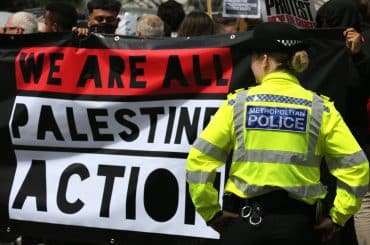

More of the ongoing contention over perceptions, slogans, and intentions. The battling over each others narrative.