
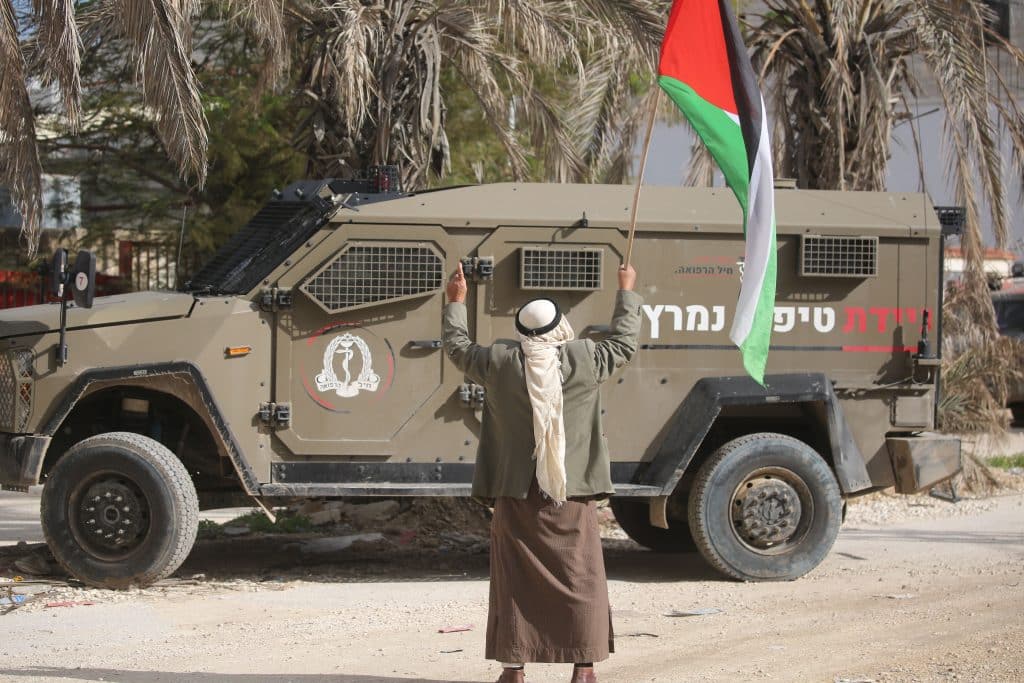
This week, the world began to grapple with the Trump administration’s abduction of Venezuela’s sitting president, Nicolás Maduro. Israel continued to tighten its grip across Gaza and the West Bank through measures that are often presented as technical or administrative, but are a sustained campaign to make life unlivable for Palestinians. And in the United States, the state is escalating repression against Palestinians and their allies, while normalizing forms of violence and detention that have become familiar features of the war on Palestine.
What ties these developments together is the accelerating erosion of the international legal order that emerged from the post-World War II era. While far from perfect and too easily dismissible by so-called “great powers” like the U.S., it provided a framework for the growth of global stability. When powerful states decide they can act outside the limits of law, people living under occupation, apartheid, or facing genocide will pay the price first, but eventually we’ll all suffer. To borrow a phrase from Astra Taylor, international law may not exist, but we’ll miss it when it’s gone.
Here’s the roundup of our coverage this week.
📹 Video
Israeli occupation forces have issued a demolition order for the Aida Youth Center playground, to be carried out anytime this week.
This decision will deprive hundreds of children from Aida Youth Center Academy and surrounding areas of their right to play and learn, as part of ongoing targeting of sports, civic facilities, and Palestinian hope, in attempts of forced displacement.
🇻🇪 VENEZUELA
The U.S. attack on Venezuela was not only illegal, it was theatrical, meant to show that Washington can invade a sovereign country, kill civilians and soldiers, seize the head of state, and treat a courtroom as a stage for regime change. Officials offered multiple justifications, from drugs to terrorism, but the clearest explanation was also the most familiar: control over oil, and control over a region.
Several of our writers tracked what this means beyond Latin America. When Washington demonstrates that adherence to international law is optional, Israel reads that signal too. It is hard to separate this moment from the broader collapse of accountability around Gaza, or from the long project of hollowing out legal constraints that were supposed to limit wars of conquest.
READ MORE → What was Trump’s illegal attack on Venezuela and the abduction of Nicolás Maduro really about? – Michael Arria
READ MORE → What the U.S. attack on Venezuela means for the Middle East – Mitchell Plitnick
READ MORE → Ushering in the age of impunity: Venezuela, Palestine, and the end of international law – Craig Mokhiber
🇵🇸 GAZA
Israel’s banning of dozens of international aid organizations is being sold as regulatory, but the effect is to cut critical lifelines in Gaza. Palestinians describe the impact in terms of survival, not policy.
We also published an important piece on Dr. Hussam Abu Safiya, a Gaza pediatrician detained without charges for a year, and on what it means that major U.S. outlets have refused to cover his case with any seriousness. The disappearance of Palestinians from elite media attention is not an accident. It is part of how a genocide becomes manageable for a political class that wants the issue to fade away.
READ MORE → How the banning of 37 international aid organizations in Gaza is being felt by Palestinians – Noor Alyacoubi
🇵🇸 WEST BANK
In the West Bank, Israel is moving against refugee camps, which are not only population centers but living reminders of the Nakba and the right of return. And it is pushing settlement expansion forward with new confidence, including the return of settlements evacuated in 2005. If even those evacuations can be reversed, then nothing is temporary. The colonial goal, as always, is permanent annexation and displacement.
READ MORE → Israel is quietly erasing Palestinian refugee camps from existence in the West Bank – Shatha Hanaysha
READ MORE → The West Bank settlements Israel evacuated in 2005 are back – Majd Jawad
🇺🇸 THE UNITED STATES
Two stories this week show how Palestine solidarity is being handled inside the United States. One reports on the killing of a Renee Good by ICE agents in Minneapolis and compares it with the murder of Ahmad Rajabi in Hebron by Israeli soldiers. Another features Leqaa Kordia, the last Columbia student protester in ICE detention, describing months of captivity that are meant to isolate, frighten, and break people who refuse to be quiet about Palestine.
READ MORE → From Palestine to Minneapolis, ICE and Israel use the same violent playbook – Ahmad Ibsais
🌍 HORN OF AFRICA
Finally, we published a sharp analysis of Israel’s move in Somaliland and how it fits into a longer strategy for regional dominance. It is worth reading alongside the Venezuela pieces. In both cases, powerful states are working to reshape regions through military leverage, client relationships, and the creation of new facts on the ground.
READ MORE → How Israel’s move in Somaliland fits in its broader strategy for regional dominance – Abdaljawad Omar

Some of our colleagues at Hasbara U still do not perceive any connection between events in Israel, ICE snatching people off the streets in the U.S., the rise of right wing parties in Germany, France and Hungary and so on. The key idea that connects all these phenomena is nativist fascism. Go to Google and type in “examples of nativist fascism in Israel”. Go to Google News and type in “the rise of nativist fascism”.
The Rise of Border Fascism – Dissent Magazine
The Ugly Origins of Trump’s “America First” Policy – FPIF
The Global Machine Behind the Rise of Far-Right Nationalism – The New York Times
etc.
Re Israel in particular –
Germany’s anti-antisemitism has failed to achieve its purported aim. Instead it has given license to proxy Israeli nationalism, fueled a rise in xenophobia, and compounded the challenge of addressing genuine antisemitism.
The Cost of Germany’s Guilt Politics
I’m always fascinated when the media and our state and federal officials succeed in having the public jump through hoops or down dead-end rabbit holes over some irrelevant comment, Friday evening press release, or policy decision (that in many cases get struck down or superceded). The idea that 9 unelected Justices will make a “final decision” is risible. See for example the 236 cases listed in the “Table of Supreme Court Decisions Overruled by Subsequent Decisions” at Congress.gov.
The Constitution is just a treaty agreement between the 50 States. The Articles of Confederation had created 13 of them, but there were no existing Senators or Representatives. So Article VII stipulated that nine States would be needed for ratification. That is the only Article in the original text that doesn’t grant powers to the Congress, which enjoys Parlimentary Supremacy over the other two branches according to the other Articles.
I have no idea why everyone accepts the talking point about the existence of “three co-equal branches of government”. It doesn’t exist in the Constitutional text. Article I: Establishes the legislative branch and gives Congress all the legislative powers and gives it rules for impeachment trials. Article II: Establishes the Office of the President, then empowers Congress to select rules and deadlines for choosing electors, providing for presidential succession by law, conducting impeachments, Ineligibility for future office, and provides for separate criminal prosecutions. Article III: Defines the judicial branch; only allows SCOTUS original jurisdiction over ambassdors, ministers, counsels, and some disputes between States. It gives Congress the power to ordain and establish “inferior Courts” and make regulations (including denial of justicabilty) to appellate or any Court’s jurisdiction over certain political or national security matters. Article IV: Governs relations between states; but grants Congress the power to prescribe the manner of proving state acts, admit new states, and regulate U.S. territories. Article V: Details the amendment process; begins by stating, “The Congress, whenever two thirds of both Houses shall deem it necessary, shall propose Amendments…” Article VI: Establishes the process Congress uses to make laws, treaties, and the Constitution as the supreme law of the land; then mentions “Senators and Representatives” who make up Congress, State legislatures, and other public officers bound by oaths.
The Fatal ICE Shooting and Gaza Are More Connected Than You Realize
Veteran and whistleblower Anthony Aguilar joins Cenk Uygur to discuss ICE agents training with Israeli security forces.
Aguilar addresses YAMAM (יחידה מרכזית מיוחדת ,ימ״מ) during the discussion. YAMAM is a counterterrorism unit of the Israeli police. I have read analysis that finds similarity with the Gestapo even though the Gestapo mainly policed non-Jews. YAMAM mainly targets Palestinians, who suffer effective enslavement according to international law under an illegal occupation. Such effective enslavement is a abstraction of the chattel slavery that existed in the USA before the end of the Civil War. Nowadays true chattel slavery does not seem to exist anywhere in the world.
[I recommend asking ChatGPT the following question to find out how modern international law interprets “slavery”: How does legal personhood fit into the international definition of slavery?]
With this distinction between chattel slavery and the modern international definition of slavery, YAMAM must be considered to combine the worst of the Gestapo with the worst of an ante bellum slave patrol. It is hard not to assume that only the most vile sort of person serves in YAMAM.
I suspect that we see in current treatment of civilian Palestinian detainees how for the last 50 years YAMAM has treated detainees that are members of the Palestinian resistance.
https://youtu.be/YkKfzJFfQfs?si=dYGRVmBosIh_lcj-
“And in the United States, the state is escalating repression against Palestinians and their allies, while normalizing forms of violence and detention that have become familiar features of the war on Palestine.+
______________________________________________
Compelling reason for advancing voter understanding of dissenting intentions and objectives.