

“By God, we’ve kicked the Vietnam syndrome once and for all.”
– March 1, 1991, George H.W. Bush
With those words then President George H. W. Bush asserted that after the debacle of Vietnam, the First Persian Gulf war had reinvigorated a new war mentality that asserted the American military, once again, held global dominance.
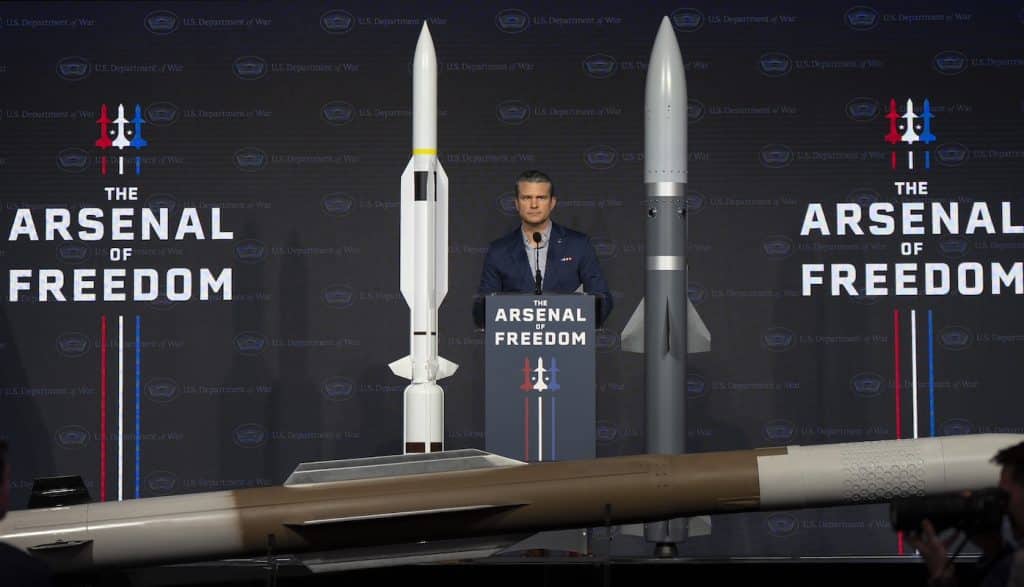
Trump and his coterie have taken such overconfidence to new heights of braggadocio, evident in the words of the former Fox News personality, Defense Secretary Pete Hegseth, who speaks about bombing Iran as if it were a boxing match. “We are punching them while they’re down, which is exactly how it should be.”
Transforming the illegal war on Iran into a sporting event is part of the gamification of American belligerence that became well established in the early twenty-first-century US wars in the Middle East. With propaganda memes and montages on TikTok, Trump and his war machine are eager to entice Americans into thinking bombing Iran is fun and exciting.
Actual footage of bombs dropping is edited between words and images drawn from TV shows and films, some of which themselves are the products of the Pentagon’s grip on Hollywood. Take for example the montage that features a sequence of clips from Iron Man, Breaking Bad, Deadpool Tropic Thunder and Braveheart, that pulls out the words, “strength,” “honor,” “freedom,” juxtaposed with real bombing footage, then “I am the danger” and “here it comes,” and another explosion. It ends with the growl, “flawless victory,” and an image of the White House.
The confusion between fact and fiction, war and entertainment, invites viewers to feel the power and experience of hyper-weapons through the eyes of popular TV heroes and film super-warrior who are always on the right side of extreme violence. The realities of human suffering, death and destruction are ripped away from what becomes simply the toxic joy of destruction. Over the course of the twenty-first century, this merger of media and war came to be known as “militainment.”
The Nintendo War
The visual gaming of Trump’s war finds its history in Bush the Elder’s war, who presided over the First Gulf War, Desert Storm, first called the Nintendo War, then turned into an actual video war game called Desert Storm. When the so-called smart bombs fell on Baghdad, they were loaded also with remote cameras that celebrated “precision” strikes that never failed to hit their targets. The new high-tech weapons resulted in limited “collateral damage,” or so the narrative went. TV visuals of the bombing were supplied to network outlets by the Pentagon. Broadcast audiences saw the war from a weapons point of view, embedding the conflict within the audiovisual experience of militarism.
H.W. Bush’s proclamation of victory could not have been accomplished without such spectacular imagery that both entertained and empowered American audiences, but most certainly failed to inform them about the destruction and loss of life. With coverage that merged Public Relation, entertainment, and war propaganda, the media ensured the continued public support for Desert Storm.
It was all part of an emerging nexus known as the military-media-industrial complex, then busily engaged in creating fantasies of war. War games used the same computer-based technologies that guided actual weapons systems, and multiple video game franchises like America’s Army and Call of Duty made millions of dollars by unifying the economies and technologies of war. They erased the realities of death; after all nobody dies in a videogame.
The War on Terror and Militainment
US television news was fully incorporated into W. Bush’s War on Terror, when the partnership between war and entertainment would make another great leap forward, and “militainment” ruled news coverage. News reports and anchors ‘embedded’ with US troops, told the story of invading Iraq over the shoulders of real soldiers, just like a ‘reality show’ and a Marine famously held an Iraqi infant in his arms on the battlefield, highlighting the war tropes of valor and humanity. With the war on terror, propaganda was designed on the battlefield, stealing block buster movie plots that embedded Bush’s twenty-first century wars firmly within entertainment genres. Saving Private Ryan on screen became Saving Private Lynch in Iraq. W. Bush, who did a less than adequate job during his stint in the Air National Guard, managed to perform a cosplay of maneuvering a fighter jet onto the USS Abraham Lincoln, just off the coast of San Diego, in a choreographed cosplay of Tom Cruise in the legendary film Top Gun. After that Bush went to the ‘green zone’ in Baghdad and passed around a fake Thanksgiving turkey to the troops and became a toy representation of a president.
Films had stepped up their collaborations with the military, and a spate of block buster movies made for the big screen featured Metal Superheroes wielding the Pentagon’s toys. It was a perfect audio-visual merger of extravagant weaponry. Ultimately, the feature film Act of Valor that starred active-duty US Navy Seals in a film first conceived as an US Army recruitment advertisement was viewed in movie theaters across the country.
The spectacular entertainment imagery would claim visual dominance over global landscapes, in acts of erasure that hid on-the-ground realities of their human victims. But the war on terror turned into costly forever wars and killed millions of people of the Middle East. With no celebrated victories, the hallow claims of fantasy wars faded from view.
The Trump-Hegseth memes are desperately trying to resurrect an entertainment-war media ecosystem, this time injected with off-the-scale levels of toxic militarism that celebrates egotistical power. But media fantasies of entertaining war were finally laid to rest when the whole world watched as the settler colonial state of Israel committed the crime of crimes—genocide—against the Palestinian people. US establishment media tried to cover for Israel’s slaughter in Gaza with egregiously pro-Israel news bias, but most of the world’s people didn’t buy it.
The New Age of the ‘Gaza Genocide Syndrome’
During two and half years of Israel’s genocide in Gaza the world has experienced the visual horrors on the ground, documented by the sacrifices of Palestinian journalists who sent their reporting across global internet platforms. Global citizens have felt 2000-pound bombs that destroy whole apartment buildings, tear up the bodies of children and extended families, and erase entire Palestinian lineages. We have heard the testimonies of doctors caring for children, or trying to, hit by Israeli sniper bullets in the head and chest, and seen the images of starving civilians killed seeking food, and the people of the world have recoiled. They have demanded that their governments stop supporting the genocide, and in the US, they called out Biden, then Trump, to stop sending deadly mega weapons to the state of Isreal.
A new ‘Gaza Genocide syndrome,’ renders the public immune to war as entertainment, especially the impulsive, needless and brutal Trump-Hegseth-Netanyahu war on Iran.
Genocide could not be translated into entertainment, and establishment media did not even try. Instead, they repeated Israeli talking points, downplayed the slaughter, dehumanized the victims and justified every destruction of civilian infrastructure as strategic necessity to kill an invisible ‘army’ supposedly embedded in every school, hospital, aid distribution center and refugee camp. Nearly 4 out of 5 Americans were against bombing Iran from the start, and though corporate media have gone all out to promote the US-Israeli war, a Quinnipiac poll released on March 5, found that 53 percent of Americans opposed to it, and that number keeps rising. Trump’s war remains “uniquely unpopular” historically, and with global publics. The US public is deeply opposed to expanding it, with 74 percent of the public opposed to sending US ground troops to Iran.
We have come full circle as a new ‘Gaza Genocide syndrome,’ renders the public immune to war as entertainment, especially the impulsive, needless and brutal Trump-Hegseth-Netanyahu war on Iran.
Currently Trump has been using the word “excursion,” likening his illegal bombings and killing of Iranian civilians and American soldiers to a quick, leisurely vacation. For an unhinged psychopath intoxicated by his own power to destroy, in an atmosphere Chris Hedges describes as “a lawless world led by idiots,” there seems to be little difference between fact and fiction. Trump spews fantasy-war delusions he seems to believe, wrongly asserting “we’ve already won,” even as he pleads for allies to send their battleship to open the Strait of Hormuz, a gambit that has utterly failed. Groping for an exit ramp he can’t take for fear of humiliation, the mad king refuses to accept the reality of defeat. At the moment, his own propaganda phrase “I am the danger” is playing out as the truth on a global stage.
This article is based in large part on the books, The Complicit Lens: US Media Coverage of Israel’s Genocide in Gaza, and A Century of Media A Century of War, both by Robin Andersen.


FDR talked of the US being the “arsenal of democracy” in a radio broadcast on 29 December 1940. Now, Kegsbreath has twisted that into the “arsenal of freedom”, a meaningless slogan begging the questions: Freedom for whom? Freedom from what? Freedom to do what?
Robin Andersen is mistaken on both counts when he says: “George W. Bush, who never served in the military, managed to maneuver a fighter jet onto the USS Abraham Lincoln…”
Unlike Captain Bonespurs, Bush did indeed have military piloting experience (in the National Guard), but no, he did not himself maneuver the plane onto the carrier:
George W. Bush did not land the jet himself! While President Bush arrived in the co-pilot’s seat of a Navy S-3B Viking (designated “Navy One”) on May 1, 2003, (dressed in an olive green, one-piece military flight suit (jumpsuit), with a commander-in-chief flight patch and a survivor vest, and exited the plane holding his white-visored helmet under his arm, and wearing combat boots), for his “Mission Accomplished” speech onboard the USS Abraham Lincoln, a professional Navy pilot handled the actual carrier landing.
Who Piloted: Navy Commander John “Skip” Lussier of the “Blue Wolves” (VS-35) piloted the aircraft for the landing.
Bush’s Role: Bush, a former Texas Air National Guard pilot, took the controls for a portion of the flight while it was in the air, but he was not carrier-qualified and did not perform the high-pressure “tailhook” landing.
The Landing: The plane caught the last of four steel wires to stop, a routine but challenging maneuver for experienced Navy pilots.
Bush later told reporters, “Yes, I flew it. Yeah, of course, I liked it,” regarding his time at the controls during the flight.
–Just for the record!
Otherwise, a very good piece!