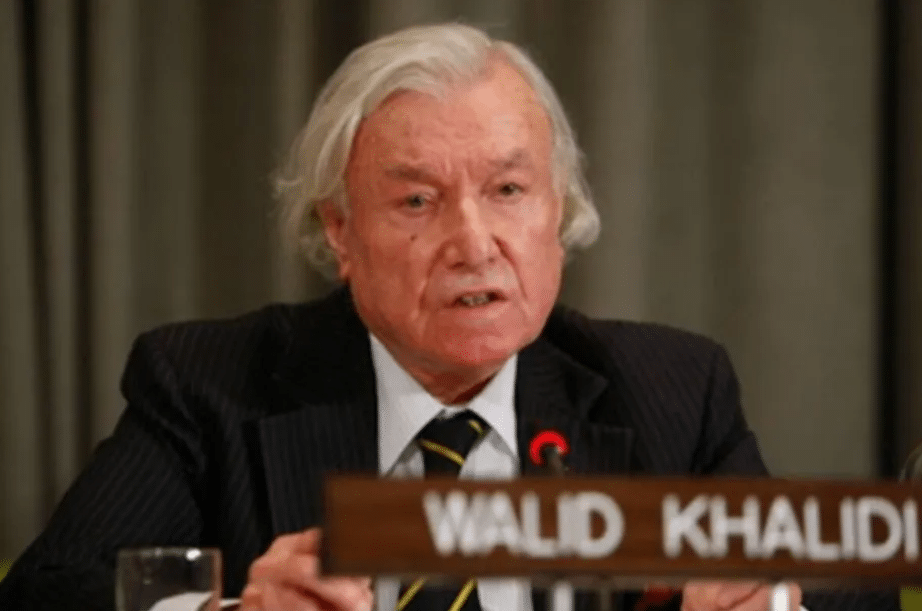
This week, Palestine lost one of its greatest scholars, Professor Walid Ahmad Samih Khalidi, who passed away peacefully in Cambridge, MA, after having celebrated his 100th birthday the previous year surrounded by family. His passing was received less with shock than with amazement at his intellectual contribution over most of his century, a legacy to which he continued to add his final meticulous touches even in his last days.
His reputation as the historian of the Nakba, established through his studies, books, and historical collections, is well known in Palestine and throughout the Arab world, as well as among researchers worldwide. But these towering scholarly achievements are less known globally, and remain to be fully recognized, especially since, from the outset, they went against the prevailing Israeli narrative around 1948 and ever since.
The historian of the Nakba
Khalidi’s earliest scholarly work uncovered the Zionist movement’s “Plan Dalet,” which he called the “master plan” to expel the Palestinian people en masse — well before the revisionist school of Israeli historians gradually revealed what Walid Khalidi had shown the world in the 1950s. His singular academic achievements since the 1970s include landmark volumes documenting the Nakba, such as From Haven to Conquest, Before Their Diaspora, and All That Remains, which provide an encyclopedic Palestinian narrative of our history, essential elements of any library on Palestine.
As the tributes to Walid Khalidi poured in over the past days from presidents and kings, from political, intellectual, and community leaders, and from his peers, his academic and scholarly biography has been prominently featured. These include not only his own publications, but no less significantly, the establishment of the Institute for Palestine Studies (IPS), the premier Palestinian scientific research center. The IPS, today operating in Palestine, Lebanon, and the U.S., is enjoying its sixth decade of world-class research on Palestine in the “all-Palestine” historical and political tradition pioneered by Khalidi, who led the Institute for over 40 years. So not only will he be remembered as a great historian, but he was also a master institution-builder and manager, drawing on his well-honed understanding of the needs of the moment.
Perhaps what is less known about this very special Oxford-educated Palestinian gentleman, with the pedigree of an aristocratic Jerusalemite family, was his deep, less visible political activism. Over three periods of his life, he engaged in different roles in Palestinian politics, and remained very much in tune with the politics of each era and with his own ability to play a role. His biography was formative in that regard, having witnessed the buildup to the Nakba and its aftermath, and having received an upbringing that combined education, patriotism, and courtesy all in one package. His father, Ahmad Samih, was a liberal educator; his grandfather an Ottoman and Mandate-era judge who established a family manuscript Library in 1900; and his uncle was the last elected mayor of Jerusalem and a critical ally of the Palestinian national leadership of his era. Another of his uncles, Ismail (my father), was a UN diplomat.
The man on whom nothing was lost
But what I would like to shed more light on, for those who know of his place in Palestinian history and those who may not, is based more on my own personal interactions with him over the past few years, as well as on some widely known milestones in his political history. Those I refer to in passing, as the definitive version of that story will hopefully be published soon, as Walid has spent the best part of the past decade writing his own memoirs. They promise to be something special in recording the history of the Palestinian national movement since 1948.
As one of the titles on the bookshelves in his Library framing him aptly puts it, Khalidi was the man on whom nothing was lost.
Some of the key public moments in his political formation are well known. He resigned in protest from a teaching position at Oxford over the Anglo-French-Israeli aggression on Egypt in 1956, later becoming a Professor at the American University of Beirut, where he remained until the 1980s. He settled into Beirut with other émigré cousins, including himself and other Khalidis who had intermarried with the Salaam clan, who were and continue to be leaders of Lebanon’s Sunni community.
Prior to the move, Khalidi had considered following in his uncle Hussein’s tradition of working with the new Hashemite Kingdom of Jordan, but he walked away from the opportunity; Khalidi, like many young Palestinian intellectuals of the post-Nakba era, had become engaged by the emerging pan-Arabist political revival, as manifested in Nasserism and the Arab National Movement (ANM), with which he was closely involved as a thought leader. He ultimately focused entirely on, and was indeed consumed by, the question of Palestine.
In parallel with the institution-building and teaching he pursued in Beirut, the 1970s put him in direct contact with the leaders of the PLO and its institutions, who were quick to lean on his research capacities and political acumen across a range of forums. He became personally close to all the Fatah leaders, including Yasser Arafat, Khalil al-Wazir, Salah Khalaf, and Mahmoud Abbas. But he was was also close to George Habash and leaders of the more radical (former ANM) factions in Lebanese and other Arab political arenas. In the turbulent Lebanese context, with his strong Lebanese family connections and pan-Arab network, Khalidi played an indispensable behind-the-scenes role — up until the 1982 Israeli invasion — in mediating fraught Palestinian-Lebanese-Arab relations.
But like so many, that war destroyed his home and library, and uprooted him at the age of 60 to the United States, where he resided principally for the rest of his life, though reinventing himself academically and politically.
Though he worked for many years at Harvard University as a visiting professor, his eyes were always on Palestine. He had already made a mark in the West, not so much as the historian of Palestine, but as a political theorist in his groundbreaking 1978 essay in Foreign Affairs, “Thinking the Unthinkable: A Sovereign Palestinian State.” This provided the first well-grounded Palestinian rationalization and conditional acceptance of the partition of Palestine into two states, with a sovereign Palestinian state within the 1967 borders.
“Unthinkable” because, until that moment, the only Palestinian concept of a resolution was a single secular democratic state in all of Palestine, and anything less was tantamount to a betrayal of the full national rights of the Palestinian people. Khalidi would perhaps never have taken the credit, but his Palestinian colleagues in the PLO by 1974 had made the two-state solution PLO policy, and it remains so to this day. Curiously, while his work as a historian established his patriotic and pan-Arab credentials indisputably, this venture into Palestinian politics (alongside his assumed class affiliations) earned him being labeled as part of the bourgeois Palestinian right.
By the late 1980s, as the PLO declared the independence of the State of Palestine, Khalidi’s growing stature in the West put him in the midst of an emerging Palestinian-American dialogue, often being proposed as a proxy for the PLO as an acceptable party with whom the Americans could speak, given that the PLO was still considered a terrorist organization. By 1991, he had been nominated by the PLO as a member of the Jordanian-Palestinian joint delegation to the Madrid Peace Conference, but he soon withdrew from that position, probably unable to be both Jordanian and Palestinian at once. By then, however, the PLO was in decline, and once it had signed off on Oslo in 1993, a deal way below the minimal conditions Khalidi had specified twenty years earlier, he reached a moment where his role could no longer counter the powerful forces that put the PLO into the Oslo corner, from which it has yet to liberate itself. The man on whom nothing was lost, indeed.
Jerusalem: the final mission
Clearly, Walid Khalidi’s formative years in Jerusalem shaped who he became, but the diaspora after 1967 cut him off and meant he could not really engage with the city or his family legacy there. But over the following decades, he translated his passion for Jerusalem into concrete action, and by the late 1980s he had connected with the few family members in Jerusalem who were responsible for safeguarding the large family endowment (waqf dhirri) in the city. These include some 50 residential and commercial properties, land in and near the Old City, and the Khalidi Library, which houses priceless Islamic manuscripts collected by the forefathers.
Walid’s natural focus to begin with was the Library, as it embodied the intellectual tradition of the family and some of the rarest written cultural heritage of Jerusalem and Palestine. As in his previous ventures, he devoted his all to the task, mobilizing international and Arab donor resources, and Khalidi family donations through the Friends of the Khalidi Library, a nonprofit 501(c) he founded with other family members in the U.S. These were used to restore the most precious elements of the collection, renovate the dilapidated premises, and produce a scholarly catalogue of the Library manuscript collection published by al-Furqan Foundation. The project was sponsored by the Saudi Sheikh, Ahmad Zaki Yamani, another of Khalidi’s close friends from the region.
By 2005, when he first asked me to help out with the Library and waqf issues, as I was regularly traveling to Palestine from Geneva, where I was then working with the UN, he had a plan in mind. At the time, perhaps I didn’t see it, but twenty years later, it has borne fruit.
At that stage, Walid had tired of the daily tasks of coordinating with family in Jerusalem, managing donor projects, and assuring that money was well spent. So I became his channel and point man for his Jerusalem project, ferrying back and forth between his high expectations and strict standards and the limited vision and capacity of family members on the ground, who had endured decades of occupation and meagre resources. Indeed, over time, Walid infused other family members and me with the same passion and commitment to our common heritage that clearly possessed him, in every possible detail and at every political level of managing such an endowment in the tense and hostile environment of Jerusalem.
Beginning with the Library, but over time growing to encompass all of the family waqf issues, I came to know a Walid Khalidi to which only the closest relatives were privy. He never ceased to astound us with his grasp of the nitty gritty of this or that waqf property’s history, of the politics and geography of Jerusalem, the extreme risks faced by our heritage in the Jerusalem limbo of competing Jordanian, Palestinian, and Israeli legal regimes and political pressures, and his willingness to stand up to the rich and powerful (if need be) in defense of the integrity of the family heritage.
In the waqf‘s 2024 battle against an extremist settler invasion of part of the Library complex, then 98-year-old “Field Marshal” Walid was at the helm of the family leadership, legally and publicly confronting the ultimately failed takeover. In his last months, he was intimately involved with the waqf‘s legal cases in Jerusalem courts to regain rights to properties leased to Christian churches for over a century.
During the two years of the Gaza war, he produced over 50 quick takes on the ongoing genocide sent to a family mailing list, focusing on the amazing military achievements of the resistance and the despicable collusion between Zionism and Imperialism. These deserve publication as gems of informed political analysis, written by the historian of the Nakba about the new Nakba. His last penned work in his life (2025) was a pamphlet exposing the Abrahamic Accords as fundamentally opposed to the traditions to which they claimed lineage.
The fallacy of Walid Khalidi being “right-wing” is no less implausible than the façade of the diplomatic gentleman-scholar that was his public persona. Just as he was systematically stern and demanding of those younger generation, so was he the charmer and delightful friend of his peers (or those who he believed qualified as such!).
By 2025, he had brought together 25 Khalidis in the U.S., of all ages, within the FKL, another of his lasting institutional achievements, always urging them to serve more and keep Jerusalem in focus.
So in bidding farewell to Walid Khalidi, we can fairly say that Palestine, Jerusalem, and the Khalidis have lost a pioneer, a teacher, and a leader. And the liberal West has lost a thinker who first spelled out a path of historic reconciliation. But of course, he lives on through the institutions he built and the intellectual output he left us. Perhaps most of all, he leaves behind the spirit of fierce intellectual integrity and independence, and of a life dedicated to serving the public good.
Raja Khalidi is a development economist based in Palestine. He is the first cousin of Walid Khalidi, separated by around 30 years.