For more than ten years now, Germany has seen a large-scale campaign against alleged antisemitism that in reality targets nothing more than criticism of Zionism – or even criticism of Israeli policy. This campaign has been driven primarily by the major political parties, the mainstream media, and several foundations, and initially focused above all on the arts and cultural sectors. Those targeted included the Cameroonian historian Achille Mbembe, the U.S. philosopher Judith Butler, the Israeli sociologist Moshe Zuckermann, the former director of the Jewish Museum Berlin Peter Schäfer, the British musician Roger Waters, and the late Syrian artist Burhan Karkutli. For a long time, the main goal was to defame and criminalize the global BDS movement. Commemoration of the Nakba was also turned into a taboo.
In the early years, these intensified campaigns were still masked as “discourses” in order to give them a liberal veneer. A few voices spoke out publicly against them, for example the Australian historian and genocide scholar Dirk Moses with his noteworthy 2021 essay “The German Catechism.” But the debates provoked by him and others largely remained confined to the cultural pages of bourgeois newspapers.
All of this changed in October 2023. The uprising in Gaza and the genocide that followed at Israel’s hands revived solidarity with Palestine in Germany. Tens of thousands poured into the streets day after day, week after week. The attacks by the authorities – from police violence to censorship and bans to the destruction of people’s livelihoods – suddenly affected a critical mass. And this was a movement that marched, resisted, and made itself heard.
Since then, the Palestine solidarity movement has sought to carry the struggle into every public space and fight it there: from the streets to cultural institutions, trade unions, university campuses and lecture halls, and even courtrooms. Even the Bundestag is no longer free of protest by spectators and individual members of parliament. Memorial sites for the victims of German fascism are no longer exempt either.
Kuffiyeh as a symbol
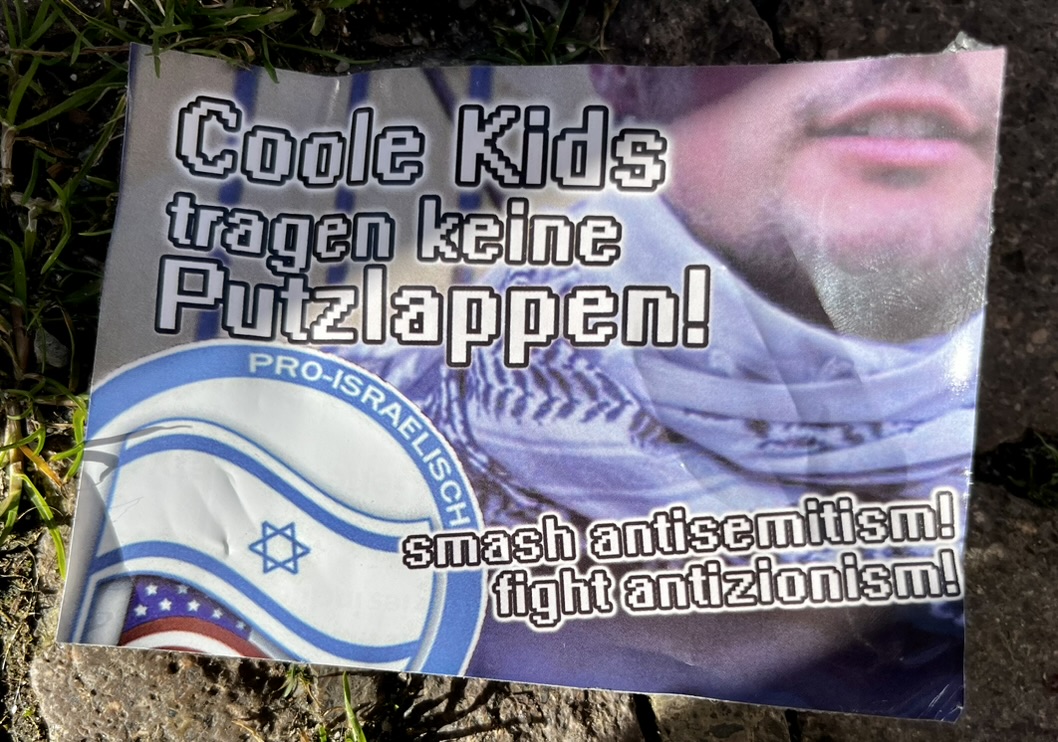
While Zionists in Palestine have recently been trying to culturally appropriate the kuffiyeh, Zionists in Germany have for years defamed it as an “antisemitic symbol” and, in the worst tradition of colonial racism, insulted it as a “rag”. They are particularly fond of spreading the myth that Amin al-Hussayni, installed by the British as the Mufti of Jerusalem and later a collaborator with the fascists, forced the Palestinian population to wear the kuffiyeh so that “terrorists” could more easily blend into the crowd.
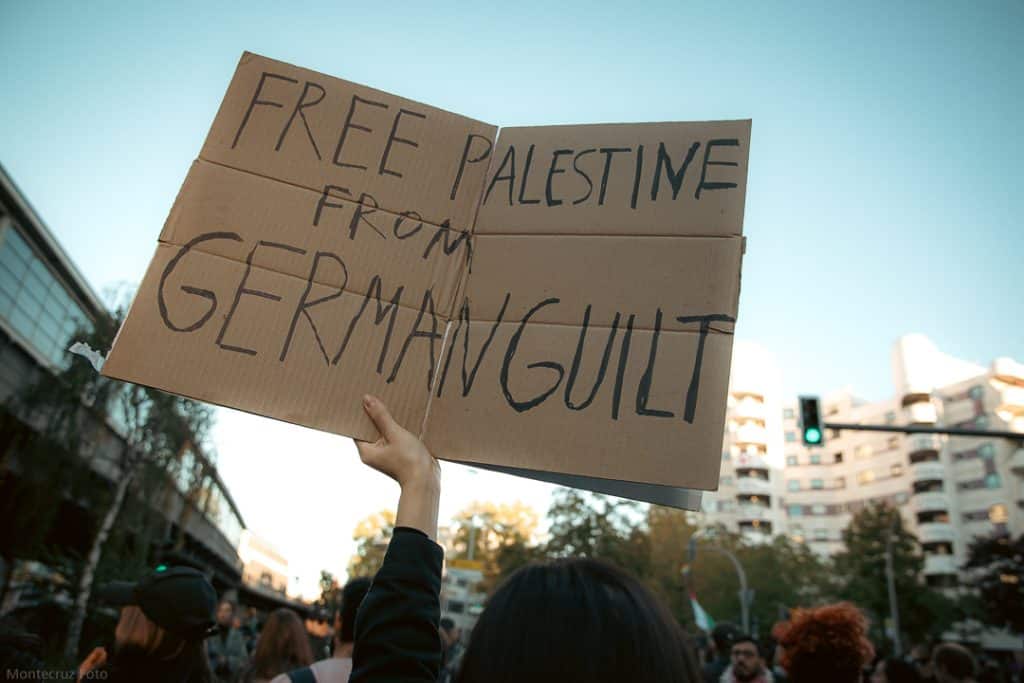
One should know that Husayni may be better known in Germany today than among Palestinians themselves, because for German Zionists he serves as a crown witness for an alleged Arab- or Islamic-fascist symbiosis. By invoking his figure, they like to portray Palestinians as the “new Nazis“ – a trick to shift German guilt onto the Palestinians. Only against this background can the full extent of the legend about Husayni allegedly imposing the kuffiyeh, and the contempt directed at the kuffiyeh in the German context, be fully understood.
After October 7, the kuffiyeh was also criminalized and turned into a taboo by German authorities and institutions. The most extreme case was the weeks-long ban on kuffiyehs in the migrant-majority Berlin district of Neukölln, particularly along Sonnenallee. At the time, police set up military-style checkpoints, patrolled the streets, and arrested people for wearing kuffiyehs or chased them through the neighborhood. Some universities and cultural institutions also imposed kuffiyeh bans through their internal regulations.
When the left-wing member of parliament Cansın Köktürk wore a kuffiyeh in the German parliament in March 2025, right-wing media reacted with outrage, and politicians from the conservative CDU demanded that the kuffiyeh be banned in the Bundestag.
Wearing the “Palestinian scarf”, as it is often called in Germany, was also prohibited at the memorial site of the former fascist concentration camp Buchenwald. In August 2024, Anna M., a communist activist with Jewish roots, and the German-Palestinian activist Mahmud Abu-Odeh were initially denied entry to the memorial because they were wearing kuffiyehs, and Abu-Odeh was also wearing a shirt with the Arabic word “huriyya” (freedom). After a lengthy discussion, they were allowed to enter.
But the following year, M. was banned from the site when she again attempted to take part in a commemoration on the former concentration camp grounds while wearing a kuffiyeh. Shortly afterward, an internal guideline from the memorial became public. In it, the kuffiyeh – along with other (pro-)Palestinian symbols such as the watermelon, the key or the olive branch, and slogans like “From the River to the Sea Palestine will be free” or “Ceasefire now“ – was classified as antisemitic. Particularly outrageous was the fact that these symbols and slogans were placed on the same level as Nazi codes, such as “88” for “Heil Hitler.”
The memorial later backtracked publicly and announced that it would revise the guideline. M.’s ban from the site, however, remained in place, forcing her to take the matter to court.
Kufiyas in Buchenwald
The campaign “Kuffiyehs in Buchenwald” emerged from this affair. Signatories include the Jewish Voice for a Just Peace, the International Jewish Anti-Zionist Network (IJAN), and numerous leftist, antifascist, anti-imperialist, and Palestinian organizations and individuals, primarily from Germany, but also from the United States, Canada, and other countries. It entered the public arena with the following demands: “1. Openly addressing the genocide in Gaza at the Buchenwald Memorial. 2. No ban on Palestinian symbols at the Buchenwald Memorial and no denigration of them as anti-Semitic. 3. No entry- or speaking bans on the premises due to solidarity with Palestine or criticism of the apartheid state of Israel.“
Contrary to what the memorial’s leadership claims, M. is not an isolated case. In addition to her and Abu-Odeh, other people have also been prohibited from entering the site while wearing a kuffiyeh. During the court proceedings over M.’s ban, the memorial’s lawyer explicitly referred to the guideline that had officially been declared “withdrawn.” On the foundation’s website it now states that “there is no blanket ban on wearing a kuffiyeh.” When Mondoweiss asked what exactly that meant, the foundation’s press spokesperson, Rikola-Gunnar Lüttgenau, responded: “There are very different situational contexts in which the kuffiyeh is worn. As ‘normal’ clothing, as a fashion accessory, or by supporters of Hamas or German far-right extremists who want to express their antisemitism through it. This must be decided on a case-by-case basis.” He did not explain, however, what such a “case-by-case assessment” would actually look like.
“That’s all a pretext and a farce,” Abu-Odeh told Mondoweiss in response. “Case-by-case assessments – we know that from the repression against the slogan ‘From the River to the Sea.’ In practice it means that people are reported to the police, imprisoned and beaten, apartments are searched, and demonstrations are broken up. And at the very end a judge decides whether it was lawful or not – sometimes yes, sometimes no. That’s just another word for arbitrariness.”
The kuffiyeh, he said, has never been a “normal item of clothing” or a “fashion accessory,” but rather “an essential part of Palestinian culture that the Zionists want to erase. Depoliticization is part of genocidal policy. Erasure is part of genocidal policy. The memorial is playing along with this dirty game.”
“It’s a disgrace,” M. also emphasized. “In the name of the victims of fascism, the victims of genocide in Palestine are now being silenced. The director of the memorial, Jens-Christian Wagner, declared last year that when a young Spanish speaker spoke of the genocide in Gaza and called for resistance in the tradition of the antifascist resistance, this was an ‘antisemitic incident’ and that one must not talk about a genocide in Gaza in a place like this.
Finger on the sore spot
“That sums up the entire hypocritical and deceitful ‘culture of remembrance’ in Germany. Buchenwald in particular – the concentration camp whose prisoners rose up and liberated themselves – is a place that stands for antifascism, internationalism, and resistance. Where in Germany, if not here, should we talk about the genocide in Gaza? Where, if not here, should we defend the right of the oppressed, the imprisoned, and those marked for mass murder to resist?”
Sam Weinstein of IJAN added: “Memorial sites of former concentration camps are increasingly being instrumentalized to undermine current political movements opposing war and genocide.” He believes that “Germany’s perverse obsession with the genocidal ideology of Zionism” is tied to more mundane interests, such as the drive to “legitimize its illegal arms deliveries to the apartheid state of Israel.”
On the eve of the U.S.-Israeli war of aggression against Iran, a public smear campaign against the initiative began, driven by Zionist politicians from various parties – from the far right to the “left“ – as well as the mainstream media, which since at least October 7, 2023 have formed an iron wall of Zionism in Germany. There have already been initial cases of canceling and physical attacks on events organized by the campaign.
But M. made clear that they will not be intimidated: “We expected attacks like these. Anyone who stands up for Palestinian rights in Germany is subjected to repression and smear campaigns. And here we have put our finger exactly where it hurts – by challenging the German state’s self-image, which rests on pseudo-antifascism and colonial arrogance, while we ourselves can authentically invoke the tradition of the victims of fascism and the antifascist resistance fighters.”
On the weekend of April 11-12, the campaign will hold its own commemoration, parallel to the official state ceremony, honoring the self-liberation of Buchenwald and the victims of genocidal policies in the past and present. A conference is also planned. It will address the history of Buchenwald and the resistance there, the colonial continuities of German fascism and imperialism, the persecution of antifascists in the Federal Republic of Germany, and the question of what antifascism means today.