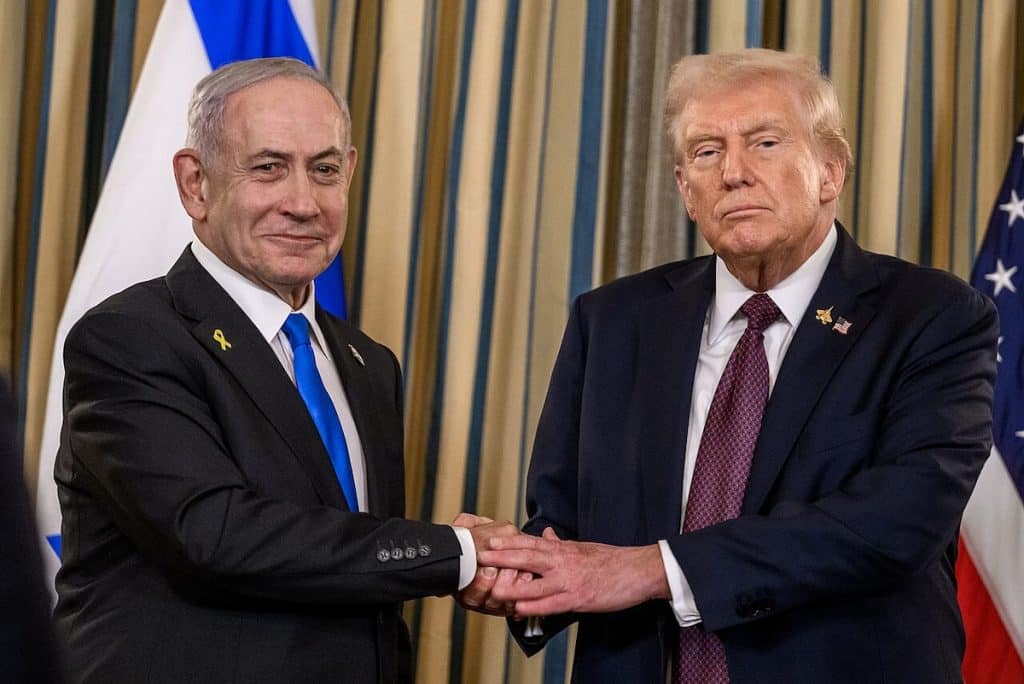
There is strong evidence that Israel is trying to sabotage Donald Trump’s supposed efforts to negotiate with Iran to end the war, but the mainstream U.S. media is downplaying or ignoring this vital truth.
Here’s what is happening:
Trump announced early on March 23 that the U.S. was having “very good and productive conversations with Iran regarding a complete and total solution of our hostilities in the Middle East.” These alleged talks then led him to postpone planned U.S. air attacks on Iranian power plants and energy infrastructure.
Almost immediately, Israel started bombing infrastructure sites in Tehran.
The mainstream U.S. media barely noticed these two arguably connected events. The Washington Post, for instance, ran a long (40 paragraph) report, with contributions from six different reporters, but the article nowhere mentioned the striking evidence that Israel might be trying to blunt or destroy Trump’s peace initiative.
In the days that followed, the mainstream failure to scrutinize Israel’s conduct continued. A Thursday (March 26) page 1 story in the New York Times relied mainly on “two senior Israeli officials and two people briefed on the matter,” who admitted that Trump’s tentative peace plan “was detailed enough to alarm Mr. Netanyahu, his staff and Israel’s defense chiefs.” But the Times report failed to even raise questions about whether an alarmed Netanyahu would consider trying to sabotage the talks.
Surely Times reporters who are based in Israel should have local sources who would be willing to at least raise the possibility that Netanyahu might try to double cross Trump, and order provocations to disrupt the “alarming” peace plan? The reporters kept their “senior Israeli officials” anonymous; surely they could have made the same offer to critics?
There was more. Here was the Times‘s morning bulletin on March 26: “An Israeli airstrike killed an Iranian naval commander who played a pivotal role in shutting down the Strait of Hormuz.” If Netanyahu genuinely supports Trump’s effort to talk peace, why would he order the assassination of yet another high-ranking Iranian official? So far, the Times has not examined this angle.
These failures are just the latest examples of how the American media is failing to look closely at what is truly motivating Israel and Benjamin Netanyahu. Trita Parsi was born in Iran, and is a recognized expert who has published two books and many articles. He posted on X, formerly Twitter, that:
Israel wants this war to go on for as long as possible to set back Iran decades, regardless of the cost to regional stability, global markets, and the American people.
Parsi could certainly be mistaken. But the mainstream U.S. media is not supposed to take sides by endorsing one view or another. What the major papers and cable news are instead supposed to do is to present the facts — in this case the suspicious connection between Trump’s peace overture and Israel’s immediate bombing attack — and then quote or put on the air a range of experts, giving their audiences the chance to form their own opinions.
Parsi continued his analysis in another post on X:
Israel’s goal is to destroy Iran’s industrial base and set the country back decades to ensure that Tehran cannot pose a challenge to Israel’s hegemonic designs for years to come — regardless of the cost to the global economy, regional stability, or Trump’s presidency.”
(At this site, Kate McMahon convincingly reinforces Parsi’s view about Israel’s real objective.)
Meanwhile, Trita Parsi has been mostly a nonperson in the mainstream. The New York Times did publish a short (seven paragraphs) opinion snippet by him on March 8, but nothing since. He has appeared on MS Now (formerly MSNBC) in the past, but apparently not since the U.S. and Israel attacked Iran on February 28.
Other genuine experts who are mostly sidelined include: Sina Toossi, an Iranian-American scholar at the Center for International Policy; Marc Lynch, a professor at George Washington, who has just published a long, persuasive indictment of the decades of U.S. policy disasters in the region titled “America’s Middle East;” and Juan Cole, another veteran Mideast expert who teaches at the University of Michigan and is also an informed and outspoken critic of the U.S.
They all have stellar credentials, But they rarely appear on cable news. Instead, we are treated to a parade of ex-U.S. diplomats and retired military officers, nearly all of whom are ignoring the suspicious role of Israel and Netanyahu.
What is the mainstream afraid of? Haaretz, one of the major newspapers in Israel, just published an editorial under the headline: “Israel Must Not Torpedo Talks Between the United States and Iran.” In part, the paper warned against what it described as Benjamin Netanyahu’s “double talk”:
. . . supporting diplomacy officially while sabotaging and agitating for continuing the war behind the scenes. Recent history shows that Israeli decision makers, chief among them Netanyahu, are practiced at torpedoing negotiations that end in agreements.”
You will never see anything similar on the editorial pages of the New York Times or the Washington Post.