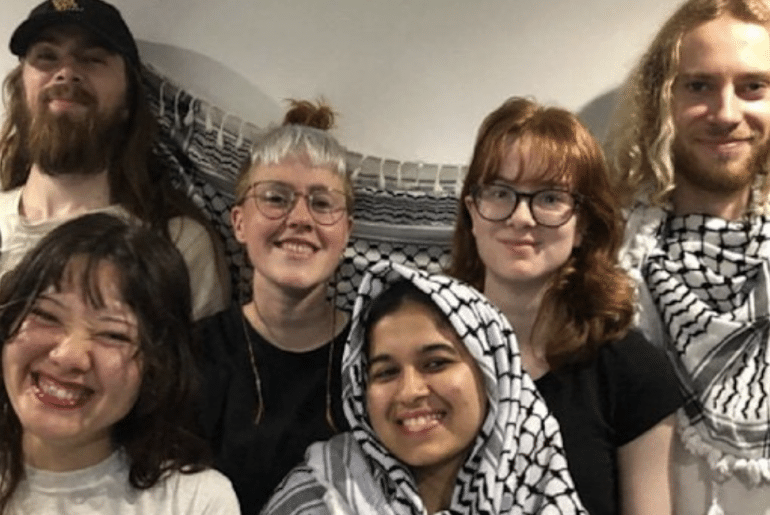
Chloé Fíona Ludden is a scientist who grew up between France and Ireland. She describes herself as a “curious person,” scientifically-minded, who has long been driven by questions like, “How can supposedly rich and developed societies tolerate so much poverty and inequality?” She studied environmental governance, and worked at multiple research institutes and international organizations, including the European Union, IPCC and the United Nations Secretariat. As a person, she strives “to restore a sense of the future as a place where we actually want to go.” Here, Ludden reflects on her voyage aboard the Freedom Flotilla’s Handala to challenge the Israeli blockade of Gaza.
Ramsey Hanhan (RH): You resigned from the UN. Why?
Chloé Ludden (CL): I was feeling a huge inadequacy between my role, and my responsibilities as a human being. It was difficult to be ordered by the Secretary General to not attend any protests or any public appearances associated with the genocide of the Palestinian people. I knew after a year that the ideal United Nations existed only in my imagination.
I decided to join the Handala after trying to move the system from the inside. I was contacting the deputy Secretary General to send UN observers and have the UN bring its voice to help the flotillas. The response was that this went beyond the intergovernmental process by which the UN abides. It was difficult for me to understand why there was so much lack of courage.
RH: When was the first time you heard about the flotilla?
CL: I learned about Mavi Marmara on a work trip to Istanbul in April 2024. Flotillas have left since 2008. Israel attacked one of them, the Mavi Marmara in 2010, killing 10 participants. In Istanbul, I met the son of one of those martyrs. He is continuing to organize flotillas, and was asking for my informal help when the Conscience ship was de-flagged. Meeting with diplomats truly led me to lose hope. The following year, the Conscience had a flag but was bombed in Malta.
RH: So, you were well aware of the dangers. Why would anyone leave a life of relative comfort in Europe and …
CL: … extreme comfort, I was in a really nice flat in New York, making a lot of money, working towards a career, but I was not myself. This is what gets us; the system stops change by providing this comfort. We have Netflix, we have those dopamine-giving, soporific tools that are … look at the new words that are coming in our society, it’s ‘doom scroll’, it’s ‘brain rot’, things that are inherently against life. We have normalized this comfort. There’s no sense of shared belonging or shared purpose.
For me, it was an affirmation — of my own voice, of Palestinian voices, of life against a system that is designed towards death and the normalization of mass suffering.
For me, it was an affirmation — of my own voice, of Palestinian voices, of life against a system that is designed towards death and the normalization of mass suffering.
Many people care, and want to do more. But they feel that they can’t because the system is perceived as some sort of immutable power that is profoundly wicked. We need to understand that there is no solidarity without sacrifice, that we have to do more than go on marches on a Saturday. Solidarity is not charity. It has to be clear that we are fighting for our own rights. I’m fighting for my own brothers and sisters in Palestine, and in Europe.
RH: Tell us about your trip aboard the Handala.
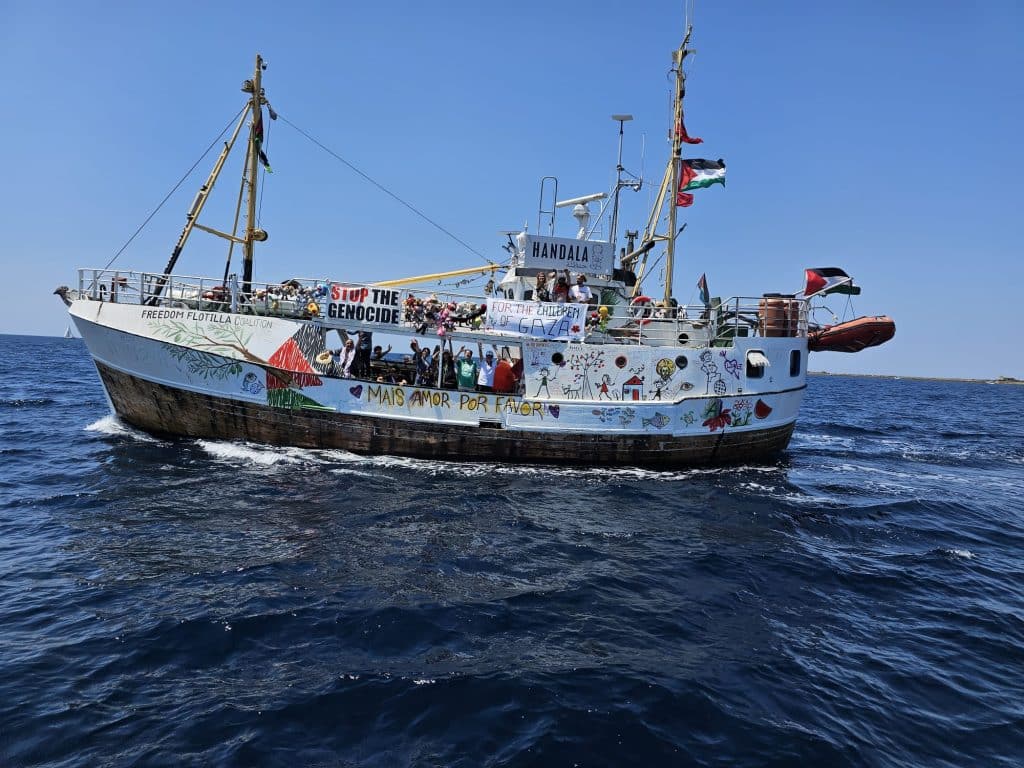
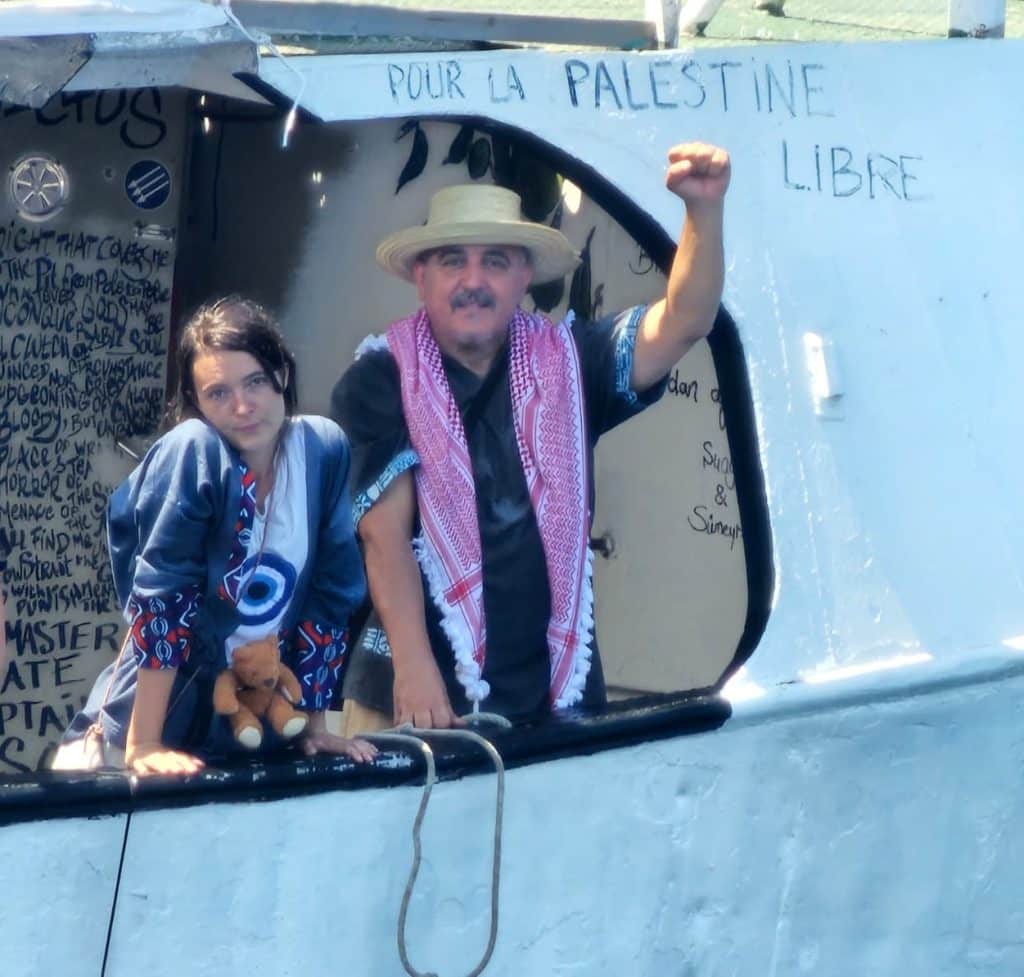
CL: The Handala was a beautiful moment in my life. We put donated teddy bears everywhere. My friend drew a Gazan phoenix on the walls. We wanted it to be as full of love as possible. We wanted the messages to be seen by the children. We wrote love letters on the walls. We do this out of love, and when you love, you don’t worry about the outcome. You show up, and that is what matters. We knew we would face military ships, but it was still abstract at the time.
Of course, in the first days, we all had seasickness, which then turned into earth sickness. Upon departure, we held events to draw attention to what is going on in Gaza. We want people to move from spectators to actors.
We came so close, under 70 miles. There were many drones on the way, but the atmosphere on the ship was peaceful. What struck me was the complete lack of interest by the media. We need the media to break the siege, but unfortunately, they’re not doing their job.
RH: You mention drones. How did you feel when you first saw them?
CL: The first drones were actually from FRONTEX. Small European observation drones cover the Mediterranean to monitor people fleeing from their countries for their lives. We had agreed that we will not be threatening or make any gestures that could be misinterpreted, so no middle fingers …
RH: … that would be my instant reaction.
CL: My instant reaction was … I was not feeling threatened, just sad thinking about the person that was monitoring that drone. The EU migration policy is to stop unsafe boats full of humans fleeing for their lives and send them back to Libya. You think of how enslaved are the people operating them. The drone is a way to wash yourself from any violence.
As we reached closer, we had bigger drones; the biggest just before interception by Israel. It was very loud. For me, it reinforced how the power imbalance is so strong such that Palestinians in Gaza and the West Bank are living with drones constantly. The sound is part of their life. Palestinians are always surveyed, always watched, but never really seen, never seen as humans or as holders of sovereign rights. This technological apparatus is part of the problem.
RH: You’re approaching the shores of Palestine, past the point where the Madleen got. What was going through your head?
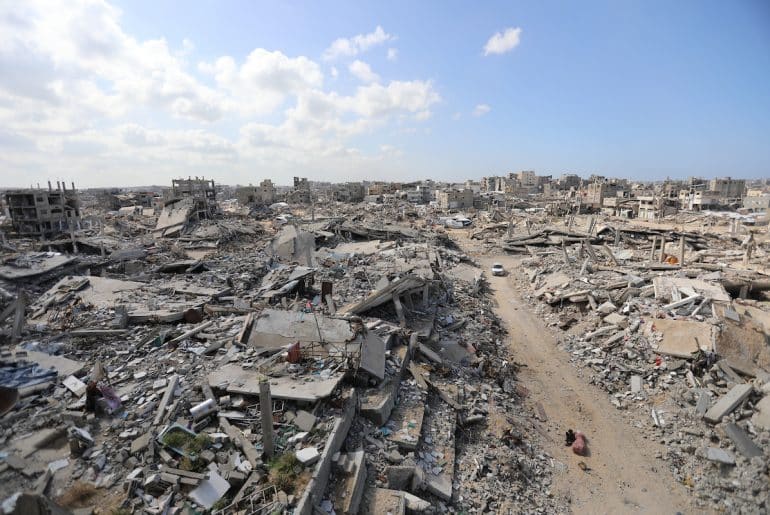
CL: Hope! The feelings in those moments are not in your head. The sensations I had were from my body. It was a feeling of “I’m exactly where I’m supposed to be.” I’m finally reaching a place where there are so many people that are continuing to live in the most absurd closeted way. We should stop asking for permission to access children and mothers and fathers who have access to nothing.
There was a mix of expectations and hope, but also the sense of ‘Why would they stop us?’ We are approaching one of the biggest militaries in the world with nothing but teddy bears and baby formula. Heartbreaking when they did board us and started cutting the ties we had used to fasten the teddy bears to the boards. Why? There’s no explanation, no reason.
RH: The Handala was boarded and everyone imprisoned. Describe your experience in Israeli custody.
CL: We were all sleep deprived. We were summoned, in international waters, by the Israeli Tzahal to stop our ships on the premise that we were entering a military private zone. They used fumigants to hide their ships, which suddenly appeared. This is the eeriest scene I remember from that trip. They had a huge warship … I-don’t-know-what kind of boat it is … and boarded our ship using Zodiac (motorboats) with so many soldiers, when we were only twenty-one.
It was the first time that I felt sad. We were humming Bella Ciao—we had agreed on this as a way to be together at times when they want to make us feel small, because those people feel powerful only by making us feel small.
The soldiers were women and men, and the women were the most shocking to me. I couldn’t stop looking at them and questioning, ‘What the hell are you doing? How can you be so cut off from your own sense of womanhood, your sense of belonging to a lineage of feminine women who are bearers of life?’ They were pretending to be nice, you know, playing nice like asking if we had any medical needs, without giving us any medicine or even feminine hygiene products in prison.
We had to stay on board the ship with them for a long time and all of us fell asleep. We never really figured out if it was something that they used. I tried to stay awake and look into their eyes. It was striking how we were physically together on the same boat, but in opposing worlds.
Once we arrived in Ashdod, the Israeli media was there, so we shouted slogans. We were not afraid because we were together. We were complete strangers before the mission, and this trip simply reinforced the fight that we were all in together. I was with Chris, and Huwaida, and Vikdis.
We were taken by the border police to the prison, with women only. We were stripped and searched. We had this masquerade of people taking our deposition. But it’s not real, even when we were in front of the judge. Nothing is real.
In prison, I felt … I remember the truck and the messages on the walls of the truck. There were names: ‘father of …’, ‘son of …’. I was thinking of the Palestinians, sometimes living 15 years in a prison cell, thinking how unfair that I had a passport and could meet my consul.
My individual story is completely irrelevant. It’s the collective stories of the political prisoners who are lingering, like Marwan Barghouti, decades in prison. For me, prison time was like a prayer, a prayer for everyone who couldn’t, didn’t have the privileges that we had, and that’s the point of the flotilla. We use our privileges against the system that gave them to us. The white skin, the US passport, we use against itself. But I also felt so frustrated and angry that I would end up here instead of with the children in Gaza.
RH: I hear there’s a new flotilla planned for April. How can we help?
CL: After the first Global Sumud Flotilla in October, which had participants from 44 countries, they installed this fake ceasefire. Many believe it is going on (even though more than 500 people have been killed since it started). People believe in governments finding a solution, or that global institutions will rebuild Gaza. The idea of having a Dubai or Las Vegas in Gaza is absurd and insulting.
We need volunteers. You can join this flotilla wherever you are. On land is just as important– going to your neighborhoods, town halls, your local charity, local NGOs, and discussing what can they do? On board, we have different roles: technicians, captains and crew, journalists, lawyers, educators, healthcare workers, eco-builders, …
My question to the people wanting to join the flotilla is, first of all, why do you want to join? Is it to become viral? Because we always need to check our motivations–look at our shadows. What is actually driving us? Is it because we want to sustain and to act?
It’s important not to tokenize the flotilla. We’re only a channel to grasp the media machine and force it to ask the right questions. If there is a ceasefire, what would bar this? Who controls the land or the territorial waters? Who controls access to food, water, energy? Journalists are not asking these questions, so citizens have to.
The flotilla consists of people from many societies coming together to refuse a situation and call for something better. The governance of this world is an insult to the intelligence and to the life force of any human being. If we accept this to become the new norm, we will have… I don’t think we can accept this, to be honest. The liberation of Palestine is tied to the democratization of our countries, everywhere. The global majority supports Palestine, even among young Americans. I have no doubt Palestine will become sovereign in our generation. It has to.
RH: Thank you so much. Is there anything else you would like to add?
CL: We are not appealing to the morality of any system. We appeal to the very legitimacy of it. Our institutions operate on a 20th century modus operandi, at a time when billionaires are hijacking global governance, … There is a mistrust in governments, and in NGOs too, because they’re contributing to a system that depends on colonialism.
I don’t want to sound Orwellian, but data privacy is also part of the fight. It’s part of sovereignty and having institutions and governance systems that are independent. Safeguards from big data and big technology will be instrumental in how we address the 21st century, because otherwise, I can see the normalization of highly technological surveillance camps that will be used to control the movement of populations fleeing from climate change.
Palestine is their attempt to normalize a way to treat people, to make us forcibly accept a governance where we feel too powerless or too busy or too tired to take part in. The flotilla reminds us that we have agency, that we can come together, that we will build, no one else is going to come and save us.
Ramsey Hanhan
Ramsey Hanhan is the author of two books, Palestine Bleeds For You (2026) and Fugitive Dreams (2022), short stories, essays, and poetry. He speaks publicly about Palestine and literature. Formerly a physics professor, he lives near Baltimore, MD. Read more of his writings at: ramseyhanhan.substack.com and ramsey-hanhan.medium.com