On March 30th, thousands of Palestinians from across the besieged Gaza Strip launched “The Great March of Return,” to demand their right to return to their pre-1948 homelands in historic Palestine. Since then, at least 29 Palestinian protesters have been killed, including a journalist and at least two minors. In this video, Palestinians who are putting their lives on the line to join the protests in Gaza explain why they are taking such a risk.
Earlier this month, Israeli police forces dressed in civilian clothes broke into the Palestinian al-Mujahidin cemetery and destroyed the tombstones of seven Palestinians killed by Israel.
Though Jerusalem’s nearly 350,000 Palestinians were barely featured in Donald Trump’s 12-minute-long speech, it is their livelihoods, that will likely be impacted the most as a result of US declaration to move the American embassy from Tel Aviv to Jerusalem. “If these decisions really go into effect, my life here in Jerusalem will become like a prison,” Abdullah Abu Jumua, 19, told Mondoweiss on Wednesday night, moments after the announcement. “I will not accept a reality in which I am living in my homeland, but under the name of another country,” the teenager said, “Jerusalem is ours and no one can take it from us.”
Over half of the Jordan Valley in the occupied West Bank has been declared an active military “firing zone” by the Israeli army. The Israeli military conducts military exercises in these areas, even if Palestinian villages still exist there. Ibziq is one such village. Uday Nawaja’a was recently killed there while tending to a flock of goats after stumbling upon an unexploded ordnance left behind by the Israeli army. “I was tending to the flock, as Uday was wandering underneath a tree, about 30 meters away,” Nawaja’a’s uncle told Mondoweiss. “Suddenly, I heard an explosion. I ran over to Uday to see what happened. But a few seconds later, he was dead.”
The West Bank village Shoshahla, located south of Bethlehem, was built in the 1870’s and by 1985 every Palestinian in the village had either been forced out or intimidated to leave by Israeli forces and settlers. But 7 years later one family did the unthinkable — they returned home. And they have been fighting to stay on their land ever since.
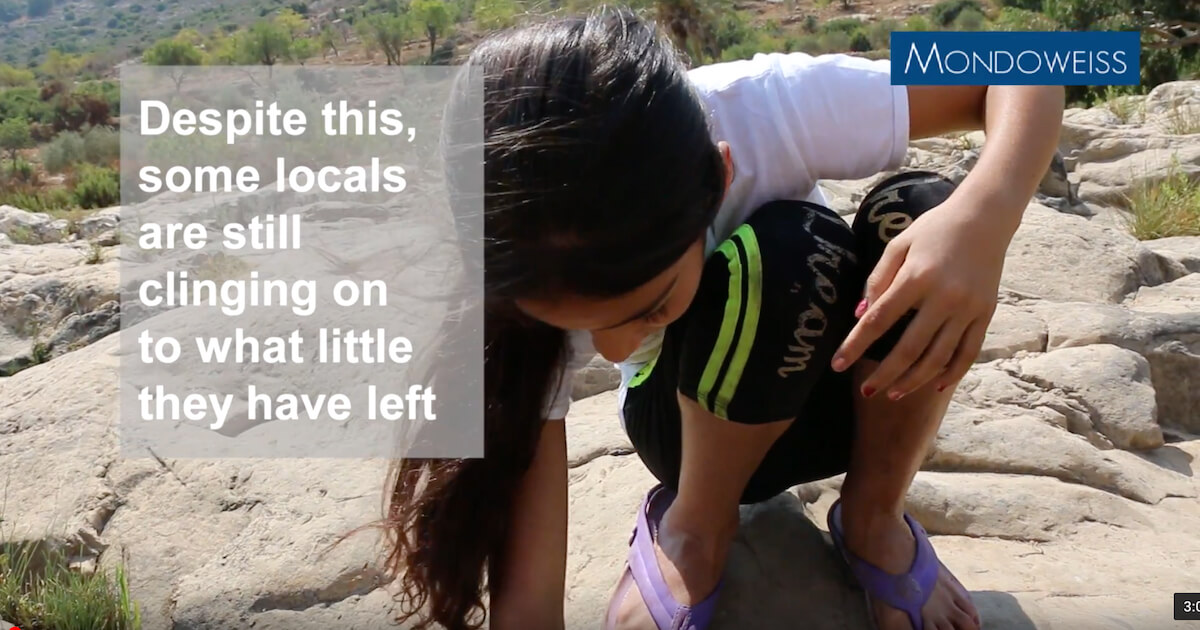
Wadi Qana was once a lush valley filled with diverse crops and livestock where dozens of Palestinian families farmed and thrived off the land. Now after years of Israeli settlements dumping their wastewater in the area, there is little life left in the valley.
In late July, dozens of Israeli settlers raided and occupied the Abu Rajab family home in the Old City of Hebron near the Ibrahimi Mosque. Since then they have slowly moved in under the constant protection of armed Israeli soldiers. Abu Rajab family members are now subjected to daily harassment from the settlers, while soldiers control the family’s every move in and out of the parts of the home where they have been able to remain.